
Quota
A quota is a government-imposed limit on the quantity or value of a good that can be imported into a country over a specific period of time. Quotas are a form of trade protection used to restrict imports and protect domestic industries from foreign competition.
Unlike tariffs, which increase the price of imports through taxation, quotas directly limit the amount of imports entering the domestic market.
Main Objectives of Quotas: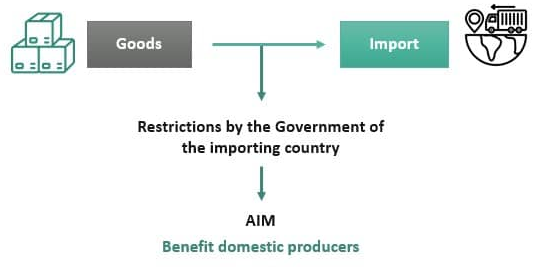
- Protect domestic producers from foreign competition.
- Reduce imports and support local industries.
- Protect employment in domestic industries.
- Improve the balance of trade.
Quota = Direct limit on imports
Effects of Quotas on Markets
When a quota is imposed, the supply of imported goods decreases. This shifts the total market supply leftward, increasing domestic prices and reducing total quantity available in the market.
The effects are experienced by consumers, producers, governments, and overall market efficiency.
Effect on Consumers
Consumers are generally negatively affected by quotas.
- Reduced imports lead to higher prices.
- Consumers face reduced product availability.
- Consumer choice decreases.
- Consumer surplus falls.
As a result, consumer welfare declines.
Effect on Domestic Producers
Domestic producers usually benefit because imported competition is restricted.
- Domestic firms increase market share.
- Higher prices raise producer revenue.
- Producer surplus increases.
- Employment in protected industries may rise.
However, reduced competition may lower incentives for innovation and efficiency.
Effect on Foreign Producers
Foreign exporters are negatively affected because they are allowed to sell fewer goods in the domestic market.
- Export sales decrease.
- Revenue and profits fall.
- Market access becomes restricted.
This may lead to trade disputes or retaliation.
Effect on Government
Unlike tariffs, quotas do not automatically generate government revenue unless import licenses are auctioned.
- Government controls import quantity directly.
- Import licenses may create quota revenue.
- Administrative costs may increase.
The government gains protection for domestic industries but may not gain significant revenue.
Effect on Market Efficiency
Quotas reduce allocative efficiency because resources may shift toward less efficient domestic producers.
- Deadweight welfare loss occurs.
- Consumers pay higher prices for fewer goods.
- Competition and innovation may decrease.
- Global efficiency is reduced.
Therefore, quotas create a trade-off between protecting domestic industries and maintaining efficient markets.
Stakeholders Affected by Quotas
A quota affects multiple stakeholders in the economy because it restricts imports and changes market prices, production levels, and competition. Different groups experience different benefits and costs depending on their role in the market.
Main stakeholders affected by quotas include:
- Consumers
- Domestic producers
- Foreign producers/exporters
- Government
- Workers
- The overall economy
Key Point:
- Quotas create both beneficiaries and losers.
- Domestic industries are protected from foreign competition.
- Consumers usually face higher prices and reduced choice.
- Market efficiency decreases due to restricted competition.
Consumers
Consumers are generally negatively affected because quotas reduce the supply of imported goods in the domestic market.
- Prices increase due to lower market supply.
- Consumers experience reduced product variety.
- Consumer surplus decreases.
- Lower-income consumers may be affected more heavily.
Overall, consumer welfare declines.
Domestic Producers
Domestic producers usually benefit because foreign competition is reduced.
- Domestic firms increase sales and market share.
- Higher prices raise profits and producer surplus.
- Protected industries may expand production.
- Reduced competition may reduce incentives for efficiency and innovation.
Domestic firms gain protection in the short run.
Foreign Producers / Exporters
Foreign producers are negatively affected because quotas limit the quantity they can export.
- Exports and revenue decrease.
- Access to foreign markets becomes restricted.
- Firms may lose market share.
- Trade disputes may arise between countries.
Foreign exporters lose competitiveness in protected markets.
Government
Governments use quotas to protect domestic industries and control import levels.
- Imports are directly controlled.
- Domestic industries and employment may be protected.
- Quota licenses may generate some revenue.
- Administrative and enforcement costs may increase.
Unlike tariffs, quotas usually generate less direct government revenue.
Workers
The effect on workers depends on the industry and market conditions.
- Workers in protected industries may gain employment.
- Domestic production increases may create jobs.
- Workers in export industries may suffer if other countries retaliate.
- Higher prices may increase living costs for workers as consumers.
Therefore, the impact on workers can be mixed.
The Overall Economy
Quotas affect efficiency, trade, and overall economic welfare.
- Domestic output may increase.
- Allocative efficiency decreases.
- Deadweight welfare loss occurs.
- Reduced competition may slow innovation and productivity growth.
Although quotas protect industries, they may reduce long-term efficiency and welfare.
Diagram: A quota and its effect on price, production, consumption, expenditures, revenue, and welfare
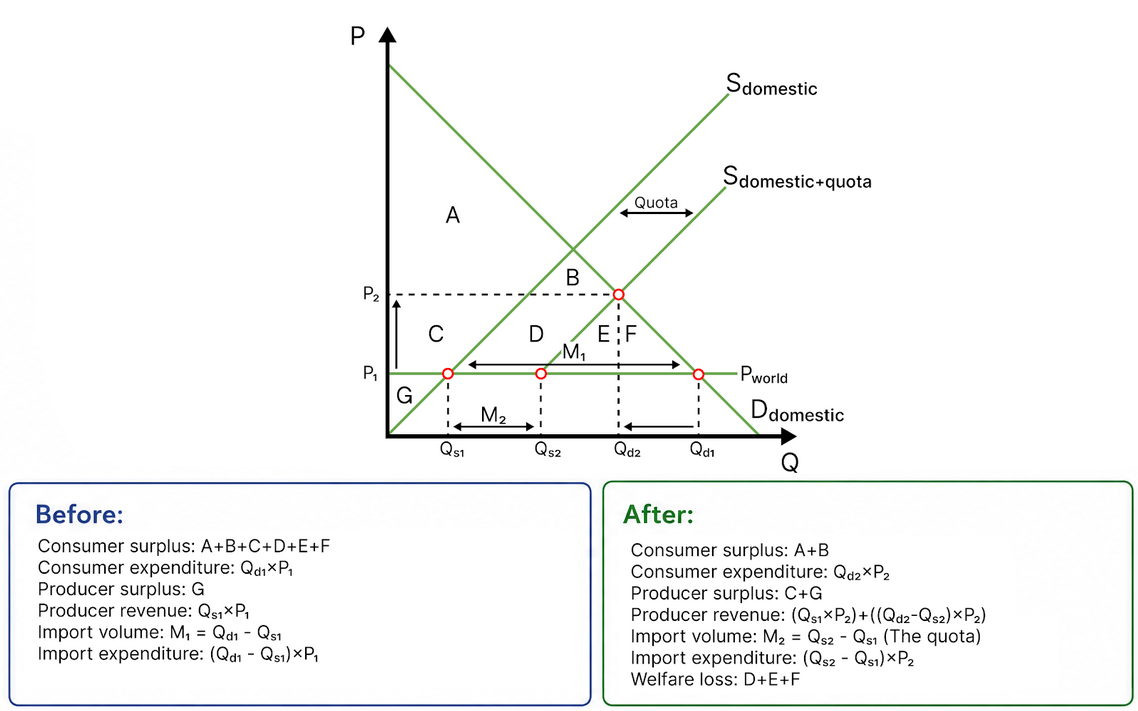
Calculation (HL ONLY): From a diagram, the effects on stakeholders of quotas:
Here, you simply need to calculate the areas and distances referenced in the diagram above.
Example 1
Explain how quotas create both winners and losers in an economy.
▶️ Answer / Explanation
A quota restricts the quantity of imports entering the domestic market.
Domestic producers benefit because reduced foreign competition allows them to increase prices, sales, and profits.
However, consumers lose because reduced supply leads to higher prices and less product variety.
Foreign producers are also negatively affected because they can sell fewer goods in the domestic market.
Therefore, quotas create winners such as domestic producers and losers such as consumers and foreign exporters.
Example 2
Using an example, explain why quotas may reduce market efficiency.
▶️ Answer / Explanation
A quota on imported cars reduces the number of foreign cars available in the domestic market.
Domestic producers increase production, even if their production costs are higher than foreign firms.
Consumers must pay higher prices and have fewer choices available.
This leads to inefficient resource allocation and creates deadweight welfare loss.
Therefore, quotas protect domestic industries but reduce allocative efficiency in the market.