
Relationship Between the Current Account and the Exchange Rate (HL only)
The current account and the exchange rate are closely related and influence each other. Changes in the exchange rate affect exports, imports, and international competitiveness, which influence the current account balance.
At the same time, changes in the current account may affect the demand and supply of a currency, influencing the exchange rate.
- Exchange rate changes affect export and import prices.
- The current account influences demand and supply for a currency.
- A depreciation may improve the current account under certain conditions.
- A strong current account surplus may lead to currency appreciation.
How Exchange Rates Affect the Current Account
Currency Depreciation
A currency depreciation occurs when the value of a currency falls in a floating exchange rate system.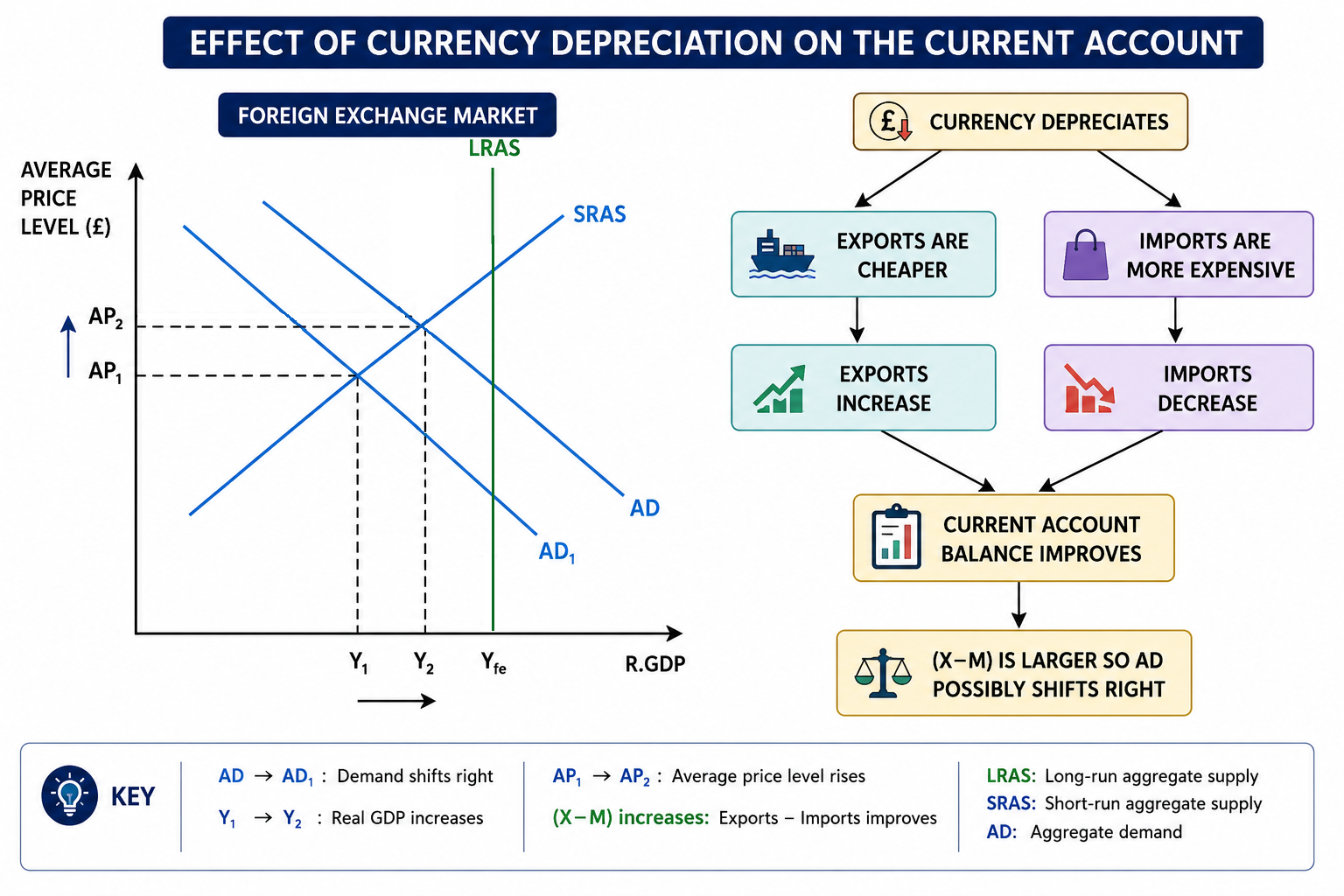
Effects on Exports:
- Exports become cheaper for foreign buyers.
- Foreign demand for exports may increase.
- Export revenues may rise.
Effects on Imports:
- Imports become more expensive for domestic consumers.
- Demand for imports may decrease.
- Import expenditure may fall.
Effect on the Current Account:
A depreciation may improve the current account balance because exports increase and imports decrease.
Depreciation → Exports ↑ and Imports ↓ → Current account improves
Currency Appreciation
A currency appreciation occurs when the value of a currency rises.
Effects on Exports:
- Exports become more expensive for foreign buyers.
- Export demand may decrease.
- Export earnings may fall.
Effects on Imports:
- Imports become cheaper for domestic consumers.
- Import demand may increase.
- Import spending may rise.
Effect on the Current Account:
An appreciation may worsen the current account balance because exports decrease and imports increase.
Appreciation → Exports ↓ and Imports ↑ → Current account worsens
The Marshall-Lerner Condition (HL only)
A depreciation will improve the current account only if demand for exports and imports is sufficiently price elastic.
This is known as the Marshall-Lerner condition.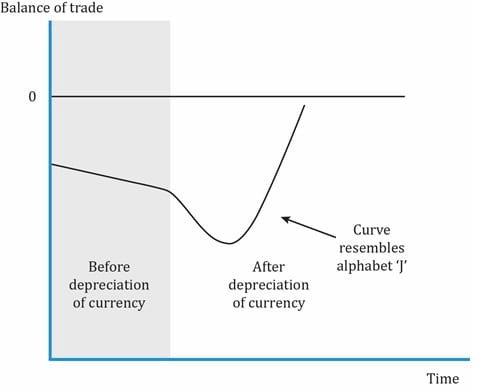
Meaning:
If consumers respond strongly to price changes:
- Export volumes rise significantly.
- Import volumes fall significantly.
In this case, the current account improves after depreciation.
If demand is price inelastic, the current account may not improve.
The J-Curve Effect (HL only)
After a depreciation, the current account may initially worsen before improving over time.
This is called the J-curve effect.
Why It Happens:
- Import prices rise immediately.
- Import and export quantities take time to adjust.
- Existing contracts may delay responses.
Over time, export demand rises and import demand falls, improving the current account.
- Short run: Current account worsens
- Long run: Current account improves
How the Current Account Affects the Exchange Rate
Current Account Surplus
A current account surplus means exports and inflows exceed imports and outflows.
Effect on Currency Demand:
- Foreign buyers demand more domestic currency to purchase exports.
- Demand for the currency increases.
Possible Result:
The currency may appreciate.
Current account surplus → Currency demand ↑ → Appreciation
Current Account Deficit
A current account deficit means imports and outflows exceed exports and inflows.
Effect on Currency Supply:
- Residents sell domestic currency to buy foreign goods and services.
- Supply of the domestic currency increases.
Possible Result:
The currency may depreciate.
Current account deficit → Currency supply ↑ → Depreciation
Importance of the Relationship
- Exchange rates influence international competitiveness.
- Current account balances affect currency markets.
- Persistent deficits or surpluses may influence economic stability.
- Governments and central banks monitor both closely.
Summary of the Relationship:
| Change | Effect on Current Account | Effect on Exchange Rate |
|---|---|---|
| Currency Depreciation | May improve current account | Currency value falls |
| Currency Appreciation | May worsen current account | Currency value rises |
| Current Account Surplus | Exports exceed imports | Currency may appreciate |
| Current Account Deficit | Imports exceed exports | Currency may depreciate |
Comparison of Short Run and Long Run Effects of Depreciation:
| Time Period | Likely Effect on Current Account | Main Reason |
|---|---|---|
| Short Run | May worsen | Import prices rise immediately |
| Long Run | May improve | Export/import quantities adjust |
Evaluation
- A depreciation does not always improve the current account because outcomes depend on price elasticities.
- Persistent current account deficits may weaken the currency and create external debt problems.
- Strong current account surpluses may strengthen the currency but reduce export competitiveness over time.
- The relationship between the current account and exchange rate is dynamic and influenced by global economic conditions.
Example 1
Explain how a depreciation of a currency may improve the current account balance.
▶️ Answer / Explanation
When a currency depreciates, exports become cheaper for foreign buyers.
This may increase demand for exports and raise export revenues.
At the same time, imports become more expensive for domestic consumers.
This may reduce import demand and lower spending on imports.
As exports rise and imports fall, the current account balance may improve.
However, this depends on the price elasticity of demand for exports and imports.
Example 2
Using an example, explain how a current account surplus may affect the exchange rate.
▶️ Answer / Explanation
A current account surplus occurs when export earnings exceed import spending.
For example, if foreign consumers buy large amounts of a country’s exports, they must demand that country’s currency to make payments.
This increases demand for the domestic currency in foreign exchange markets.
As demand for the currency rises, the currency may appreciate.
Therefore, a persistent current account surplus may lead to an appreciation of the exchange rate.