
Relationship Between the Financial Account and the Exchange Rate (HL only)
The financial account and the exchange rate are closely connected because financial flows between countries affect the demand and supply of currencies.
The financial account records international flows of investment and financial capital, including: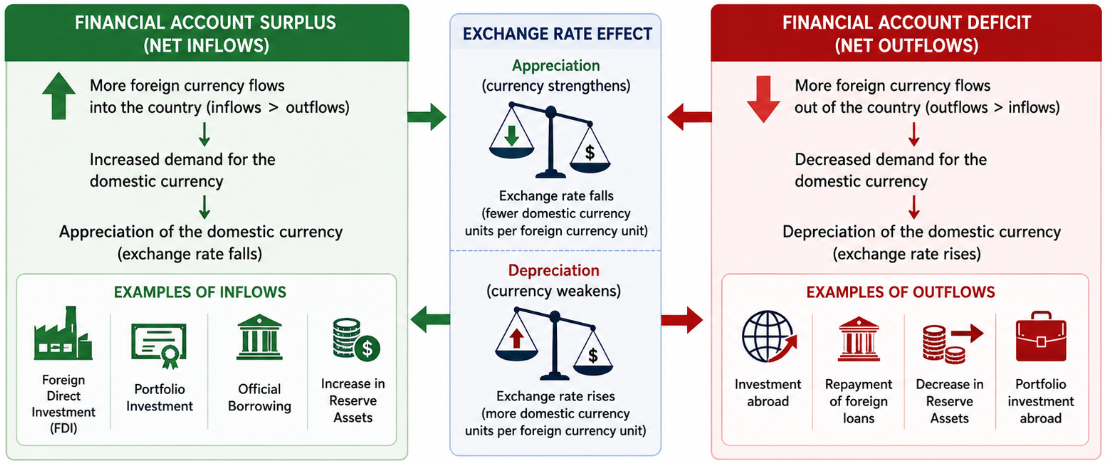
- Foreign direct investment (FDI)
- Portfolio investment
- Official borrowing
- Changes in reserve assets
Changes in these financial flows influence exchange rates, while exchange rate movements also affect international investment decisions.
- Financial inflows increase demand for a currency.
- Financial outflows increase supply of a currency.
- Exchange rates influence investor confidence and returns.
- The financial account helps finance current account imbalances.
How the Financial Account Affects the Exchange Rate
Financial Inflows
Financial inflows occur when foreign investors buy domestic assets or invest in the economy.
Examples:
- Foreign direct investment (FDI).
- Foreign purchases of shares and bonds.
- Foreign bank deposits.
Effect on Currency Demand:
Foreign investors must buy the domestic currency to invest in the country.
This increases demand for the domestic currency.
Possible Result:
The currency may appreciate.
Financial inflows → Currency demand ↑ → Appreciation
Example of Financial Inflows
If a foreign company builds a factory in India, it must convert foreign currency into Indian rupees.
This increases demand for rupees in the foreign exchange market.
As demand for rupees rises, the rupee may appreciate.
Financial Outflows
Financial outflows occur when domestic residents invest abroad.
Examples:
- Domestic firms buying foreign businesses.
- Residents purchasing foreign shares and bonds.
- Capital flight.
Effect on Currency Supply:
Residents sell domestic currency to buy foreign currencies.
This increases the supply of the domestic currency in foreign exchange markets.
Possible Result:
The currency may depreciate.
Financial outflows → Currency supply ↑ → Depreciation
Relationship Between Interest Rates and Financial Flows
Interest rates strongly influence portfolio investment flows.
Higher Interest Rates
If domestic interest rates rise:
- Foreign investors may buy domestic financial assets.
- Portfolio inflows increase.
- Demand for the currency rises.
Possible Result:
The currency appreciates.
Higher interest rates → Financial inflows ↑ → Appreciation
Lower Interest Rates
If domestic interest rates fall:
- Foreign investors may move funds abroad.
- Financial outflows increase.
- Demand for the currency decreases.
Possible Result:
The currency depreciates.
Lower interest rates → Financial outflows ↑ → Depreciation
How Exchange Rates Affect the Financial Account
Expected Appreciation
If investors expect a currency to appreciate:
- Foreign investors may buy domestic assets.
- Financial inflows increase.
- Demand for the currency rises further.
This may create additional appreciation pressure.
Expected Depreciation
If investors expect a currency to depreciate:
- Investors may move funds out of the country.
- Capital flight may occur.
- Financial outflows increase.
This may cause further depreciation.
Speculation and Short-Term Capital Flows
Financial markets often respond quickly to expectations about exchange rates.
Speculators may buy or sell currencies to profit from expected changes.
Effects:
- Large short-term capital flows may occur.
- Exchange rates may become volatile.
- Financial instability may increase.
Relationship Between the Financial Account and the Current Account
The financial account often finances current account imbalances.
Example:
- A current account deficit may be financed through financial inflows such as FDI or borrowing.
- A current account surplus may lead to financial outflows and foreign investment abroad.
The exchange rate is therefore influenced by both trade flows and financial flows.
Summary of the Relationship:
| Financial Account Change | Effect on Currency |
|---|---|
| Financial Inflows Increase | Currency may appreciate |
| Financial Outflows Increase | Currency may depreciate |
| Higher Interest Rates | Attract portfolio investment and appreciation |
| Capital Flight | Currency depreciation pressure |
Comparison Between Current Account and Financial Account Effects on Exchange Rates:
| Account | Main Source of Currency Demand/Supply |
|---|---|
| Current Account | Trade in goods and services |
| Financial Account | Investment and capital flows |
Evaluation
- Financial flows may have a very strong short-term effect on exchange rates.
- Portfolio investment can be highly volatile and quickly leave a country during crises.
- FDI is usually more stable and supports long-term development.
- Speculation and investor expectations can increase exchange rate instability.
- The exchange rate is influenced by both trade flows and financial market conditions.
Example 1
Explain how an increase in foreign direct investment may affect the exchange rate.
▶️ Answer / Explanation
Foreign direct investment involves foreign firms investing in domestic businesses or production facilities.
To invest, foreign investors must buy the domestic currency.
This increases demand for the domestic currency in foreign exchange markets.
As demand rises, the currency may appreciate.
Therefore, increased FDI inflows may strengthen the exchange rate.
Example 2
Using an example, explain how capital flight may affect the exchange rate.
▶️ Answer / Explanation
Capital flight occurs when investors rapidly move financial assets out of a country.
For example, if investors fear political instability, they may sell domestic assets and buy foreign currencies.
This increases the supply of the domestic currency in foreign exchange markets.
As supply increases, the currency may depreciate.
Therefore, capital flight can create strong downward pressure on the exchange rate.