
Significance of Different Barriers to Economic Growth and/or Economic Development
Countries may face a wide range of economic, political, social, geographical, and environmental barriers that limit economic growth and economic development.
The significance of each barrier varies between countries depending on factors such as income levels, institutions, geography, political stability, and access to resources. Some barriers mainly affect economic growth, while others have a greater impact on human development and living standards.
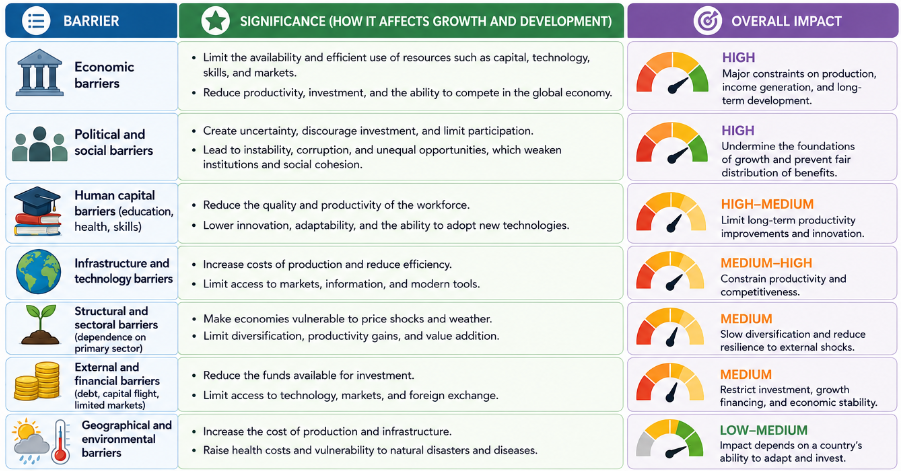
Economic Barriers
Low Human Capital
Low levels of education and healthcare reduce labor productivity and economic efficiency.
Significance:
- Reduces productivity and innovation.
- Limits industrialization and technological progress.
- Weakens long-term economic growth.
Human capital is often considered one of the most important determinants of development because skilled and healthy workers support productivity and innovation.
Poor Infrastructure and Technology
Weak infrastructure increases business and transport costs.
Significance:
- Discourages domestic and foreign investment.
- Limits industrial and agricultural productivity.
- Reduces trade competitiveness.
Countries with poor infrastructure may struggle to participate effectively in global trade.
Dependence on Primary Sector Production
Heavy reliance on agriculture or raw material exports creates economic vulnerability.
Significance:
- Export earnings become unstable due to fluctuating commodity prices.
- Economic diversification remains limited.
- Growth may become highly dependent on world demand.
This barrier is especially important for many low-income developing countries.
Indebtedness
High levels of debt may reduce government spending on development.
Significance:
- Debt repayments reduce funds for healthcare, education, and infrastructure.
- Economic instability may increase.
- Governments may adopt austerity policies.
Excessive debt may therefore slow both growth and development.
Political and Institutional Barriers
Weak Institutions and Corruption
Weak institutions reduce confidence, investment, and economic efficiency.
Significance:
- Corruption misallocates resources.
- Property rights and legal systems may remain weak.
- Businesses face uncertainty and reduced incentives to invest.
Many economists consider institutional quality a major determinant of long-term development.
Unequal Political Power
Political systems that concentrate power among elites may limit inclusive development.
Significance:
- Policies may benefit small groups rather than society as a whole.
- Inequality and poverty may persist.
- Political instability and conflict may increase.
Inclusive political systems generally support stronger long-term development.
Social Barriers
Gender Inequality
Gender inequality reduces the effective use of human resources.
Significance:
- Female labor force participation may remain low.
- Human capital development weakens.
- Household incomes and productivity may decrease.
Reducing gender inequality can significantly improve development outcomes.
Economic Inequality
High inequality may prevent the benefits of growth from reaching poorer groups.
Significance:
- Poverty may persist despite economic growth.
- Social tensions and instability may increase.
- Access to education and healthcare may remain unequal.
Inclusive growth is therefore important for development.
Geographical and Environmental Barriers
Landlocked Geography
Landlocked countries face higher transportation and trade costs.
Significance:
- Exports become less competitive.
- Dependence on neighboring countries increases.
- Access to international markets becomes difficult.
Geography can therefore strongly influence development opportunities.
Tropical Climates and Endemic Diseases
Some tropical regions experience climate and disease-related challenges.
Significance:
- Diseases such as malaria reduce productivity.
- Healthcare costs increase.
- Agricultural productivity may suffer.
Environmental conditions may therefore slow development.
Why the Significance of Barriers Differs Between Countries
- Countries have different levels of income and infrastructure.
- Political stability and institutional quality vary.
- Natural resources and geography differ.
- Historical and cultural factors influence development patterns.
For example, landlocked geography may be highly significant for some African countries, while institutional quality may be more important in others.
Interdependence of Barriers
Many barriers reinforce one another.
For example:
- Poor education reduces productivity and income.
- Low income limits tax revenue.
- Weak government revenue reduces healthcare and infrastructure spending.
- Poverty and inequality may therefore continue.
Development barriers are therefore often linked through poverty cycles.
Summary of Significant Barriers:
| Barrier | Main Impact on Development |
|---|---|
| Low Human Capital | Low productivity and innovation |
| Poor Infrastructure | High costs and weak investment |
| Weak Institutions and Corruption | Low confidence and inefficient resource allocation |
| Primary Sector Dependence | Economic instability and limited diversification |
| Gender and Economic Inequality | Underused human capital and persistent poverty |
| Geography and Disease | Reduced trade and productivity |
| Indebtedness | Lower government development spending |
Evaluation
- No single barrier explains underdevelopment completely.
- Institutional quality and human capital are often considered especially important for long-term development.
- Barriers interact and reinforce each other through poverty cycles.
- Effective development policies usually require addressing several barriers simultaneously.
Example 1
Explain why weak institutions may be considered a significant barrier to economic development.
▶️ Answer / Explanation
Weak institutions may reduce confidence among businesses and investors.
For example, poor legal systems and weak property rights may create uncertainty about ownership and contracts.
This discourages domestic and foreign investment.
Corruption may also reduce the efficiency of government spending and public services.
Therefore, weak institutions may significantly limit economic growth and development.
Example 2
Using an example, explain why low human capital may create a serious development barrier.
▶️ Answer / Explanation
Low human capital means workers may lack education, skills, and good health.
For example, limited access to education may reduce literacy and technical skills.
This lowers labor productivity and makes industrialization more difficult.
Firms may struggle to adopt advanced technology and compete internationally.
Therefore, low human capital may seriously restrict long-term economic development.