
Single Indicators of Economic Development
Single indicators are individual measures used to assess and compare the level of economic development between countries. Because economic development is multidimensional, economists use a variety of indicators to measure different aspects of living standards and well-being. No single indicator can fully measure development, so different indicators focus on economic, social, and environmental conditions.
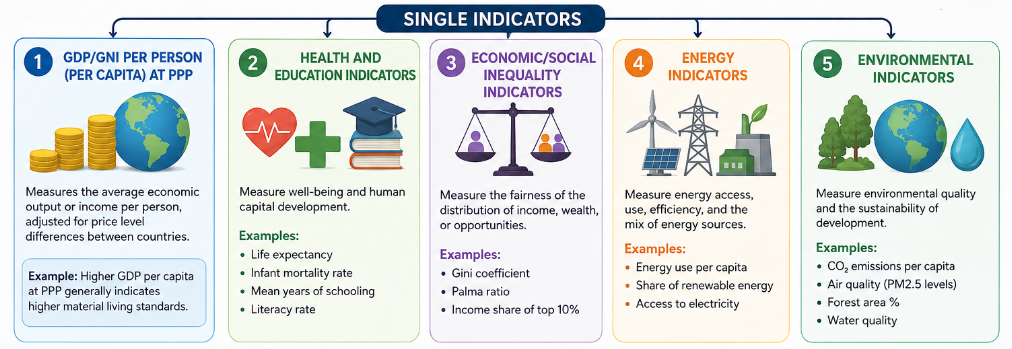
- Different indicators measure different dimensions of development.
- Some indicators focus on income and production.
- Others measure health, education, inequality, or environmental quality.
- Each indicator has advantages and limitations.
GDP/GNI per Person (Per Capita) at PPP
GDP per capita measures the average value of goods and services produced per person in a country.
GNI per capita measures average income earned by residents of a country, including income from abroad.
PPP (Purchasing Power Parity) adjusts income data to account for differences in living costs between countries.
PPP adjusts income so that the same basket of goods can be compared across countries.
What It Measures:
- Average income and material living standards.
- Economic performance.
- Ability to consume goods and services.
Advantages:
- Easy to calculate and compare.
- PPP improves international comparisons.
- Indicates average economic well-being.
Limitations:
- Does not show income distribution.
- Ignores non-market activities.
- Does not measure health, education, or environmental quality.
Health and Education Indicators
Health and education indicators measure social development and quality of life.
Health Indicators
Common health indicators include:
- Life expectancy.
- Infant mortality rate.
- Access to healthcare.
- Nutrition levels.
Importance:
- Reflect quality of healthcare systems.
- Indicate living standards and well-being.
- Healthy populations are more productive.
Education Indicators
Common education indicators include:
- Literacy rate.
- School enrollment rates.
- Average years of schooling.
Importance:
- Education improves human capital.
- Skilled workers increase productivity.
- Education improves employment opportunities and living standards.
Limitations of Health and Education Indicators:
- May not reflect quality differences fully.
- Data may be unreliable in some countries.
- Single indicators may not show overall development.
Economic and Social Inequality Indicators
These indicators measure how evenly income, wealth, and opportunities are distributed within a country.
Common Indicators:
- Gini coefficient.
- Poverty rates.
- Gender inequality indicators.
Importance:
- Show whether development benefits all groups.
- High inequality may reduce social stability.
- Income growth may not improve living standards equally.
Limitations:
- May not capture all forms of inequality.
- Difficult to compare across countries accurately.
Energy Indicators
Energy indicators measure access to and use of energy resources.
Common Energy Indicators:
- Energy consumption per capita.
- Access to electricity.
- Use of renewable energy.
Importance:
- Energy access supports industrial production and living standards.
- Reliable energy improves healthcare, education, and infrastructure.
- Renewable energy use supports sustainability.
Limitations:
- High energy use may also indicate environmental problems.
- Energy consumption alone does not guarantee development.
Environmental Indicators
Environmental indicators measure sustainability and environmental quality.
Common Environmental Indicators:
- Carbon dioxide emissions.
- Air and water pollution levels.
- Deforestation rates.
- Access to clean water and sanitation.
Importance:
- Environmental quality affects long-term living standards.
- Measures sustainability of economic activity.
- Helps assess environmental damage and resource use.
Limitations:
- Environmental data may be difficult to measure accurately.
- Single indicators may not capture overall sustainability.
Summary of Single Indicators:
| Indicator Type | Main Focus |
|---|---|
| GDP/GNI per capita at PPP | Income and material living standards |
| Health Indicators | Healthcare and life expectancy |
| Education Indicators | Literacy and schooling |
| Inequality Indicators | Income and social distribution |
| Energy Indicators | Access to energy and infrastructure |
| Environmental Indicators | Sustainability and environmental quality |
Evaluation
- No single indicator fully measures economic development.
- Income indicators are useful but incomplete.
- Social and environmental indicators provide broader understanding of well-being.
- Economists often combine multiple indicators to assess development more accurately.
Example 1
Explain why GDP per capita at PPP is a better measure of living standards than GDP per capita alone.
▶️ Answer / Explanation
GDP per capita measures average income or output per person.
However, prices and living costs differ between countries.
PPP adjusts GDP data to reflect differences in purchasing power.
This allows more accurate comparison of living standards because the same amount of income may buy different quantities of goods in different countries.
Therefore, GDP per capita at PPP is a more realistic measure of material well-being.
Example 2
Using an example, explain why environmental indicators are important in measuring development.
▶️ Answer / Explanation
Economic growth may occur alongside environmental damage such as pollution or deforestation.
For example, a country may increase industrial production rapidly but also experience rising carbon emissions and poor air quality.
Environmental indicators help measure whether economic activity is sustainable.
They show the long-term impact of development on natural resources and living standards.
Therefore, environmental indicators are important because development should protect future well-being as well as current economic growth.