
Strengths and Limitations of Approaches to Measuring Economic Development
Economic development is a multidimensional concept involving improvements in living standards, health, education, equality, and sustainability. Because development includes many dimensions, economists use different approaches and indicators to measure it. Each approach has strengths and limitations, meaning no single measure can fully capture the level of development of a country.
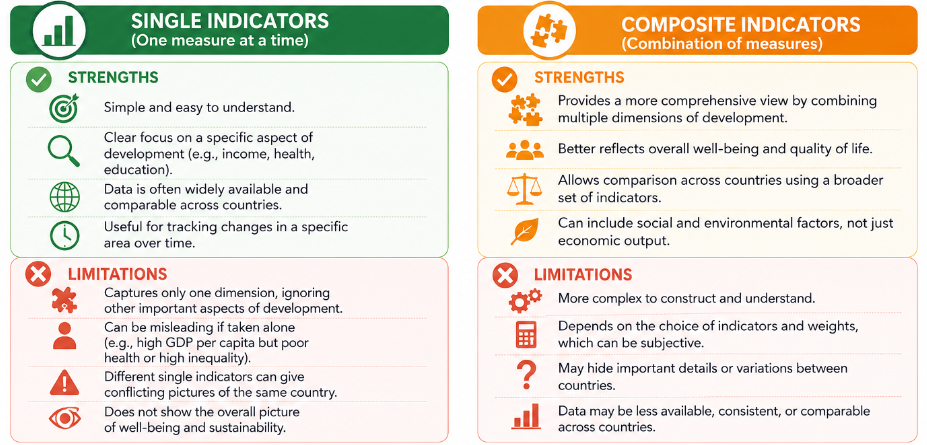
Key Point:
- Different indicators measure different dimensions of development.
- Income alone cannot fully explain living standards.
- Composite indicators provide broader measures but also have limitations.
- Using multiple indicators gives a more complete understanding of development.
GDP/GNI per Capita at PPP
GDP per capita and GNI per capita at PPP measure average income and material living standards.
Strengths
- Easy to calculate and compare between countries.
- PPP adjusts for differences in living costs.
- Provides information about average income and economic performance.
- Useful for comparing material standards of living.
Limitations
- Does not show income distribution or inequality.
- Ignores health, education, and environmental quality.
- Does not measure informal or non-market activities.
- Higher income does not always mean better quality of life.
Therefore, GDP/GNI per capita alone is an incomplete measure of development.
Health and Education Indicators
Indicators such as life expectancy, literacy rates, and school enrollment measure social development.
Strengths
- Measure quality of life and human well-being.
- Reflect access to healthcare and education.
- Help evaluate human capital development.
Limitations
- Single indicators do not measure overall development.
- Data quality may vary between countries.
- May not fully reflect quality differences in education or healthcare.
These indicators provide important social information but remain incomplete individually.
Inequality Indicators
Inequality indicators such as the Gini coefficient measure how evenly income and wealth are distributed.
Strengths
- Show whether development benefits the whole population.
- Highlight income and social inequality.
- Useful for evaluating equity and inclusion.
Limitations
- Do not measure total income or living standards directly.
- Difficult to capture all forms of inequality.
- International comparisons may be difficult.
Countries with similar average incomes may have very different levels of inequality.
Environmental Indicators
Environmental indicators measure sustainability and environmental quality.
Strengths
- Measure long-term sustainability.
- Show environmental impact of economic activity.
- Highlight issues such as pollution and climate change.
Limitations
- Environmental data may be difficult to collect accurately.
- Indicators may not reflect all environmental problems.
- Some indicators are difficult to compare internationally.
Environmental indicators are important because development should be sustainable.
Composite Indicators
Composite indicators combine several measures into one index.
Examples include:
- HDI
- GII
- IHDI
- Happy Planet Index
Strengths of Composite Indicators
- Provide broader measures of development.
- Include multiple dimensions such as health, education, and inequality.
- Allow more meaningful comparisons between countries.
- Recognize that development is multidimensional.
Limitations of Composite Indicators
- Choice of components and weights may be subjective.
- Some important aspects of development may still be excluded.
- Data collection may be complex and unreliable in some countries.
- Different indicators may produce different rankings.
No composite indicator can fully measure every aspect of development.
Comparison of Approaches to Measuring Development:
| Approach | Strengths | Limitations |
|---|---|---|
| GDP/GNI per capita at PPP | Easy comparison of average income | Ignores inequality and quality of life |
| Health and Education Indicators | Measure human well-being | Incomplete individually |
| Inequality Indicators | Show distribution of development | Do not measure total living standards |
| Environmental Indicators | Measure sustainability | Difficult to measure fully |
| Composite Indicators | Broad multidimensional measures | Subjective weighting and data issues |
Why Multiple Indicators Are Needed
- Development includes economic, social, political, and environmental dimensions.
- One indicator cannot fully capture all aspects of well-being.
- Countries may perform well in some areas but poorly in others.
- Combining indicators provides more accurate analysis.
Economists therefore use multiple approaches when evaluating development.
Evaluation
- No measure of development is perfect.
- Income indicators are useful but incomplete.
- Composite indicators provide broader understanding but involve subjective choices.
- The best approach is usually to combine several indicators for balanced analysis.
Example 1
Explain one strength and one limitation of using GDP per capita at PPP to measure development.
▶️ Answer / Explanation
One strength of GDP per capita at PPP is that it adjusts for differences in living costs between countries.
This allows more accurate comparison of average material living standards.
However, one limitation is that it does not show how income is distributed within the country.
A country may have high average income while still experiencing severe poverty and inequality.
Therefore, GDP per capita at PPP is useful but incomplete as a measure of development.
Example 2
Using an example, explain why composite indicators may provide a better measure of development than single indicators.
▶️ Answer / Explanation
Composite indicators combine several dimensions of development into one measure.
For example, the HDI includes health, education, and income indicators.
This provides a broader picture of living standards and human well-being than income alone.
A country with high GDP per capita but poor healthcare and education may have a lower HDI ranking.
Therefore, composite indicators often provide a more complete measure of development.