
Strengths and Limitations of Government Intervention versus Market-Oriented Approaches to Achieving Economic Growth and Economic Development
Countries use different approaches to promote economic growth and economic development.
Two major approaches are:
- Government intervention approaches, where governments actively influence the economy.
- Market-oriented approaches, where market forces and private sector decisions play the main role.
Both approaches have strengths and limitations, and many countries use a combination of the two.
- Government intervention focuses more on equity, stability, and public welfare.
- Market-oriented approaches focus more on efficiency, competition, and private enterprise.
- The effectiveness of each approach depends on institutional quality and economic conditions.
- Most successful economies use mixed approaches.
Government Intervention Approaches
Government intervention involves active government policies to influence economic activity and development. 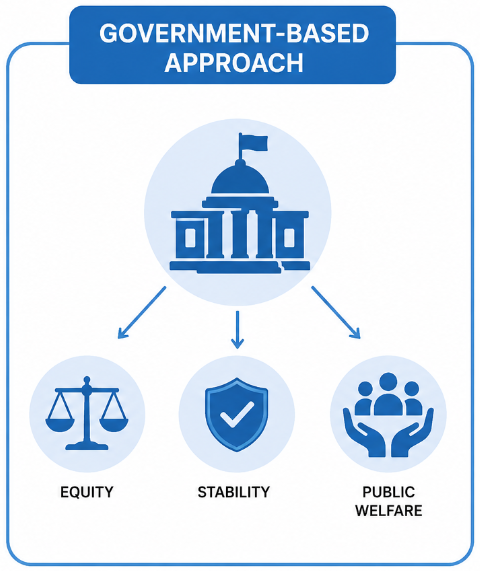
Examples include:
- Redistribution policies.
- Provision of merit goods.
- Industrial policies.
- Infrastructure investment.
- Trade protection.
- State ownership and regulation.
Strengths of Government Intervention
Reduction of Poverty and Inequality
Governments may use taxes, transfer payments, and minimum wages to redistribute income.
Advantages:
- Improves equity and social inclusion.
- Supports vulnerable groups.
- May improve living standards and social stability.
Provision of Merit Goods
Governments can provide education, healthcare, and infrastructure that may be underprovided by markets.
Advantages:
- Improves human capital and productivity.
- Supports long-term economic development.
- Reduces poverty and inequality.
Correction of Market Failures
Government intervention may address problems such as pollution, monopolies, and information failures.
Advantages:
- Protects consumers and the environment.
- Promotes social welfare.
- Encourages sustainable development.
Support for Infant Industries
Governments may protect new domestic industries using tariffs, subsidies, or quotas.
Advantages:
- Allows industries time to develop.
- Promotes industrialization and diversification.
- May increase employment.
Limitations of Government Intervention
Government Failure
Governments may allocate resources inefficiently.
Limitations:
- Corruption and bureaucracy may reduce efficiency.
- Political decisions may be influenced by special interests.
- Projects may waste public resources.
High Government Spending
Large intervention programs may require high public spending.
Limitations:
- Budget deficits and national debt may increase.
- Higher taxes may reduce incentives to work or invest.
Reduced Efficiency and Competition
Excessive regulation or protection may weaken market incentives.
Limitations:
- Protected firms may become inefficient.
- Innovation and productivity growth may slow.
- Consumers may face higher prices and less choice.
Market-Oriented Approaches
Market-oriented approaches rely mainly on private enterprise and market forces.
Examples include:
- Trade liberalization.
- Privatization.
- Deregulation.
- Free-market competition.
Strengths of Market-Oriented Approaches
Greater Efficiency
Competition encourages firms to minimize costs and improve productivity.
Advantages:
- Resources are allocated more efficiently.
- Productivity and innovation increase.
- Economic growth may accelerate.
Lower Prices and Greater Choice
Competition encourages firms to improve products and reduce prices.
Advantages:
- Consumers benefit from more choice.
- Lower production costs may reduce prices.
Encouragement of Investment and Entrepreneurship
Reduced regulation and stronger property rights encourage private investment.
Advantages:
- Business creation and innovation increase.
- Foreign investment may rise.
- Economic flexibility improves.
Limitations of Market-Oriented Approaches
Increased Inequality
Market systems may distribute income unevenly.
Limitations:
- Poverty and inequality may increase.
- Access to healthcare and education may remain unequal.
- Economic growth may not benefit all groups equally.
Market Failures
Markets may fail to provide socially desirable outcomes.
Limitations:
- Negative externalities such as pollution may increase.
- Merit goods may be underprovided.
- Monopolies may reduce competition.
Structural Unemployment
Trade liberalization and deregulation may cause industries to shrink.
Limitations:
- Workers may lose jobs.
- Some regions and industries may decline.
- Adjustment costs may be high in the short run.
Comparison Between Government Intervention and Market-Oriented Approaches:
| Aspect | Government Intervention | Market-Oriented Approaches |
|---|---|---|
| Main Focus | Equity and social welfare | Efficiency and competition |
| Role of Government | Active involvement | Limited involvement |
| Main Strength | Reduces inequality and market failures | Encourages efficiency and innovation |
| Main Limitation | Risk of government failure | Risk of inequality and market failure |
| Examples | Education, healthcare, redistribution | Privatization, deregulation, free trade |
Why Mixed Approaches Are Common
- Pure free-market systems may increase inequality and market failures.
- Excessive government intervention may reduce efficiency and innovation.
- Most economies therefore combine markets with government policies.
- Balanced approaches may support both growth and development.
Successful economies often combine market efficiency with social protection and institutional support.
Example 1
Explain one strength and one limitation of government intervention in promoting economic development.
▶️ Answer / Explanation
One strength of government intervention is that governments can provide merit goods such as education and healthcare.
This improves human capital, productivity, and long-term living standards.
However, one limitation is that government programs may be inefficient due to corruption or bureaucracy.
This may lead to waste of public resources and reduced economic efficiency.
Therefore, government intervention can support development but may also create government failure.
Example 2
Using an example, explain why market-oriented approaches may promote economic growth.
▶️ Answer / Explanation
Market-oriented approaches such as trade liberalization increase competition between firms.
For example, reducing tariffs allows domestic firms to compete with foreign producers.
Competition encourages firms to improve efficiency, reduce costs, and innovate.
This may increase productivity, exports, and economic growth.
However, less efficient domestic firms may close, leading to structural unemployment.
Therefore, market-oriented approaches may promote growth but may also create adjustment costs.