
Subsidy / Export Subsidy
A subsidy is a payment or financial assistance provided by the government to producers or consumers to encourage production or consumption of a good or service. An export subsidy is a specific type of subsidy given to domestic firms that export goods to foreign markets. It lowers production costs and makes exports more competitive internationally.
Governments use subsidies to support domestic industries, increase exports, protect employment, and promote economic growth.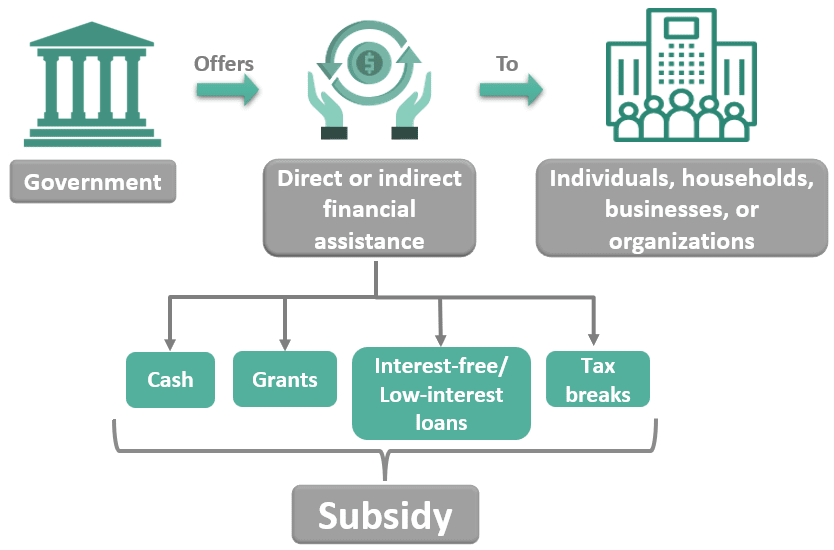
Main Objectives of Subsidies:
- Support domestic industries.
- Encourage exports and improve international competitiveness.
- Protect jobs in strategic industries.
- Promote production of socially desirable goods.
Subsidy = Government financial support to producers or consumers
Effects of Subsidies on Markets
When a subsidy is provided to producers, production costs decrease. This shifts the supply curve to the right, increasing market supply and lowering prices.
Export subsidies specifically encourage firms to increase exports by making domestically produced goods cheaper in international markets.
Effect on Consumers
Consumers generally benefit from subsidies because prices may decrease.
- Lower prices increase affordability.
- Consumer surplus increases.
- Greater output increases product availability.
- Consumption of subsidized goods may rise.
Consumers experience higher welfare in the short run.
Effect on Domestic Producers
Domestic producers benefit significantly from subsidies.
- Production costs decrease.
- Firms increase output and sales.
- Producer revenue and profits may rise.
- Export firms become more competitive globally.
Subsidies help firms survive foreign competition and expand production.
Effect on Foreign Producers
Foreign producers may be negatively affected by export subsidies.
- Subsidized exports become cheaper internationally.
- Foreign firms may lose market share.
- International competition intensifies.
- Trade disputes may occur.
Export subsidies may therefore distort global trade.
Effect on Government
Governments bear the financial cost of subsidies.
- Government expenditure increases.
- Budget deficits may rise.
- Governments may support strategic industries and employment.
- Long-term subsidies may become financially expensive.
Subsidies create an opportunity cost because government funds could be used elsewhere.
Effect on Market Efficiency
Subsidies may improve production in some industries but can also reduce allocative efficiency.
- Resources may remain in inefficient industries.
- Overproduction may occur.
- Deadweight welfare loss may arise.
- Market signals may become distorted.
Therefore, subsidies can create a trade-off between protection and efficiency.
Stakeholders Affected by Subsidies / Export Subsidies
Subsidies and export subsidies affect multiple stakeholders because they change production costs, market prices, output levels, and international competitiveness. Different groups experience different benefits and costs depending on their role in the economy.
Main stakeholders affected include:
- Consumers
- Domestic producers
- Foreign producers
- Government
- Workers
- The overall economy
Consumers
Consumers often benefit from subsidies because lower production costs can reduce market prices.
- Prices of subsidized goods may decrease.
- Consumer surplus increases.
- Product availability may increase.
- Consumers gain greater affordability.
Consumer welfare generally improves in the short run.
Domestic Producers
Domestic producers are usually the main beneficiaries of subsidies.
- Production costs decrease.
- Profits and revenue may increase.
- Firms can expand output and market share.
- Export firms become more competitive internationally.
Subsidies help domestic industries survive foreign competition and economic downturns.
Foreign Producers
Foreign producers are often negatively affected by export subsidies.
- Subsidized domestic goods become cheaper internationally.
- Foreign firms may lose sales and market share.
- Competition in international markets intensifies.
- Trade disputes and retaliation may occur.
Export subsidies may therefore distort international trade.
Government
Governments finance subsidies using public funds.
- Government expenditure increases.
- Budget deficits may worsen.
- Governments may achieve policy goals such as employment protection.
- Subsidies create opportunity costs for other public services.
Governments must balance economic benefits with financial costs.
Workers
Workers in subsidized industries often benefit from increased production and employment.
- Firms may hire more workers.
- Jobs in strategic industries may be protected.
- Wages and job security may improve.
- Workers in non-subsidized sectors may not benefit equally.
Subsidies can therefore support employment in targeted industries.
The Overall Economy
Subsidies affect economic efficiency, government finances, and market structure.
- Domestic production and exports may increase.
- Some industries may become dependent on government support.
- Allocative efficiency may decrease.
- Long-term government spending may become unsustainable.
Although subsidies may support growth and employment, they can distort market signals and resource allocation.
Diagram: A subsidy and its effect on price, production, consumption, expenditures, revenue, and welfare
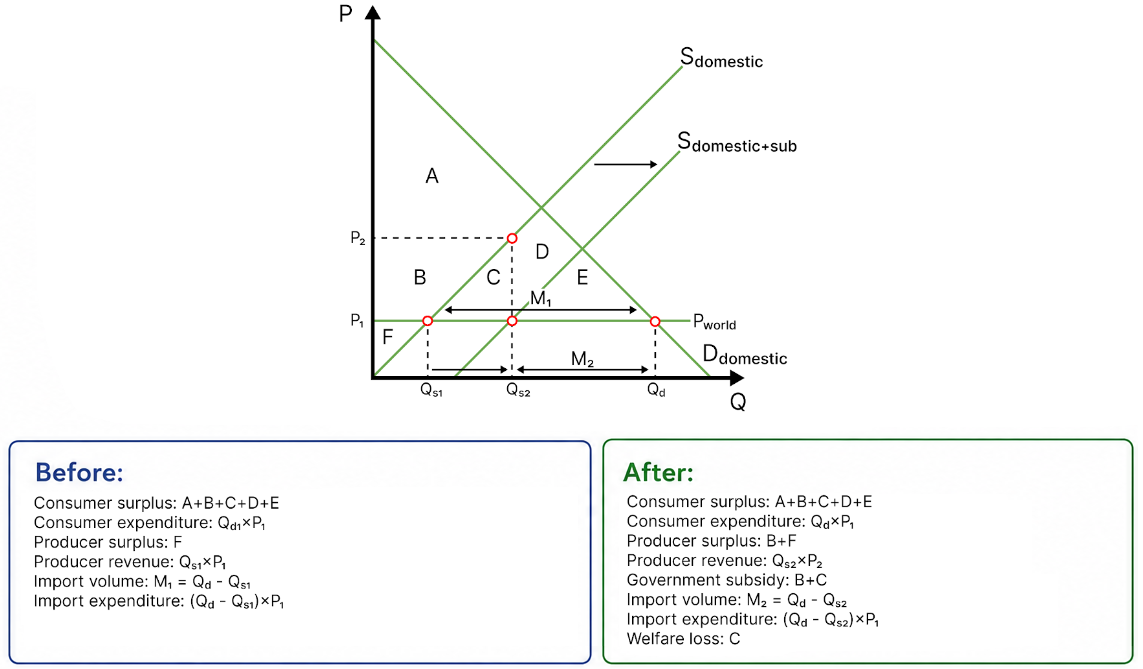
Calculation (HL ONLY): From a diagram, the effects on stakeholders of subsidies:
Here, you simply need to calculate the areas and distances referenced in the diagram above
Example 1
Explain how subsidies create both benefits and costs for different stakeholders.
▶️ Answer / Explanation
Subsidies reduce production costs for domestic firms, allowing them to increase output and lower prices.
Consumers benefit through lower prices and increased availability of goods, while domestic producers gain higher profits and competitiveness.
However, governments must finance subsidies using public funds, creating an opportunity cost.
Foreign producers may also lose market share because subsidized domestic goods become more competitive.
Therefore, subsidies create both advantages and disadvantages for different stakeholders.
Example 2
Explain how subsidies affect consumers and domestic producers.
▶️ Answer / Explanation
A subsidy lowers production costs for domestic firms.
As firms increase supply, market prices may decrease, benefiting consumers through lower prices and greater availability of goods.
Domestic producers also benefit because lower costs increase profits and encourage higher production.
Therefore, subsidies can improve both consumer welfare and producer revenue in the short run.