
The Marshall-Lerner Condition and the J-Curve Effect (HL only)
The Marshall-Lerner condition and the J-curve effect help explain how a change in the exchange rate affects the current account balance.
These concepts are especially important when analyzing the effects of a currency depreciation on exports and imports.
- A depreciation does not automatically improve the current account.
- The response of export and import demand depends on price elasticity.
- In the short run, the current account may initially worsen after depreciation.
- In the long run, the current account may improve if elasticities are sufficient.
The Marshall-Lerner Condition
The Marshall-Lerner condition states that a depreciation (or devaluation) of a currency will improve the current account balance only if the combined price elasticity of demand for exports and imports is greater than one.
Condition:
$\text{Price elasticity of demand for exports + Price elasticity of demand for imports > 1}$
Meaning:
- Consumers must respond strongly to price changes.
- Export demand must rise significantly after depreciation.
- Import demand must fall significantly after depreciation.
If these responses are large enough, export earnings increase and import spending decreases, improving the current account.
How Depreciation Affects Exports and Imports
Effects on Exports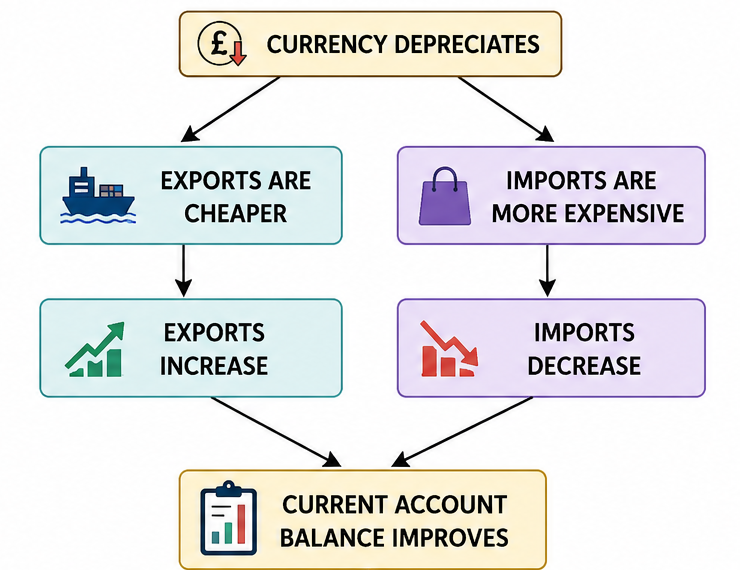
When a currency depreciates:
- Exports become cheaper for foreign buyers.
- Foreign demand for exports may increase.
If export demand is elastic:
- Export quantity demanded rises significantly.
- Total export revenue increases.
Effects on Imports
When a currency depreciates:
- Imports become more expensive for domestic consumers.
- Demand for imports may decrease.
If import demand is elastic:
- Import quantity demanded falls significantly.
- Total import spending decreases.
If the Marshall-Lerner Condition Is Satisfied
Depreciation → Exports ↑ and Imports ↓ → Current account improves
Example:
- Foreign consumers buy many more exports because they are cheaper.
- Domestic consumers sharply reduce imports because they are expensive.
The current account balance improves.
If the Marshall-Lerner Condition Is Not Satisfied
If export and import demand are price inelastic:
- Export demand changes only slightly.
- Import demand remains high despite higher prices.
Result:
- Import spending may increase.
- Current account may not improve.
This is more likely when:
- Imports are necessities.
- There are few domestic substitutes.
- Export demand is weak.
The J-Curve Effect
The J-curve effect explains how the current account balance may initially worsen after a depreciation before improving over time.
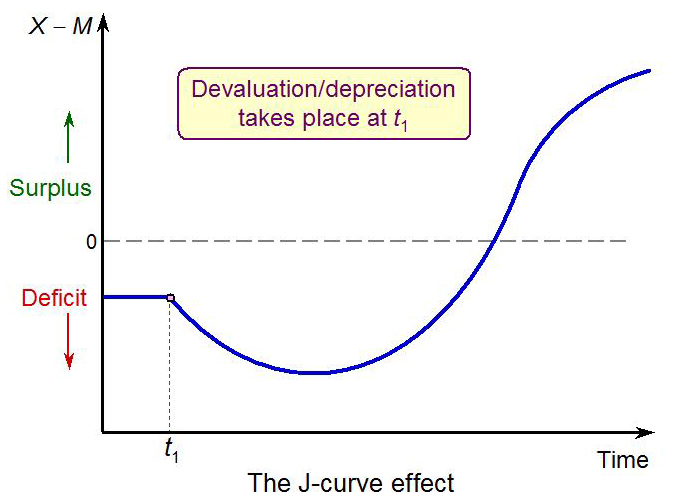
The shape of the adjustment resembles the letter “J”.
Short-Run Effects of Depreciation
Immediately after depreciation: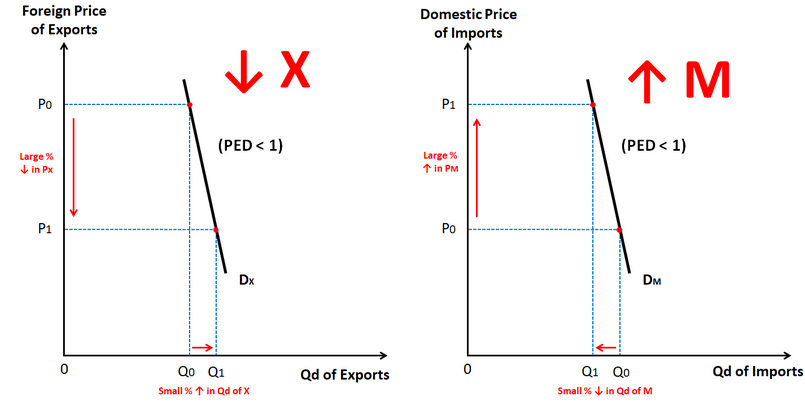
- Import prices rise instantly.
- Export and import quantities change slowly.
- Existing contracts may prevent immediate adjustment.
Result:
Import spending may rise faster than export earnings.
The current account initially worsens.
Short run → Current account deteriorates
Long-Run Effects of Depreciation
Over time: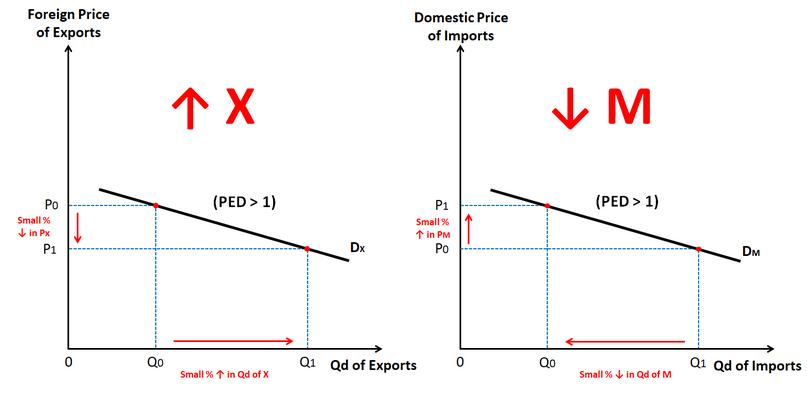
- Consumers adjust purchasing behavior.
- Export demand increases.
- Import demand decreases.
Result:
The current account improves if the Marshall-Lerner condition is satisfied.
Long run → Current account improves
Why the J-Curve Occurs
- Import contracts are fixed in the short run.
- Consumers and firms need time to find alternatives.
- Production and export expansion take time.
- Habits and consumption patterns adjust slowly.
Relationship Between the Marshall-Lerner Condition and the J-Curve
- The J-curve explains short-run adjustment.
- The Marshall-Lerner condition explains long-run improvement.
- A depreciation may initially worsen the current account but later improve it if elasticities are sufficient.
Summary of the Marshall-Lerner Condition:
| Condition | Effect on Current Account After Depreciation |
|---|---|
| Elasticities > 1 | Current account improves |
| Elasticities < 1 | Current account may worsen |
Summary of the J-Curve Effect:
| Time Period | Effect on Current Account | Main Reason |
|---|---|---|
| Short Run | May worsen | Import prices rise immediately |
| Long Run | May improve | Demand quantities adjust |
Importance for Policymakers
- Governments must consider elasticities before relying on depreciation.
- Short-run worsening of the current account may create political and economic pressure.
- Countries heavily dependent on imported necessities may experience inflation after depreciation.
- Supply-side policies may be needed alongside exchange rate changes.
Evaluation
- A depreciation does not guarantee improvement in the current account.
- The effectiveness of depreciation depends on price elasticities of exports and imports.
- The J-curve effect means that short-run outcomes may differ from long-run outcomes.
- Global demand conditions and domestic productive capacity also affect success.
- Countries with weak export sectors may gain limited benefits from depreciation.
Example 1
Explain how the Marshall-Lerner condition determines whether a depreciation improves the current account balance.
▶️ Answer / Explanation
The Marshall-Lerner condition states that a depreciation improves the current account only if the combined price elasticity of demand for exports and imports is greater than one.
If export demand is elastic, foreign consumers buy significantly more exports after prices fall.
If import demand is elastic, domestic consumers sharply reduce imports after prices rise.
As export earnings rise and import spending falls, the current account improves.
However, if demand is price inelastic, the current account may not improve after depreciation.
Example 2
Using an example, explain the J-curve effect after a currency depreciation.
▶️ Answer / Explanation
Suppose a country’s currency depreciates.
Immediately after depreciation, imports become more expensive.
However, import and export quantities may not change quickly because contracts and consumption habits take time to adjust.
As a result, import spending may initially rise, causing the current account to worsen.
Over time, consumers reduce imports and foreign demand for exports increases.
The current account then begins to improve.
This short-run worsening followed by long-run improvement is called the J-curve effect.