
Trading Blocs
A trading bloc is a group of countries that agree to reduce or eliminate trade barriers between member countries in order to promote trade and economic cooperation.
Trading blocs encourage economic integration by making the movement of goods, services, and sometimes factors of production easier among members.

The level of integration differs depending on the type of trading bloc.
Main Types of Trading Blocs:
- Free Trade Areas / Free Trade Agreements
- Customs Unions
- Common Markets
Trading Bloc = Group of countries reducing trade barriers between members
Free Trade Areas / Free Trade Agreements
A free trade area (FTA) is a trading bloc in which member countries remove tariffs and other trade barriers between themselves while maintaining independent trade policies toward non-member countries.
Each country is free to set its own tariffs and trade restrictions on imports from outside the bloc.
Main Features:
- Free trade between member countries.
- No common external tariff.
- Independent trade policies toward non-members.
- Encourages trade and specialization among members.
Advantages:
- Increases trade between members.
- Greater consumer choice and lower prices.
- Promotes competition and efficiency.
- Encourages economic growth.
Disadvantages:
- Trade diversion may occur.
- Complex rules of origin may be required.
- Benefits may not be equally distributed.
Examples:
- USMCA (formerly NAFTA), the European Union
Customs Unions
A customs union is a trading bloc in which member countries remove trade barriers among themselves and adopt a common external tariff (CET) against non-member countries.
This means all member countries apply the same tariffs to imports coming from outside the union.
Main Features: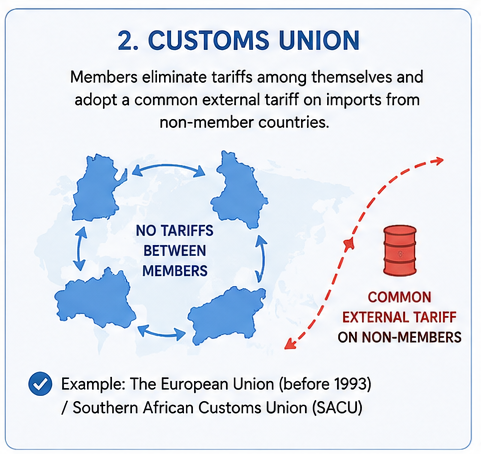
- Free trade between member countries.
- Common external tariff on non-members.
- Greater coordination of trade policies.
- Reduces trade barriers within the union.
Advantages:
- Simplifies trade among members.
- Prevents trade deflection.
- Promotes regional economic integration.
- Increases bargaining power internationally.
Disadvantages:
- Countries lose some trade policy independence.
- Trade diversion may occur.
- Disagreements over common tariffs may arise.
Example:
- customs union system
Common Markets
A common market is a deeper form of economic integration in which member countries have free trade, a common external tariff, and free movement of factors of production such as labor and capital.
In addition to removing trade barriers, common markets allow workers and investment to move freely between member countries.
Main Features: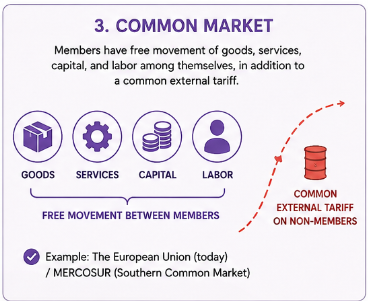
- Free trade between members.
- Common external tariff.
- Free movement of labor and capital.
- Deeper economic integration.
Advantages:
- Efficient allocation of labor and capital.
- Greater employment and investment opportunities.
- Larger integrated markets.
- Increased economic efficiency and growth.
Disadvantages:
- Loss of economic sovereignty.
- Migration pressures between countries.
- Unequal economic benefits among members.
- Economic shocks may spread more easily.
Example:
- European Union (EU)
Comparison of Trading Blocs:
| Feature | Free Trade Area | Customs Union | Common Market |
|---|---|---|---|
| Free Trade Between Members | Yes | Yes | Yes |
| Common External Tariff | No | Yes | Yes |
| Free Movement of Labor | No | No | Yes |
| Free Movement of Capital | No | No | Yes |
| Level of Integration | Lowest | Medium | Higher |
Evaluation
- Trading blocs generally increase trade creation and economic cooperation.
- Deeper integration may improve efficiency and economic growth.
- Trade diversion may reduce benefits for non-member countries.
- Higher integration also means greater loss of national policy independence.
Example 1
Explain the difference between a free trade area and a customs union.
▶️ Answer / Explanation
Both free trade areas and customs unions remove trade barriers between member countries.
However, in a free trade area, each country keeps its own trade policies and tariffs toward non-member countries.
In contrast, a customs union requires all members to adopt a common external tariff on imports from outside the union.
Therefore, customs unions involve a deeper level of economic integration than free trade areas.
Example 2
Using an example, explain one advantage and one disadvantage of a common market.
▶️ Answer / Explanation
A common market allows free movement of labor and capital between member countries.
One advantage is that workers and businesses can move freely to areas with better opportunities, improving resource allocation and economic efficiency.
For example, workers may move to countries with labor shortages, helping increase productivity.
One disadvantage is that migration may create pressure on housing, healthcare, and public services in some countries.
Therefore, while common markets increase integration and efficiency, they may also create social and economic challenges.