
▶️ Answer/Explanation
(a)
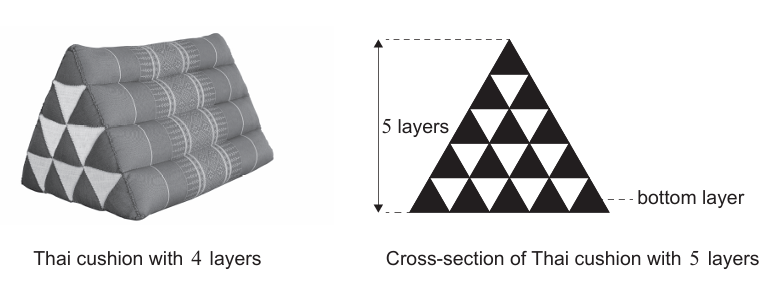
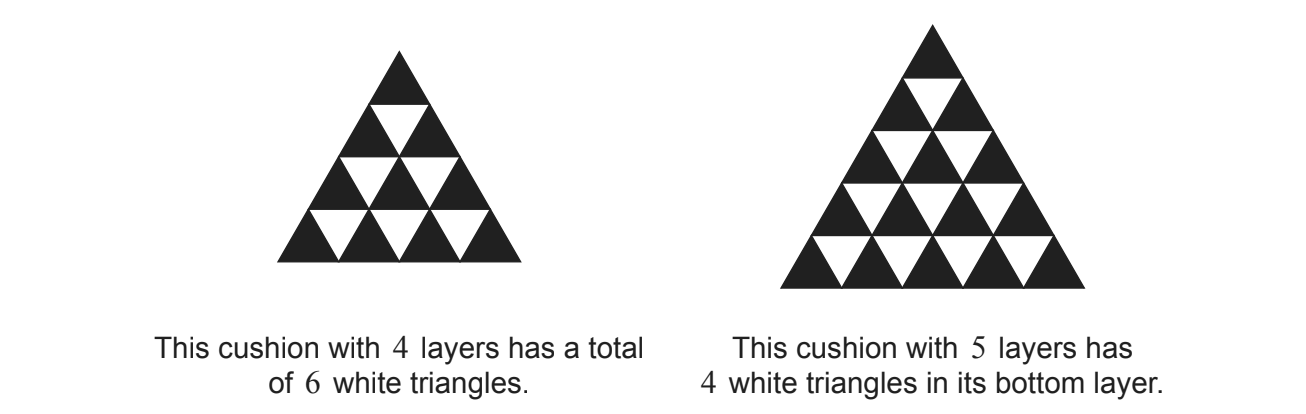
(i) For 4 layers, the bottom layer has \( \boxed{7} \) prisms.
(ii) For 5 layers, the bottom layer has \( \boxed{9} \) prisms.
(b)
(i) The common difference is \( \boxed{2} \).
(ii) The first term is 1, common difference 2. The number of prisms in the bottom layer with \( n \) layers is:
\( u_n = 1 + 2(n-1) = \boxed{2n – 1} \).
(c)
(i) For \( n = 9 \), \( u_9 = 2(9) – 1 = \boxed{17} \).
(ii) The total number of prisms is the sum of the arithmetic series:
\( S_9 = \frac{9}{2}(1 + 17) = \frac{9}{2} \times 18 = \boxed{81} \).
(d)
The total number of prisms in \( n \) layers is:
\( S_n = \frac{n}{2}\big(1 + (2n – 1)\big) = \frac{n}{2}(2n) = \boxed{n^2} \).
(e)
The total triangles in the 4-layer cushion is \( 4^2 = 16 \). White triangles = 6, so black triangles = \( 16 – 6 = \boxed{10} \).
(f)
The black triangles per layer form the sequence: 1, 2, 3, …, \( n \). This is arithmetic with first term 1, common difference 1.
Total black triangles = \( \frac{n}{2}(1 + n) = \boxed{\frac{n(n+1)}{2}} \).
(g)
Total white triangles = \( \frac{n(n-1)}{2} \). Total black triangles = \( \frac{n(n+1)}{2} \).
Sum = \( \frac{n(n-1)}{2} + \frac{n(n+1)}{2} = \frac{n}{2}\big[(n-1) + (n+1)\big] = \frac{n}{2}(2n) = \boxed{n^2} \).