
▶️ Answer/Explanation
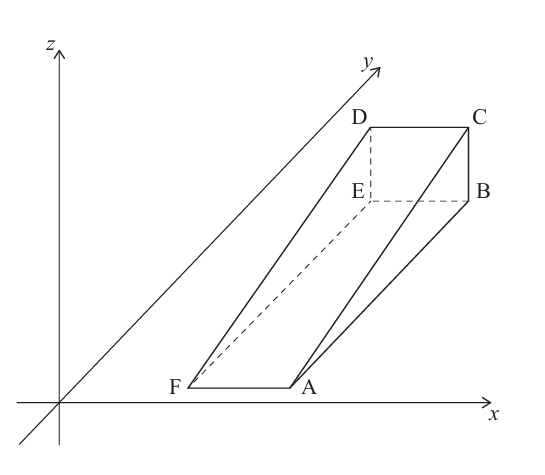
(a) Find \( AC \).
Using the distance formula in 3D:
\( AC = \sqrt{(13-13)^2 + (25-1)^2 + (7-0)^2} = \sqrt{0^2 + 24^2 + 7^2} = \sqrt{576 + 49} = \sqrt{625} = 25 \, \text{cm} \).
\( \boxed{25} \)
(b) Show that triangle \( ABC \) is right-angled.
Method 1 (vectors):
\( \overrightarrow{AB} = (0, 24, 0) \) and \( \overrightarrow{BC} = (0, 0, 7) \).
Since \( \overrightarrow{AB} \cdot \overrightarrow{BC} = 0 \), \( AB \perp BC \). Therefore, \( \triangle ABC \) is right-angled at \( B \).
Method 2 (Pythagoras):
\( AB = 24 \), \( BC = 7 \), \( AC = 25 \).
Check: \( 24^2 + 7^2 = 576 + 49 = 625 = 25^2 \).
Hence, by the converse of Pythagoras, \( \triangle ABC \) is right-angled at \( B \).
Triangle \( ABC \) is right-angled.
(c) Volume of the prism.
Cross-section is triangle \( ABC \), area = \( \frac{1}{2} \times AB \times BC = \frac{1}{2} \times 24 \times 7 = 84 \, \text{cm}^2 \).
Width (depth) of prism = \( AD = 13 – 4 = 9 \, \text{cm} \).
Volume = area of cross-section × width = \( 84 \times 9 = 756 \, \text{cm}^3 \).
\( \boxed{756} \)
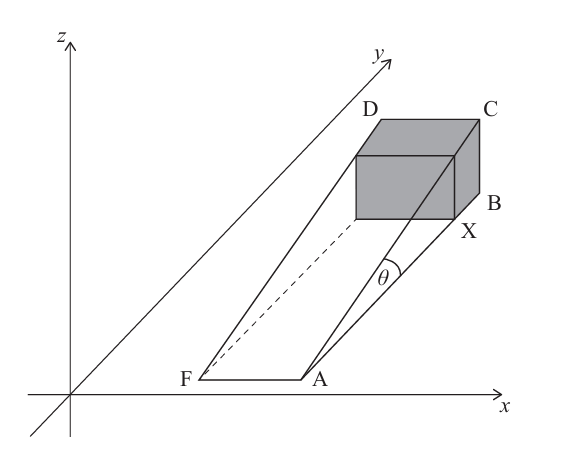
(d) (i) Find \( \theta \).
In triangle \( ABC \), \( \theta \) is the angle at \( A \).
Using right-angled trigonometry:
\( \tan \theta = \frac{BC}{AB} = \frac{7}{24} \Rightarrow \theta = \tan^{-1}\left(\frac{7}{24}\right) \approx 16.26^\circ \).
\( \boxed{16.3^\circ} \) (3 s.f.)
(d) (ii) Find \( AX \).
New volume = \( 625 \, \text{cm}^3 \), width remains \( 9 \, \text{cm} \).
Let new triangle be \( AXY \) similar to \( ABC \), with \( AX \) as base.
Area of new triangle = \( \frac{625}{9} \approx 69.444 \, \text{cm}^2 \).
For similar triangles, area ratio = \( k^2 \), where \( k = \frac{AX}{AB} \).
\( k^2 = \frac{625/9}{84} = \frac{625}{756} \Rightarrow k = \sqrt{\frac{625}{756}} \approx 0.90924 \).
Then \( AX = k \times AB = 0.90924 \times 24 \approx 21.82 \, \text{cm} \).
\( \boxed{21.8} \) (3 s.f.)
(e) Selling price.
Final volume = \( 625 \, \text{cm}^3 \).
Material needed (including 10% waste) = \( 625 \times 1.10 = 687.5 \, \text{cm}^3 \).
Cost of material = \( 687.5 \times 0.025 = 17.1875 \, \text{USD} \).
Selling price (including 20% profit) = \( 17.1875 \times 1.20 = 20.625 \, \text{USD} \).
Rounded to two decimal places = \( 20.63 \, \text{USD} \).
\( \boxed{20.63} \)