Home / IB Mathematics SL 5.5 integration as anti-differentiation AI SL Paper 2 – Exam Style Questions

IB Mathematics SL 5.5 integration as anti-differentiation AI SL Paper 2 - Exam Style Questions - New Syllabus

Question

Consider the functions defined by:
\(f(x) = 1.5^x, \text{ for } x \ge 0\)
\(g(x) = 6 – \frac{3}{x}, \text{ for } x > 0\).
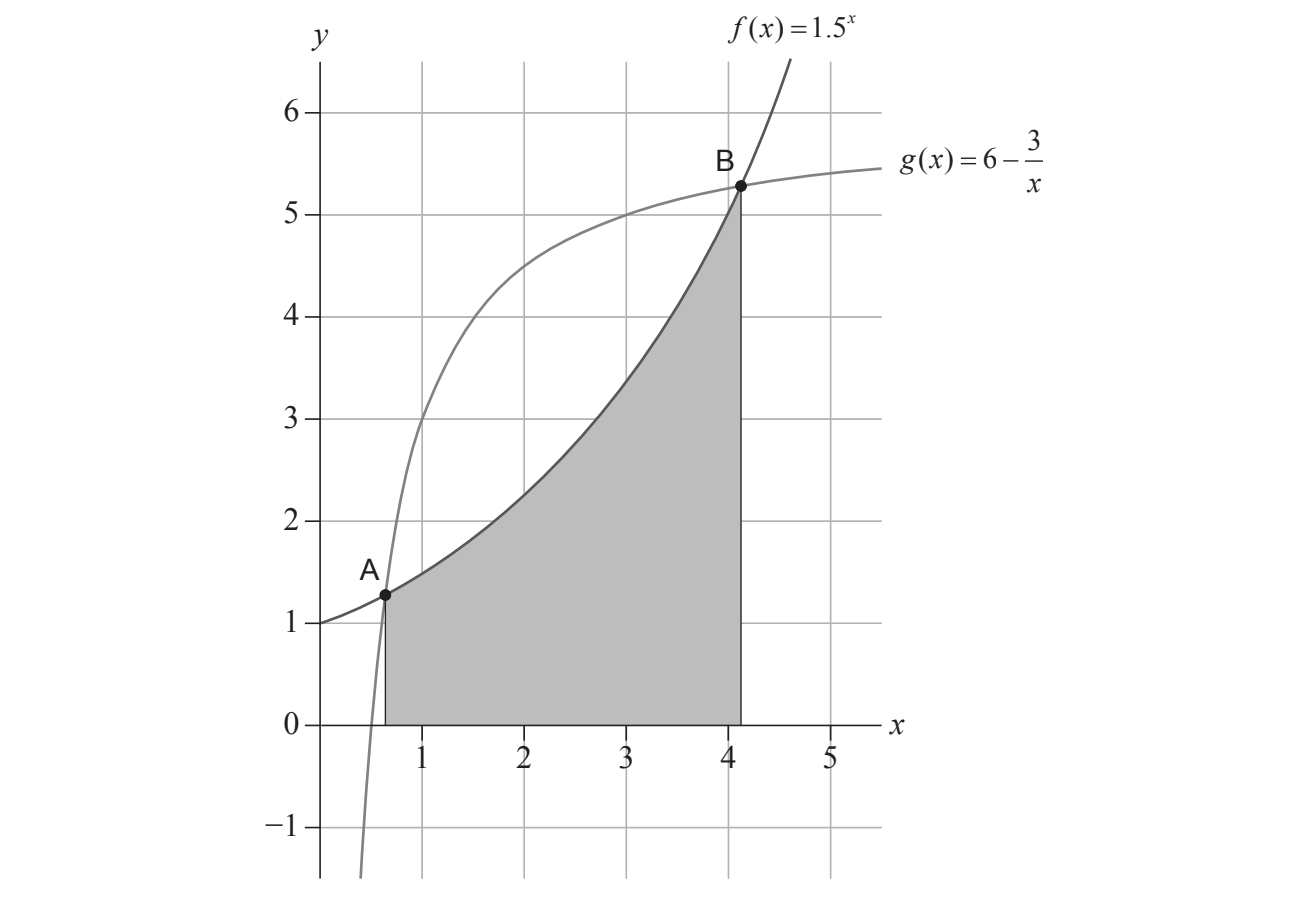
Graph showing the intersection of exponential and rational functions
The graphs of \(y = f(x)\) and \(y = g(x)\) intersect at two points, \(A\) and \(B\).
(a) Find the x-coordinates of points \(A\) and \(B\) by solving \(f(x) = g(x)\).
(b) (i) Write down the definite integral that represents the area of the region bounded by \(y = f(x)\), the \(x\)-axis, and the vertical lines through \(A\) and \(B\).
(ii) Calculate the value of this area.
(iii) Hence, or otherwise, find the area of the region entirely enclosed between the two curves.
There exists a point where \(x = k\) such that the tangent to \(f(x)\) has the same gradient as the tangent to \(g(x)\).
(c) Determine the value of \(k\).

Most-appropriate topic codes (IB Mathematics AI SL 2025):

SL 2.1: Solving equations graphically or using technology — part (a)
SL 5.5: Definite integrals and the area under a curve — part (b)(i, ii)
SL 5.5: Area between two curves — part (b)(iii)
SL 5.3: Derivatives and gradients of tangents — part (c)
▶️ Answer/Explanation
Detailed solution

(a)
Using a GDC to find the intersection of \(y = 1.5^x\) and \(y = 6 – 3/x\):
The x-coordinates are 0.638 (0.637623…) and 4.10 (4.09811…).

(b)
(i) The shaded region is under \(f(x)\) from \(x=0.638\) to \(x=4.10\).
Integral: \(\int_{0.638}^{4.10} 1.5^x \, dx\) (or \(\int_{0.638}^{4.10} f(x) \, dx\)).
(ii) Calculating the definite integral:
Area = 9.80 (9.81 or 9.80788…).
(iii) The region enclosed between the curves is \(\int_{0.638}^{4.10} (g(x) – f(x)) \, dx\).
Using GDC: Area = 5.38 (5.38290…).

(c)
Set the derivatives equal: \(f'(x) = g'(x)\).
\(f'(x) = 1.5^x \ln(1.5)\).
\(g'(x) = 3x^{-2} = \frac{3}{x^2}\).
Solve \(1.5^x \ln(1.5) = \frac{3}{x^2}\).
\(k = \mathbf{1.86}\) (1.86406…).

Scroll to Top