
Question
(ii) Describe the sequence of transformations that maps the graph of \( y = g^{-1}(x) \) onto the graph of \( y = f(x) \).
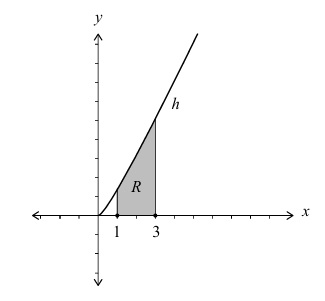
(ii) Hence or otherwise, calculate the area of \( R \), providing your answer in the form \( p + q \ln r \), where \( p, q, r \in \mathbb{Q}^+ \).
▶️ Answer/Explanation
(a) Find \( f^{-1}(8) \):
Let \( x = f^{-1}(8) \), so \( f(x) = 8 \).
\( 4^x = 8 \implies (2^2)^x = 2^3 \)
\( 2^{2x} = 2^3 \implies 2x = 3 \)
Answer: \( \boxed{\frac{3}{2}} \)
(b)(i) Find \( g^{-1}(x) \):
Let \( y = 1 + \log_2 x \). Interchange \( x \) and \( y \):
\( x = 1 + \log_2 y \implies \log_2 y = x – 1 \)
Convert to exponential form:
\( y = 2^{x-1} \)
Answer: \( \boxed{g^{-1}(x) = 2^{x-1}} \)
(b)(ii) Transformations:
Comparing \( y = 2^{x-1} \) to \( f(x) = 4^x = 2^{2x} \):
1. Translation by vector \( \begin{pmatrix} -1 \\ 0 \end{pmatrix} \) (shifts \( 2^{x-1} \) to \( 2^x \)).
2. Horizontal stretch with scale factor \( \frac{1}{2} \) (transforms \( 2^x \) to \( 2^{2x} \)).
(c) Show \( (f \circ g)(x) = 4x^2 \):
\( (f \circ g)(x) = f(g(x)) = f(1 + \log_2 x) \)
\( = 4^{1 + \log_2 x} = 4^1 \cdot 4^{\log_2 x} \)
Since \( 4 = 2^2 \), \( 4^{\log_2 x} = (2^2)^{\log_2 x} = 2^{2\log_2 x} = 2^{\log_2 x^2} = x^2 \).
Thus, \( 4 \cdot x^2 = 4x^2 \). (Shown)
(d)(i) Algebraic verification:
\( 2x – 1 + \frac{1}{2x+1} = \frac{(2x-1)(2x+1) + 1}{2x+1} = \frac{4x^2 – 1 + 1}{2x+1} = \frac{4x^2}{2x+1} \). (Shown)
(d)(ii) Calculate Area:
Area \( = \int_{1}^{3} \left( 2x – 1 + \frac{1}{2x+1} \right) dx \)
\( = \left[ x^2 – x + \frac{1}{2}\ln|2x+1| \right]_{1}^{3} \)
Evaluate at bounds:
Upper (\( x=3 \)): \( 3^2 – 3 + \frac{1}{2}\ln(7) = 6 + \frac{1}{2}\ln 7 \)
Lower (\( x=1 \)): \( 1^2 – 1 + \frac{1}{2}\ln(3) = \frac{1}{2}\ln 3 \)
Area \( = (6 + \frac{1}{2}\ln 7) – (\frac{1}{2}\ln 3) = 6 + \frac{1}{2}\ln(\frac{7}{3}) \)
Final Answer: \( \boxed{6 + \frac{1}{2}\ln \frac{7}{3}} \)