
Question
Let \( z_3 \) and \( z_4 \) represent the two square roots of \( -1 + \sqrt{3}i \), where \( \operatorname{Re}(z_3) > 0 \).
(i) determine the values of \( z_1 \) and \( z_2 \);
(ii) deduce the values of \( z_3 \) and \( z_4 \).
(i) Plot the positions of points \( A, B, C, D \) on an Argand diagram.
(ii) Calculate the area of the polygon formed by these four points.
The four numbers \( \frac{1}{z_1}, \frac{1}{z_2}, \frac{1}{z_3}, \frac{1}{z_4} \) satisfy a related equation of the form \( pw^4 + qw^2 + r = 0 \) with \( p, q, r \in \mathbb{Z} \).
(i) Find the Cartesian form \( a + bi \) for \( \frac{1}{z_1} \).
(ii) Hence, deduce the area of the polygon formed by the vertices \( E, F, G, H \).
Syllabus Topic Codes (IB Mathematics AA HL):
• AHL 1.13: Modulus-argument (polar) form — part (a)
• AHL 1.14: Powers and roots of complex numbers — parts (a), (b)
• AHL 2.12: Sum and product of roots of polynomial equations — part (d)
▶️ Answer/Explanation
(a)
Write \( w = -1 – \sqrt{3}i \).
Modulus: \( |w| = \sqrt{(-1)^2 + (-\sqrt{3})^2} = \sqrt{1+3} = 2 \).
Argument: \( \arg w = -\frac{2\pi}{3} \) (or \( \frac{4\pi}{3} \)), since \( w \) lies in the third quadrant.
Thus \( w = 2 \left( \cos\left(-\frac{2\pi}{3}\right) + i\sin\left(-\frac{2\pi}{3}\right) \right) \).
The square roots are: \( z = \sqrt{2} \left( \cos\left( -\frac{\pi}{3} + k\pi \right) + i\sin\left( -\frac{\pi}{3} + k\pi \right) \right) \), \( k = 0, 1 \).
So the two roots are: \( z = \sqrt{2} \left( \cos\left( -\frac{\pi}{3} \right) + i\sin\left( -\frac{\pi}{3} \right) \right) \) and \( z = \sqrt{2} \left( \cos\left( \frac{2\pi}{3} \right) + i\sin\left( \frac{2\pi}{3} \right) \right) \).
\( \boxed{\sqrt{2} \left( \cos\left( -\frac{\pi}{3} \right) + i\sin\left( -\frac{\pi}{3} \right) \right),\; \sqrt{2} \left( \cos\left( \frac{2\pi}{3} \right) + i\sin\left( \frac{2\pi}{3} \right) \right)} \)
(b)(i)
From (a) in Cartesian form:
\( z_1 = \sqrt{2} \left( \frac12 – \frac{\sqrt{3}}{2}i \right) = \frac{\sqrt{2}}{2} – \frac{\sqrt{6}}{2}i \), but \( \operatorname{Re}(z_1) > 0 \), so take the root with positive real part:
\( z_1 = \sqrt{2} \left( \frac12 + \frac{\sqrt{3}}{2}i \right) = \frac{\sqrt{2}}{2} + \frac{\sqrt{6}}{2}i \).
The other root is \( z_2 = -\frac{\sqrt{2}}{2} – \frac{\sqrt{6}}{2}i \).
\( \boxed{z_1 = \frac{\sqrt{2}}{2} + \frac{\sqrt{6}}{2}i,\; z_2 = -\frac{\sqrt{2}}{2} – \frac{\sqrt{6}}{2}i} \)
(b)(ii)
\( z_3, z_4 \) are the square roots of \( -1 + \sqrt{3}i \), which is the complex conjugate of \( -1 – \sqrt{3}i \).
Hence \( z_3 = \overline{z_1} = \frac{\sqrt{2}}{2} – \frac{\sqrt{6}}{2}i \) and \( z_4 = \overline{z_2} = -\frac{\sqrt{2}}{2} + \frac{\sqrt{6}}{2}i \).
\( \boxed{z_3 = \frac{\sqrt{2}}{2} – \frac{\sqrt{6}}{2}i,\; z_4 = -\frac{\sqrt{2}}{2} + \frac{\sqrt{6}}{2}i} \)
(c)(i)
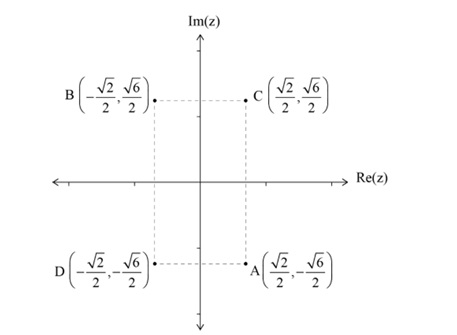
Points on Argand diagram:
A: \( \left( \frac{\sqrt{2}}{2}, \frac{\sqrt{6}}{2} \right) \) B: \( \left( -\frac{\sqrt{2}}{2}, \frac{\sqrt{6}}{2} \right) \)
C: \( \left( \frac{\sqrt{2}}{2}, -\frac{\sqrt{6}}{2} \right) \) D: \( \left( -\frac{\sqrt{2}}{2}, -\frac{\sqrt{6}}{2} \right) \)
They form a rectangle centred at the origin.
(c)(ii)
The rectangle has horizontal side length \( \sqrt{2} \) and vertical side length \( \sqrt{6} \).
Area = \( \sqrt{2} \times \sqrt{6} = \sqrt{12} = 2\sqrt{3} \).
\( \boxed{2\sqrt{3}} \)
(d)
Given \( z^4 + 2z^2 + 4 = 0 \). Let \( w = \frac{1}{z} \), so \( z = \frac{1}{w} \).
Substitute: \( \left( \frac{1}{w} \right)^4 + 2\left( \frac{1}{w} \right)^2 + 4 = 0 \) ⇒ \( \frac{1}{w^4} + \frac{2}{w^2} + 4 = 0 \).
Multiply by \( w^4 \): \( 1 + 2w^2 + 4w^4 = 0 \) ⇒ \( 4w^4 + 2w^2 + 1 = 0 \).
Thus \( p = 4,\; q = 2,\; r = 1 \).
\( \boxed{p = 4,\; q = 2,\; r = 1} \)
(e)(i)
\( z_1 = \frac{\sqrt{2}}{2} + \frac{\sqrt{6}}{2}i \).
Modulus: \( |z_1| = \sqrt{ \left( \frac{\sqrt{2}}{2} \right)^2 + \left( \frac{\sqrt{6}}{2} \right)^2 } = \sqrt{ \frac{2}{4} + \frac{6}{4} } = \sqrt{2} \).
Argument: \( \arg z_1 = \arctan\left( \frac{\sqrt{6}}{\sqrt{2}} \right) = \arctan(\sqrt{3}) = \frac{\pi}{3} \).
Thus \( \frac{1}{z_1} = \frac{1}{\sqrt{2}} \left( \cos\left( -\frac{\pi}{3} \right) + i\sin\left( -\frac{\pi}{3} \right) \right) = \frac{1}{\sqrt{2}} \left( \frac12 – \frac{\sqrt{3}}{2}i \right) = \frac{\sqrt{2}}{4} – \frac{\sqrt{6}}{4}i \).
\( \boxed{\frac{\sqrt{2}}{4} – \frac{\sqrt{6}}{4}i} \)
(e)(ii)
The points \( \frac{1}{z_1}, \frac{1}{z_2}, \frac{1}{z_3}, \frac{1}{z_4} \) are obtained by rotating the original rectangle by \( -\frac{\pi}{3} \) and scaling by factor \( \frac{1}{|z|^2} = \frac{1}{2} \).
Scaling reduces the area by factor \( \left( \frac{1}{2} \right)^2 = \frac14 \).
Thus new area = \( \frac14 \times 2\sqrt{3} = \frac{\sqrt{3}}{2} \).
\( \boxed{\frac{\sqrt{3}}{2}} \)