
▶️ Answer/Explanation
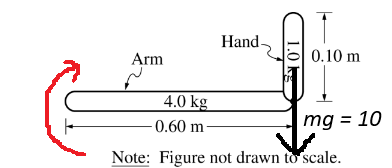
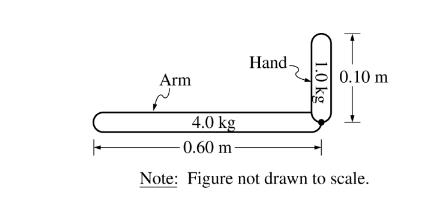
The magnitude of the torque is given by \( \tau = r F \sin \theta \), where \( r \) is the perpendicular distance from the shoulder to the point of application of the force, \( F \) is the weight of the hand, and \( \theta \) is the angle between \( r \) and \( F \).
The force due to the weight of the hand is \( F = mg = (1.0)(9.8) = 9.8\,\text{N} \).
The perpendicular distance from the shoulder is approximately \( r = 0.60\,\text{m} \), and the angle between \( r \) and \( F \) is \(90^\circ\).
Therefore, \( \tau = (0.60)(9.8)\sin 90^\circ = (0.60)(9.8) = 5.88\,\text{N m} \).
This is closest to \(6\,\text{N m}\).
✅ Answer: (A)
▶️ Answer/Explanation
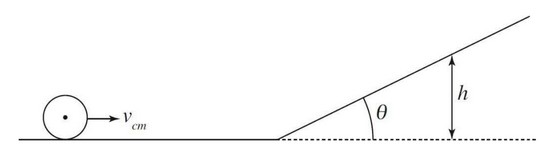
Use conservation of mechanical energy.
Initial energy (rolling without slipping) is the sum of translational and rotational kinetic energies:
\(K_T=\tfrac{1}{2}mv_{cm}^2\), and \(K_R=\tfrac{1}{2}I\omega^2\).
For rolling without slipping, \(v_{cm}=\omega r\) so \(\omega=\dfrac{v_{cm}}{r}\).
At the maximum height, the cylinder momentarily comes to rest, so all kinetic energy becomes gravitational potential energy \(mgh\):
\(\tfrac{1}{2}mv_{cm}^2+\tfrac{1}{2}I\omega^2=mgh\).
Substitute \(I=\tfrac{1}{2}mr^2\) and \(\omega=\dfrac{v_{cm}}{r}\):
\(\tfrac{1}{2}mv_{cm}^2+\tfrac{1}{2}\left(\tfrac{1}{2}mr^2\right)\left(\dfrac{v_{cm}}{r}\right)^2=mgh\).
\(\tfrac{1}{2}mv_{cm}^2+\tfrac{1}{4}mv_{cm}^2=mgh\).
\(\tfrac{3}{4}mv_{cm}^2=mgh\).
Therefore \(h=\dfrac{3v_{cm}^2}{4g}\), which corresponds to option (D).
✅ Answer: (D)