
▶️ Answer/Explanation
(a)
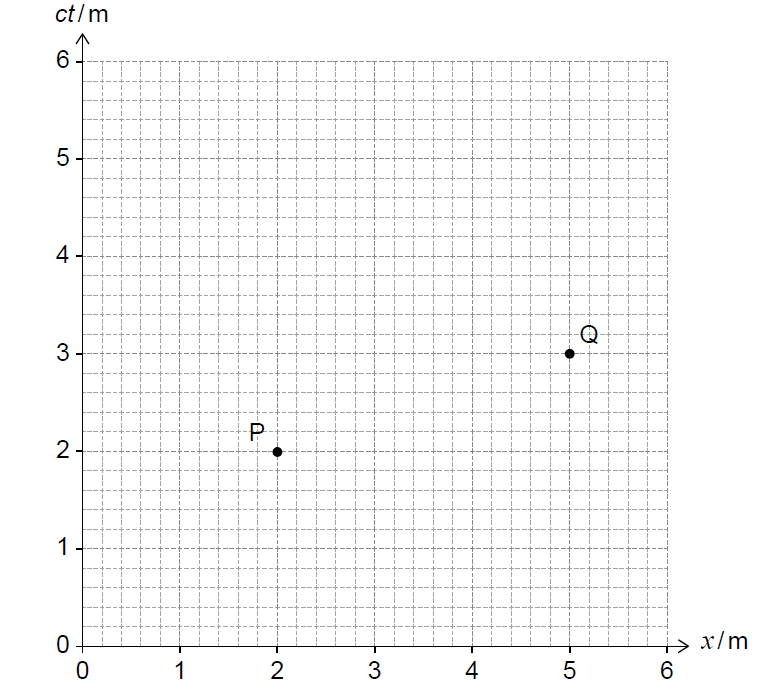
(i) From the diagram, event P has coordinates \((x=2, ct=2)\) and event Q has coordinates \((x=5, ct=3)\).
\(\Delta x = 5 – 2 = 3\,m\).
\(c\Delta t = 3 – 2 = 1\,m\).
\[ (\Delta s)^2 = (c\Delta t)^2 – (\Delta x)^2 = 1^2 – 3^2 = -8\,m^2. \] (ii) An invariant quantity is one that has the same numerical value in all inertial reference frames.
(b)
(i) Because P and Q are simultaneous in frame \(S’\), the straight line joining P and Q represents the \(x’\)-axis (a line of constant \(ct’\)). This line passes through the origin and is parallel to PQ. The \(ct’\)-axis corresponds to \(x’=0\) and is symmetric to the \(x’\)-axis about the light cone. The slope of the \(x’\)-axis is \(1/3\), so the slope of the \(ct’\)-axis is \(3\).
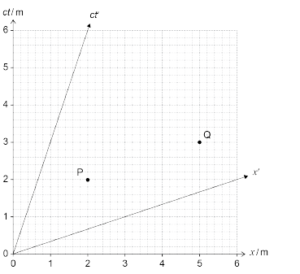
(ii) On a \((x, ct)\) diagram, the slope of the \(x’\)-axis gives \(\beta = v/c\).
\[ \text{slope} = \frac{\Delta ct}{\Delta x} = \frac{1}{3} \Rightarrow \frac{v}{c} = \frac{1}{3}. \] Hence, \[ v = \frac{c}{3} \approx 1.0 \times 10^{8}\,m\,s^{-1}. \]