Home / IBDP Physics- D.2 Electric and magnetic fields- IB Style Questions For HL Paper 1A

IBDP Physics- D.2 Electric and magnetic fields- IB Style Questions For HL Paper 1A -FA 2025

Question

The unit of μ₀ × ε₀ expressed in fundamental SI units is which of the below.
(A) m⁻²s²
(B) TCN⁻¹m⁻¹s
(C) m²s⁻²
(D) TC²A⁻¹N⁻¹m⁻¹
▶️ Answer/Explanation
Detailed solution

From electromagnetism: c² = 1/(μ₀ε₀) where c is speed of light
So μ₀ε₀ = 1/c²
Speed has SI units m/s, so 1/c² has units s²/m² = m⁻²s²
Answer: (A) m⁻²s²

Question

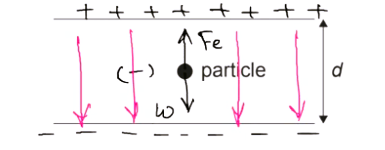
A negatively charged particle is stationary halfway between two horizontal charged plates. The plates are separated by a distance \( d \) with potential difference \( V \) between them.
What is the magnitude of the electric field and the direction of the electric field at the position of the particle?
OptionMagnitude of electric fieldDirection of electric field
A\( \dfrac{2V}{d} \)up
B\( \dfrac{V}{d} \)up
C\( \dfrac{2V}{d} \)down
D\( \dfrac{V}{d} \)down
▶️ Answer / Explanation
Detailed solution


Between parallel charged plates, the electric field is uniform and given by:

\( E = \dfrac{V}{d} \)

The particle is stationary, so the electric force balances the weight. Since the weight acts downward, the electric force on the particle must act upward.

The particle is negatively charged, so the electric force acts opposite to the direction of the electric field.

Therefore, the electric field must be directed downward.

Hence, the magnitude of the electric field is \( \dfrac{V}{d} \) and its direction is downward.

Answer: D

Question

P and R are parallel wires carrying the same current into the plane of the paper. P and R are equidistant from a point Q. The line PQ is perpendicular to the line RQ.
The magnetic field due to P at Q is \( X \). What is the magnitude of the resultant magnetic field at Q due to both wires?
(A) \( \dfrac{x}{2} \)
(B) \( x \)
(C) \( x\sqrt{2} \)
(D) \( 2x \)
▶️ Answer / Explanation
Detailed solution

The magnetic field produced by a long straight current-carrying wire is given by:

\( B = \dfrac{\mu_0 I}{2\pi r} \)

Since wires P and R carry the same current and are equidistant from point Q, the magnitudes of the magnetic fields at Q due to each wire are equal.

Hence, the magnetic field at Q due to wire P has magnitude \( X \), and the magnetic field at Q due to wire R also has magnitude \( X \).

From the geometry of the arrangement, the directions of these two magnetic fields at Q are perpendicular to each other.
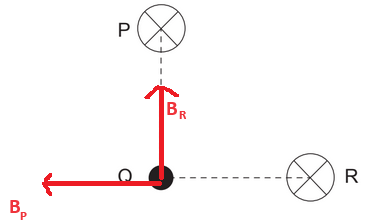
Therefore, the resultant magnetic field at Q is given by vector addition:

\( B_{\text{resultant}} = \sqrt{X^2 + X^2} = X\sqrt{2} \)

Answer: (C)

Scroll to Top