Home / IBDP Physics- E.4 Fission- IB Style Questions For SL Paper 1A

IBDP Physics- E.4 Fission- IB Style Questions For SL Paper 1A -FA 2025

Question

Which of below is a suitable material for use as a moderator in a nuclear reactor
(A) cadmium.
(B) concrete.
(C) uranium-238.
(D) water.
▶️ Answer/Explanation
Detailed solution

1. Function of Moderator:
A moderator slows down fast neutrons to thermal energies to facilitate fission.

2. Evaluate Materials:

  • (A) Cadmium: Used for control rods (absorbs neutrons).
  • (B) Concrete: Used for shielding.
  • (C) Uranium-238: Fuel.
  • (D) Water: Often graphite or water (heavy or light) is used as a moderator because hydrogen atoms have similar mass to neutrons, maximizing energy transfer during collisions.

Answer: (D)

Question

In nuclear fission, a nucleus of element X absorbs a neutron \(\mathrm{n}\) to give a nucleus of element Y and a nucleus of element Z.
\(\mathrm{X} + \mathrm{n} \rightarrow \mathrm{Y} + \mathrm{Z} + 2\mathrm{n}\)
What is \(\dfrac{\text{magnitude of the binding energy per nucleon of }\mathrm{Y}} {\text{magnitude of the binding energy per nucleon of }\mathrm{X}}\) and \(\dfrac{\text{total binding energy of }\mathrm{Y}\text{ and }\mathrm{Z}} {\text{total binding energy of }\mathrm{X}}\)?
 \(\dfrac{\text{BE per nucleon of }\mathrm{Y}} {\text{BE per nucleon of }\mathrm{X}}\)\(\dfrac{\text{Total BE of }\mathrm{Y}\text{ and }\mathrm{Z}} {\text{Total BE of }\mathrm{X}}\)
Agreater than \(1\)greater than \(1\)
Bless than \(1\)greater than \(1\)
Cgreater than \(1\)less than \(1\)
Dless than \(1\)less than \(1\)
▶️ Answer/Explanation
Detailed solution

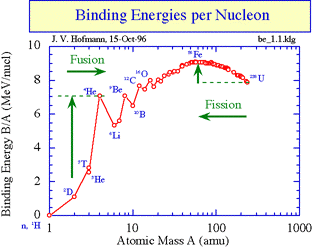
In nuclear fission, a very heavy nucleus splits into two medium-mass nuclei. Medium-mass nuclei lie higher on the binding-energy-per-nucleon curve than very heavy nuclei. Hence the binding energy per nucleon increases in the products.

Therefore, \(\dfrac{\text{BE per nucleon of }\mathrm{Y}}{\text{BE per nucleon of }\mathrm{X}} > 1\).

Because energy is released in fission, the total binding energy of the products (\(\mathrm{Y}\) and \(\mathrm{Z}\)) is greater than the total binding energy of the original nucleus \(\mathrm{X}\). Hence, \(\dfrac{\text{Total BE of }\mathrm{Y}\text{ and }\mathrm{Z}}{\text{Total BE of }\mathrm{X}} > 1\).
Answer: (A)

Question

What are the principal roles of a moderator and of a control rod in a thermal nuclear reactor?
 Role of moderatorRole of control rod
A.increases kinetic energy of neutronsmaintains a constant rate of reaction
B.increases kinetic energy of neutronsabsorbs energy transferred in the reactor
C.reduces kinetic energy of neutronsmaintains a constant rate of reaction
D.reduces kinetic energy of neutronsabsorbs energy transferred in the reactor
▶️ Answer/Explanation
Detailed solution

In a thermal reactor, fast neutrons produced by fission are less likely to cause further fission of \(\,^{235}\text{U}\) than slow (thermal) neutrons.
A moderator slows neutrons down by repeated collisions, so it reduces the kinetic energy of neutrons.

Control rods (made of neutron absorbers such as boron, cadmium, or hafnium) absorb neutrons.
By inserting or withdrawing the rods, the reactor can be kept critical so the chain reaction proceeds at a constant rate.

Answer: (C)

Scroll to Top