
IBDP Physics- E.4 Fission- IB Style Questions For SL Paper 2 -FA 2025
Question
(a)(ii) State one reason why, in practice, a diameter larger than your answer to (a)(i) is required.
(a)(iii) Outline why the individual turbines should not be placed close to each other.
(a)(iv) Some members of the community propose that the wind farm should be located at sea rather than on land. Evaluate this proposal. [8]
(b)(ii) One advantage of the reduction in coal consumption is that less carbon dioxide will be released. State one other advantage and one disadvantage of constructing the wind farm.
(b)(iii) Suggest the likely effect on the Earth’s temperature of a reduction in atmospheric greenhouse gases. [7]
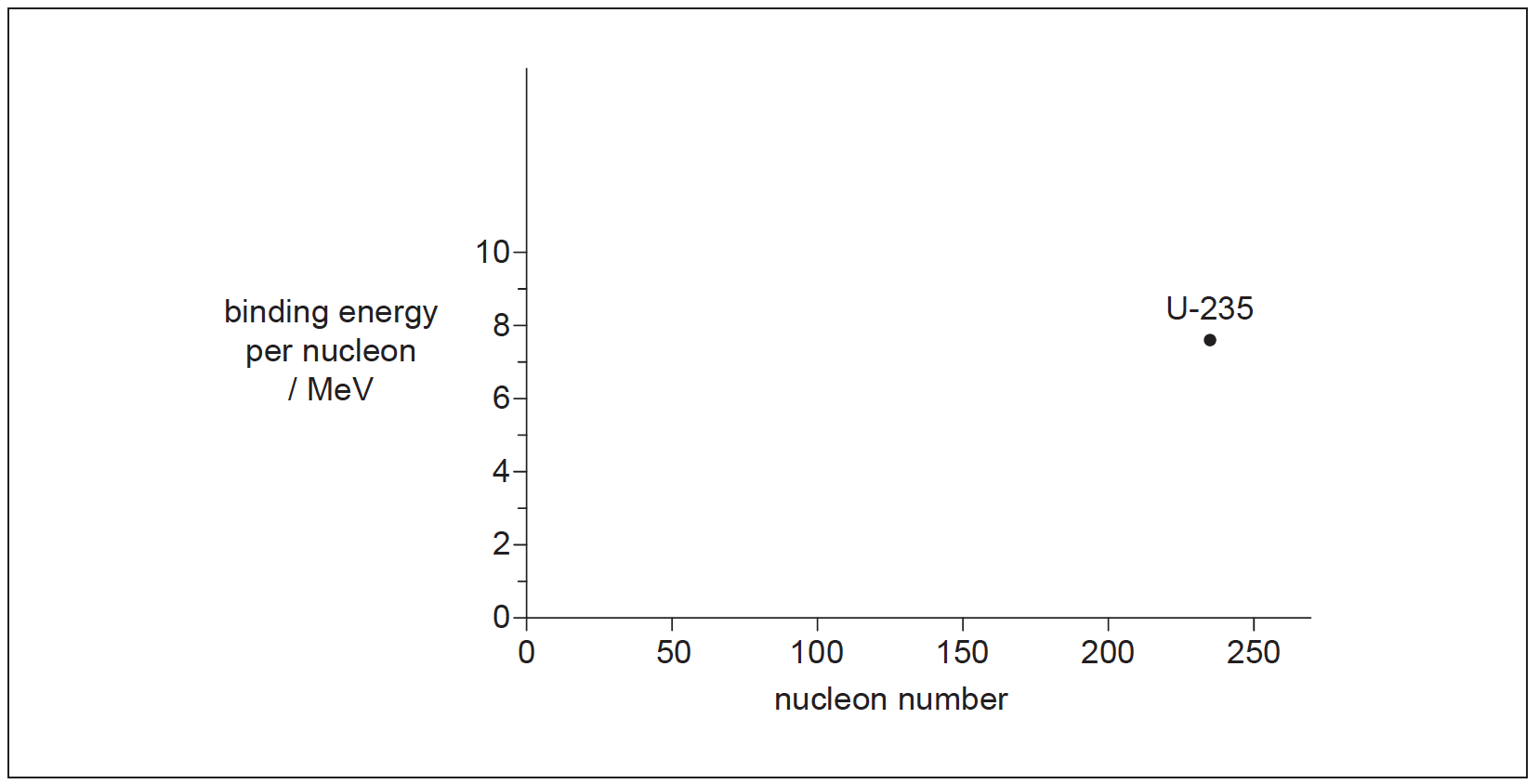
(d)(ii) Explain, with reference to your graph, why energy is released during fission of U-235. [5]
(e)(i) State the nuclear equation for this decay.
(e)(ii) Define the term radioactive half-life.
(e)(iii) A sample of rock contains \(5.6\,\text{mg}\) of U-235 at present. The half-life of U-235 is \(7.0\times10^{8}\) years. Calculate the initial mass of U-235 if the rock formed \(2.1\times10^{9}\) years ago. [4]
• A.3 Work, energy and power — parts (a), (b)(i), (b)(ii)
• B.2 Greenhouse effect — part (b)(iii)
• E.3 Radioactive decay — parts (c), (e)(i), (e)(ii), (e)(iii)
• E.4 Fission — parts (d)(i), (d)(ii)
▶️ Answer / Explanation
(i) Maximum wind power per turbine: \(P=\dfrac{750000}{5\times0.30}=5.0\times10^{5}\,\text{W}\).
\(P=\dfrac{1}{8}\rho\pi d^{2}v^{3}\Rightarrow d=\left(\dfrac{8P}{\rho\pi v^{3}}\right)^{1/2}\approx40\,\text{m}\).
(ii) Not all kinetic energy can be extracted / electrical and mechanical losses / turbines may be feathered at extreme wind speeds.
(iii) Turbines placed too close experience wake effects and reduced wind speed behind leading turbines.
(iv) Advantages: higher average wind speeds, more space.
Disadvantages: higher installation and maintenance costs, access difficulties, wave damage.
(i) Energy per hour \(=0.75\times3600=2700\,\text{MJ}\).
Mass of coal saved \(=\dfrac{2700}{35}=77.1\,\text{kg}\).
(ii) Advantage: renewable energy / reduced fuel costs / energy independence.
Disadvantage: variable output / noise / visual impact / ecological effects.
(iii) Fewer greenhouse gases absorb and re-emit less infrared radiation, so less energy is returned to Earth and global temperature decreases.
(i) Curve rises steeply, reaches a maximum near nucleon number \(A\approx56\), then slowly decreases towards U-235.
(ii) U-235 lies on the decreasing side of the curve. During fission it splits into smaller nuclei with higher binding energy per nucleon. The increase in binding energy per nucleon corresponds to energy released.
(i) \( {}^{235}_{92}\text{U}\rightarrow{}^{231}_{90}\text{Th}+{}^{4}_{2}\alpha \).
(ii) Radioactive half-life is the time taken for the number of unstable nuclei (or the activity) to reduce to half its initial value.
(iii) \(2.1\times10^{9}\) years corresponds to three half-lives.
Initial mass \(=5.6\times2^{3}=45\,\text{mg}\).