
▶️ Answer/Explanation
(a)
The solar constant is the intensity (power per unit area) of solar radiation received at the top of the Earth’s atmosphere, measured perpendicular to the rays, at the average Earth–Sun distance.
(b)
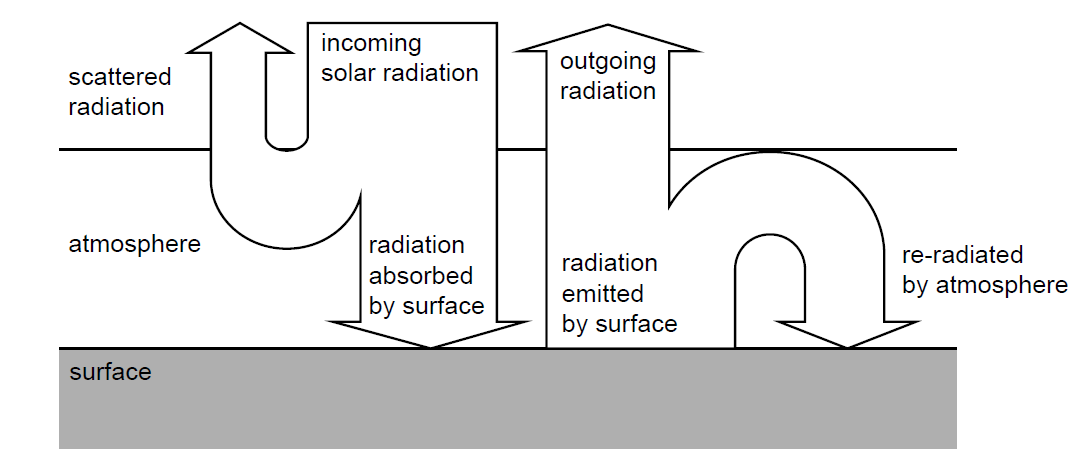
(i) Greenhouse gas molecules absorb infrared radiation emitted by the surface because the radiation energy matches the difference between molecular energy levels (resonance). The molecules then re-radiate this energy in all directions, including back towards the surface.
(ii) Average incoming intensity \(I_{in} = \frac{S}{4} \approx 340\,W\,m^{-2}\).
Absorbed intensity \(= (1 – \text{albedo}) \times I_{in} = (1 – 0.30) \times 340 = 238\,W\,m^{-2}\) (approx \(240\)).
(iii) At the surface: Energy In = Energy Out.
Absorbed Solar + Re-radiated from Atmosphere = Emitted by Surface.
Emitted by surface \(I_{emit} = \epsilon \sigma T^4 = 0.90 \times 5.67 \times 10^{-8} \times (288)^4 \approx 351\,W\,m^{-2}\).
\(238 + I_{atm} = 351 \implies I_{atm} = 113\,W\,m^{-2}\).
(c)
Using \(S \approx 1360\,W\,m^{-2}\) and \(d = 1.5 \times 10^{11}\,m\):
\(P = S \times 4\pi d^2 \approx 3.8 \times 10^{26}\,W\).
(d)
(i) \(\Delta m = [4(1.007276) + 2(0.000549)] – 4.001506 = 0.028696\,u\).
Energy \(Q = 0.028696 \times 931.5\,MeV \approx 26.7\,MeV\).
(ii) Fusion releases energy which creates outward radiation pressure. This pressure balances the inward gravitational pull, preventing collapse and maintaining a stable radius.
(iii) By analysing the Sun’s absorption spectrum (Fraunhofer lines), characteristic lines corresponding to helium can be identified.
(e)
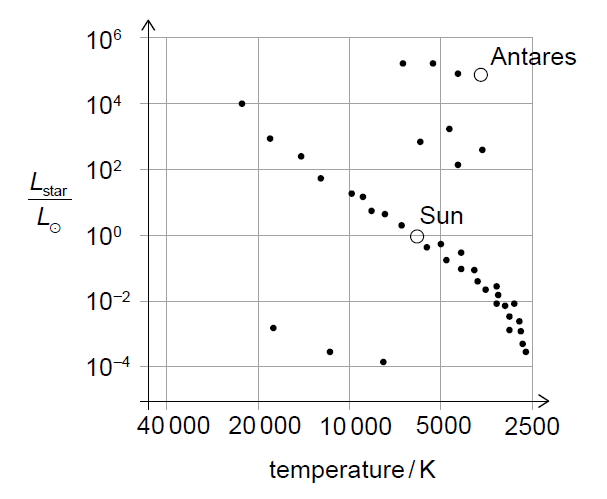
(i) Red supergiant.
(ii) The Sun fuses hydrogen into helium, whereas Antares, being a supergiant, has much higher core temperatures and pressures, allowing fusion of heavier elements.