Home / IB DP Physics Mock Exam HL Paper 1B Set 1

IB DP Physics Mock Exam HL Paper 1B Set 1 - 2025 Syllabus

IB DP Physics Mock Exam HL Paper 1B Set 1

Prepare for the IB DP Physics Mock Exam HL Paper 1B Set 1 with our comprehensive mock exam set 1. Test your knowledge and understanding of key concepts with challenging questions covering all essential topics. Identify areas for improvement and boost your confidence for the real exam

IB DP Physics Mock Tests -All Sets

Question 

A student investigates a water sample in order to find its density. The volume is measured using a measuring cylinder, while the mass is obtained using an electronic balance.
(a) State one way of improving the accuracy of the volume measurement.
The following measurements are obtained:
Volume\((10.6 \pm 0.2)\,cm^{3}\)
Mass\((10.82 \pm 0.01)\,g\)
(b) (i) Determine the density of the sample and calculate its absolute uncertainty.
(ii) Give your final answers in \(kg\,m^{-3}\), using an appropriate number of significant figures.
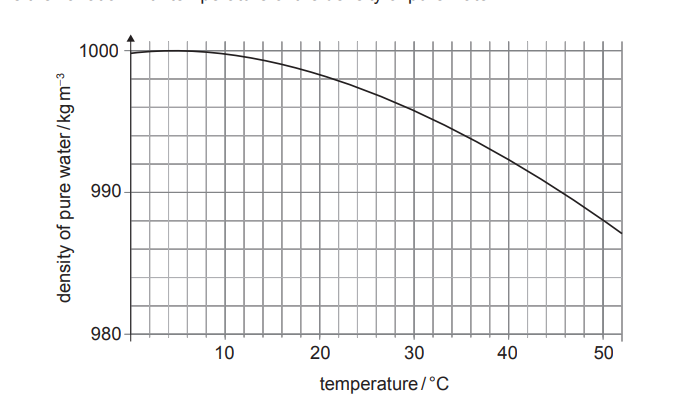
During the measurement, the water sample was at a temperature of \(35^{\circ}C\). A graph is provided that shows how the density of pure water varies with temperature.
(c) Suggest whether the water sample may be regarded as pure.
▶️ Answer/Explanation
Detailed solution

(a)
To ensure accuracy, the student should read the volume at the bottom of the meniscus. Alternatively, ensure the cylinder is placed on a horizontal surface so it is vertical, or ensure eyes are level with the reading to avoid parallax error.

(b)
(i) First, calculate the density \(\rho\):
\[\rho = \frac{m}{V} = \frac{10.82}{10.6} \approx 1.02\,g\,cm^{-3}\]
Next, calculate the uncertainty. The fractional uncertainty in mass \(\frac{0.01}{10.82}\) is negligible compared to the volume. We use the fractional uncertainty of the volume:
\[\frac{\Delta \rho}{\rho} \approx \frac{\Delta V}{V} = \frac{0.2}{10.6}\]
\[\Delta \rho = 1.02 \times \frac{0.2}{10.6} \approx 0.019 \approx 0.02\,g\,cm^{-3}\]
So, \(\rho = (1.02 \pm 0.02)\,g\,cm^{-3}\).

(ii) Converting to \(kg\,m^{-3}\) (multiplying by \(1000\)):
\[\rho = 1020 \pm 20\,kg\,m^{-3}\]
The answer is stated to the correct precision (matching the uncertainty).

(c)
Using the provided graph, the density of pure water at \(35^{\circ}C\) is approximately \(994 \pm 1\,kg\,m^{-3}\). The calculated density of the sample is \(1020 \pm 20\,kg\,m^{-3}\) (range \(1000\) to \(1040\)). Since the value for pure water lies outside the uncertainty range of the sample, the sample is not pure.

Scroll to Top