
Question
(ii) Complete the table by calculating \(\sin \theta_r\) for the row where \(\theta_r = 49^\circ\).
| \(\theta_i\) (°) | \(\theta_r\) (°) | \(\sin \theta_i\) | \(\sin \theta_r\) |
| 10 | 15 | 0.174 | 0.259 |
| 20 | 31 | 0.342 | 0.515 |
| 25 | 39 | 0.423 | 0.629 |
| 30 | 49 | 0.500 | |
| 35 | 60 | 0.574 | 0.866 |
| 40 | 75 | 0.643 | 0.966 |
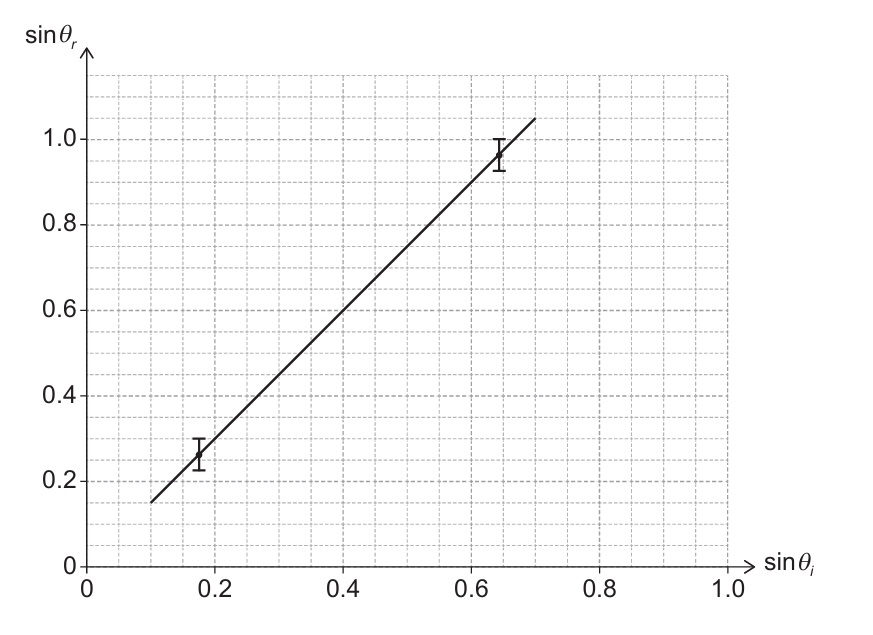
(ii) On the students’ graph, draw the line of maximum possible gradient.
(iii) Determine the refractive index of the glass and its absolute uncertainty.
▶️ Answer/Explanation
(a)
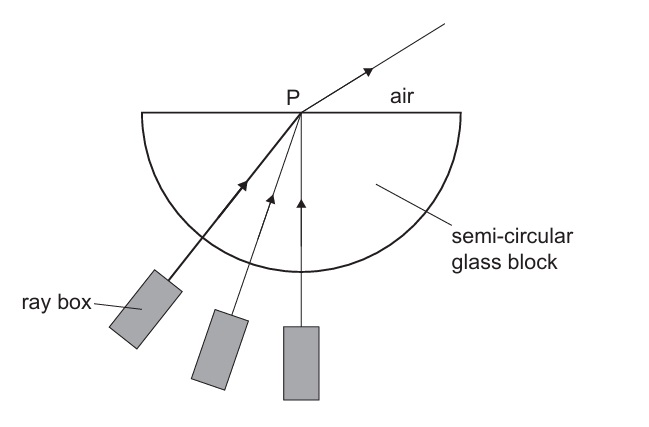
Ensure the incident ray is directed toward the centre P of the flat side so that it strikes along a radial line (angle of incidence = 0° at the curved surface).
\(\boxed{\text{Aim incident ray toward centre P of flat side}}\)
(b)(i)
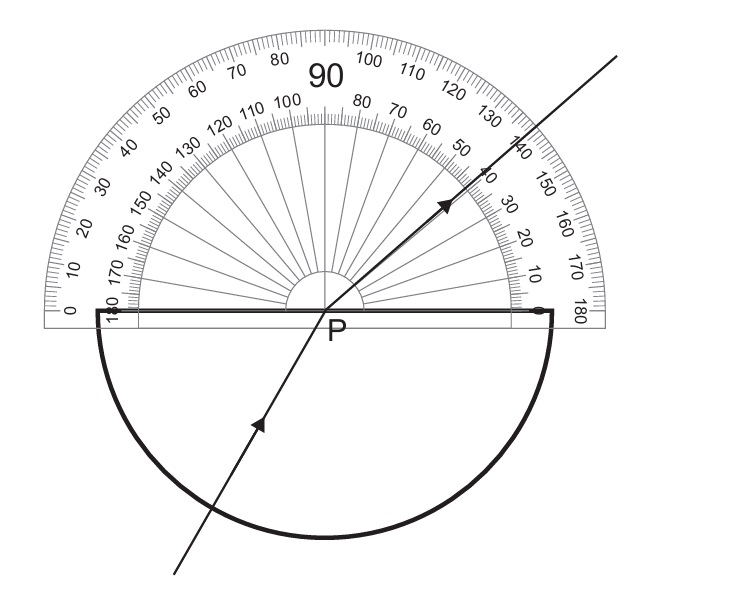
From the protractor description, \(\theta_i\) is measured from the normal to the incident ray. The value is approximately \(48^\circ\)–\(49^\circ\). Since the table row for \(\theta_i = 30^\circ\) has \(\theta_r = 49^\circ\), the corresponding \(\theta_i\) for that measurement is \(30^\circ\).
\(\boxed{30^\circ}\)
(b)(ii)
For \(\theta_r = 49^\circ\), \(\sin 49^\circ \approx 0.7547 \approx 0.755\).
\(\boxed{0.755}\)
(c)(i)
Using two points on the best-fit line, e.g., (0.2, 0.3) and (0.8, 1.2):
\[ \text{Gradient} = \frac{1.2 – 0.3}{0.8 – 0.2} = \frac{0.9}{0.6} = 1.5 \]
\(\boxed{1.5}\)
(c)(ii)
Draw a straight line from the lower end of the first error bar (smallest \(\sin \theta_i\)) to the upper end of the last error bar (largest \(\sin \theta_r\)). This line should be steeper than the best-fit line.
\(\boxed{\text{Line drawn through extremes of error bars}}\)
(c)(iii)
The refractive index \(n = \text{gradient} = 1.5\).
Uncertainty from max/min gradients: If max gradient ≈ 1.7 and min ≈ 1.5 (or similar), \(\Delta n \approx 0.2\).
\(\boxed{n = 1.5 \pm 0.2}\)