
▶️ Answer/Explanation
(a)
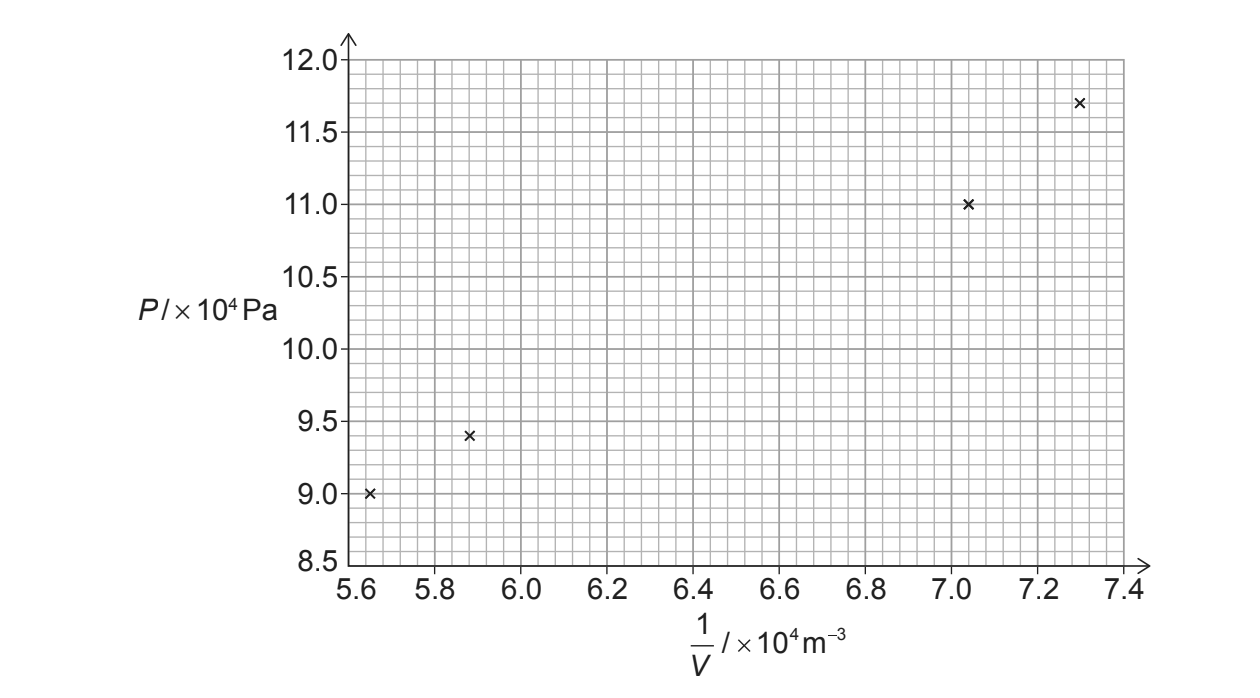
(i) Calculate \(\frac{1}{V}\) for the missing point: \(\frac{1}{1.54 \times 10^{-5}} \approx 6.49 \times 10^{4}\,m^{-3}\).
Plot the point at \((6.5 \times 10^{4}, 10.3 \times 10^{4})\) on the graph (within half a square) .
(ii) A clear, single straight line should be drawn using a ruler, ensuring the points are balanced about the line.
(iii) If the relationship \(PV = K\) holds, then \(P = K \times \frac{1}{V}\). Therefore, the graph of \(P\) versus \(\frac{1}{V}\) should be a straight line that passes through (or is close to) the origin. Alternatively, one could evaluate \(PV\) for each data point to confirm they are approximately constant.
(b)
(i) Determine the gradient of the best-fit line using two points on the line. Alternatively, calculate the average \(PV\) for the data points.
\(K = \text{gradient} \approx 1.56\) (Accept range \(1.55 – 1.60\)) .
(ii) The unit is Joules (\(J\)), \(Nm\), or \(Pa\,m^{3}\) .
(c)
Using the ideal gas equation \(PV = Nk_{B}T\), we know that \(PV = K\), so \(K = Nk_{B}T\) .
Rearranging for \(N\) (number of molecules):
\(N = \frac{K}{k_{B}T}\)
Using \(K \approx 1.59\) (or the value calculated in b(i)), \(T = 291\,K\), and Boltzmann’s constant \(k_{B} \approx 1.38 \times 10^{-23}\,J\,K^{-1}\):
\(N = \frac{1.59}{1.38 \times 10^{-23} \times 291} \approx 3.96 \times 10^{20}\) .
Answer: \(3.96 \times 10^{20}\) molecules (approx \(4.0 \times 10^{20}\)).