
▶️ Answer/Explanation
(a)
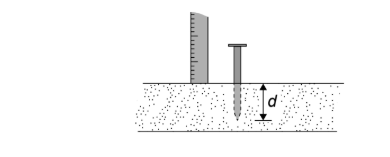
To ensure accuracy, the ruler should be placed perpendicular (vertical) to the wood surface or kept close and parallel to the nail to reduce parallax error. Any zero error of the ruler should also be considered.
(b)
(i) A controlled variable could be the diameter, length, mass, or type of the nail, or the type or density of the wood.
(ii) The value of \(d\) is found by measuring the total length of the nail and subtracting the length remaining above the wood surface.
(iii) Since \(d\) is obtained from two length measurements, the absolute uncertainties add: \(1\,mm + 1\,mm = \pm 2\,mm\) (or \(0.002\,m\)).
(iv) For direct proportionality, \(\frac{P}{d}\) should be constant.
For \(P = 50\,kPa, d = 15\): \(\frac{50}{15} \approx 3.3\).
For \(P = 300\,kPa, d = 37\): \(\frac{300}{37} \approx 8.1\).
Since these ratios differ significantly, \(d\) is not directly proportional to \(P\).
(c)
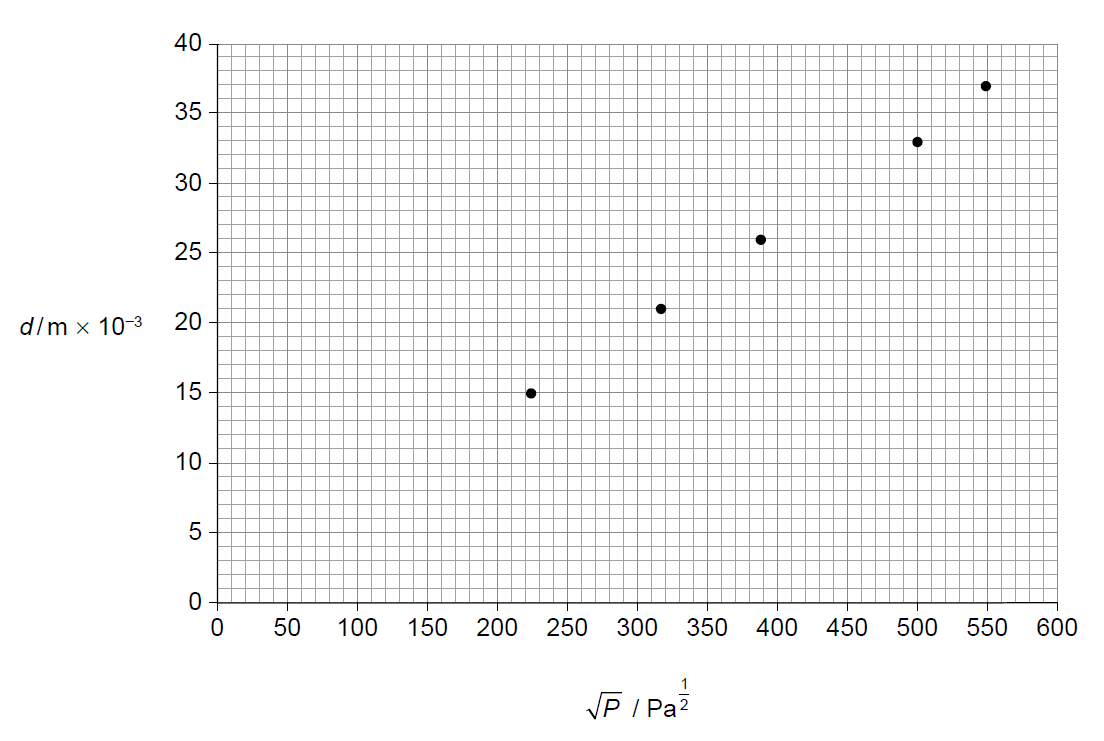
(i) The missing point corresponds to \(P = 200\,kPa\).
\(\sqrt{P} = \sqrt{200 \times 10^{3}} \approx 447\,Pa^{1/2}\).
From the table, \(d = 30 \times 10^{-3}\,m\).
The point is approximately \((447, 30)\).
(ii) The percentage uncertainty in \(\sqrt{P}\) is half that of \(P\): \(\frac{1}{2} \times 8\% = 4\%\).
For \(d = 33\,mm\), \(P = 250\,kPa\), so \(\sqrt{P} = 500\,Pa^{1/2}\).
Absolute uncertainty \(= 0.04 \times 500 = \pm 20\,Pa^{1/2}\).
Draw a horizontal error bar from \(480\) to \(520\).
(iii) \(k = \frac{d}{\sqrt{P}}\).
Units of \(k = kg^{-1/2} m^{3/2} s^{1}\).
Hence, \(x = \frac{3}{2}\) and \(y = 1\).
(d)
Taking only one reading does not account for random uncertainties or anomalies in the wood or nail. Repeating measurements and averaging would improve reliability.