Home / IB DP Physics Mock Exam SL Paper 1B Set 5

IB DP Physics Mock Exam SL Paper 1B Set 5 - 2025 Syllabus

IB DP Physics Mock Exam SL Paper 1B Set 5

Prepare for the IB DP Physics Mock Exam SL Paper 1B Set 5 with our comprehensive mock exam set 5. Test your knowledge and understanding of key concepts with challenging questions covering all essential topics. Identify areas for improvement and boost your confidence for the real exam

IB DP Physics Mock Tests -All Sets

Question 

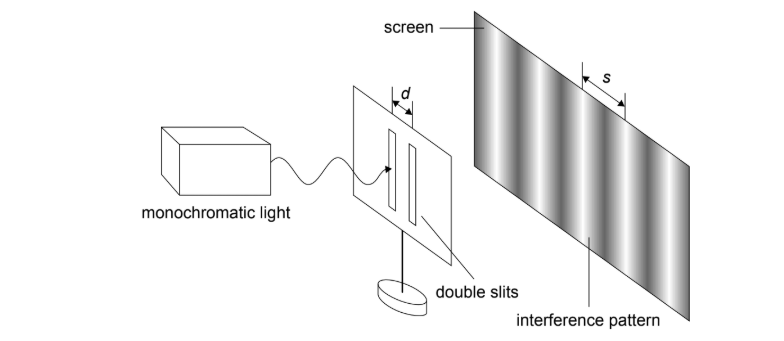
Students perform a double-slit experiment in order to find the wavelength of monochromatic light. Light from the source passes through a double slit with adjustable separation \(d\). An interference pattern is produced on a screen positioned at a fixed distance from the slits. The spacing between adjacent fringes is denoted by \(s\).
(a) A ruler marked in millimetres is used to measure \(s\). Describe a procedure that allows \(s\) to be determined with a reduced absolute uncertainty.
(b) Explain how using a smaller value of \(d\) affects the fractional uncertainty in the measured value of \(s\).
(c) (i) To find \(\lambda\), students draw a graph with \(s\) on the vertical axis. State which quantity should be plotted on the horizontal axis so that the line of best fit is straight.
(ii) A calculator gives a value of \(\lambda = 611.089\,nm\) with a percentage uncertainty of \(\pm 5\%\). State how this result should be written in the conclusion, including the absolute uncertainty and using an appropriate number of significant figures.
▶️ Answer/Explanation
Detailed solution

(a)
To reduce absolute uncertainty, measure the total distance across multiple fringes (for example, 10 fringes) and divide this distance by the number of fringes (minus one).

(b)
From the relation \(s = \frac{\lambda D}{d}\), decreasing \(d\) produces a larger fringe spacing \(s\). As the ruler’s absolute uncertainty remains the same, the fractional uncertainty \(\frac{\Delta s}{s}\) becomes smaller.

(c)
(i) Since \(s = (\lambda D)\frac{1}{d}\), plotting \(s\) against \(\frac{1}{d}\) (or \(d^{-1}\)) gives a straight line through the origin.
(ii) The absolute uncertainty is \(5\%\) of \(611.089\,nm \approx 30.55\,nm\), which rounds to \(\pm 30\,nm\). The wavelength should be rounded to the same precision, giving \(610\,nm\).
Final result: \(\lambda = 610 \pm 30\,nm\).

Scroll to Top