Home / IB Maths SL 2.6 Modelling skills AI HL Paper 2- Exam Style Questions

IB Maths SL 2.6 Modelling skills AI HL Paper 2- Exam Style Questions- New Syllabus

Question

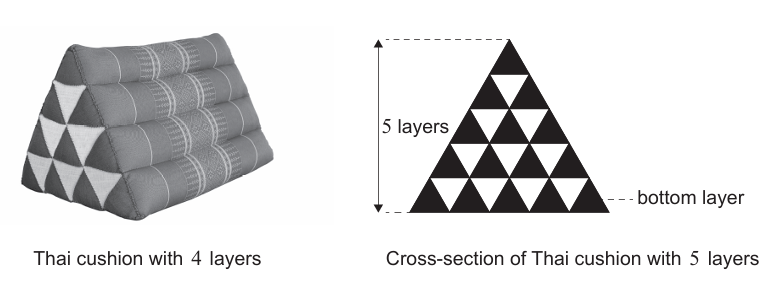
Traditional Thai cushions are constructed with a triangular cross-section, built from stacked layers of smaller triangular components. For mathematical analysis, these components are modeled as individual triangular prisms.
Diagram of Thai cushion layers
 
(a) Determine the quantity of triangular prisms located in the foundation layer of a cushion containing:
(i) exactly \( 4 \) layers.
(ii) exactly \( 5 \) layers.
An observer, Mayumi, notes that the number of prisms in the foundation layer follows an arithmetic progression as the total number of layers increases.
(b) (i) State the common difference of this arithmetic sequence.
(ii) Formulate a general expression for the number of triangular prisms in the foundation layer of a cushion with \( n \) total layers.
(c) Mayumi intends to manufacture a larger cushion consisting of \( 9 \) layers.
(i) Find the number of prisms required for the foundation layer of this \( 9 \)-layer cushion.
(ii) Calculate the total number of triangular prisms needed to complete the entire cushion.
(d) Derive a simplified expression for the total number of triangular prisms required for a cushion with \( n \) layers.
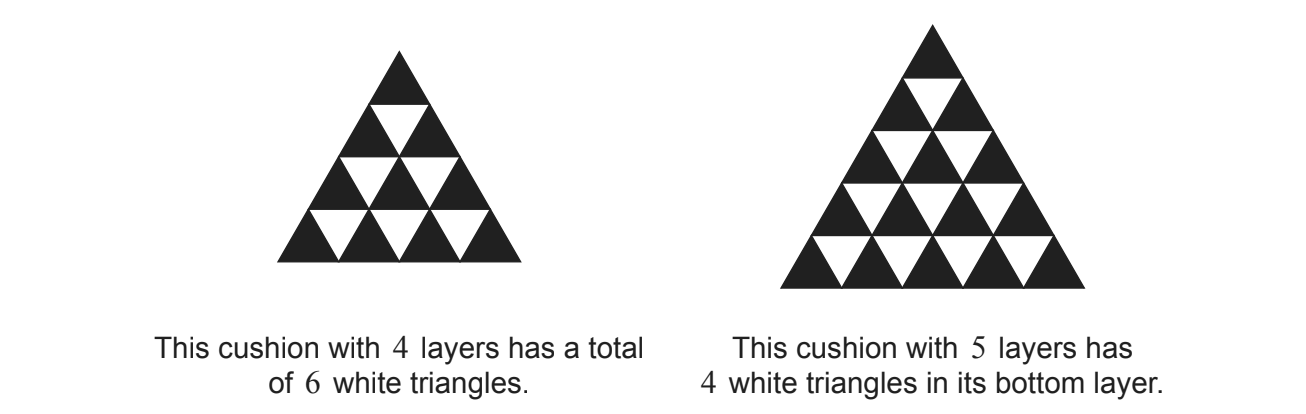
Color pattern diagram of the cushion
 
(e) A \( 4 \)-layer cushion is designed with a color pattern resulting in \( 6 \) white triangular faces. State the total number of black triangular faces present in this \( 4 \)-layer design.
(f) The quantity of black triangles in each successive layer also forms an arithmetic sequence. Find and simplify an expression for the cumulative number of black triangles in a cushion with \( n \) layers.
(g) Given that the total number of white triangles in an \( n \)-layer cushion is \( \frac{n(n-1)}{2} \), use this alongside your result from part (f) to find a simplified expression for the combined total of black and white triangles in the cushion.

Most-appropriate topic codes:

SL 1.2: Arithmetic sequences and series — parts (b), (c), (d), (f), (g) 
SL 2.6: Modelling skills: creating, fitting, and using models — all parts 
▶️ Answer/Explanation

(a)

(i) For 4 layers, the bottom layer has \( \boxed{7} \) prisms.

(ii) For 5 layers, the bottom layer has \( \boxed{9} \) prisms.

(b)

(i) The common difference is \( \boxed{2} \).

(ii) The first term is 1, common difference 2. The number of prisms in the bottom layer with \( n \) layers is:

\( u_n = 1 + 2(n-1) = \boxed{2n – 1} \).

(c)

(i) For \( n = 9 \), \( u_9 = 2(9) – 1 = \boxed{17} \).

(ii) The total number of prisms is the sum of the arithmetic series:

\( S_9 = \frac{9}{2}(1 + 17) = \frac{9}{2} \times 18 = \boxed{81} \).

(d)

The total number of prisms in \( n \) layers is:

\( S_n = \frac{n}{2}\big(1 + (2n – 1)\big) = \frac{n}{2}(2n) = \boxed{n^2} \).

(e)

The total triangles in the 4-layer cushion is \( 4^2 = 16 \). White triangles = 6, so black triangles = \( 16 – 6 = \boxed{10} \).

(f)

The black triangles per layer form the sequence: 1, 2, 3, …, \( n \). This is arithmetic with first term 1, common difference 1.

Total black triangles = \( \frac{n}{2}(1 + n) = \boxed{\frac{n(n+1)}{2}} \).

(g)

Total white triangles = \( \frac{n(n-1)}{2} \). Total black triangles = \( \frac{n(n+1)}{2} \).

Sum = \( \frac{n(n-1)}{2} + \frac{n(n+1)}{2} = \frac{n}{2}\big[(n-1) + (n+1)\big] = \frac{n}{2}(2n) = \boxed{n^2} \).

Scroll to Top