
1.1 – Integers, Factors, Multiples and Order of Operations
This topic develops the foundations of number operations used throughout mathematics. You will work with positive and negative integers, identify factors and multiples, recognise prime and composite numbers, use prime factorisation to find the HCF and LCM, and apply the correct order of operations when evaluating numerical expressions.
Integers
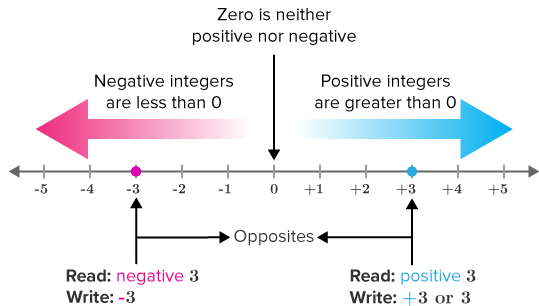
An integer is a whole number that can be positive, negative or zero.
| Type | Examples | Description |
|---|---|---|
| Positive integers | \(1,2,3,4,\ldots\) | Integers greater than zero |
| Negative integers | \(-1,-2,-3,-4,\ldots\) | Integers less than zero |
| Zero | \(0\) | Neither positive nor negative |
Integers can be represented on a number line. Numbers increase as we move to the right and decrease as we move to the left.
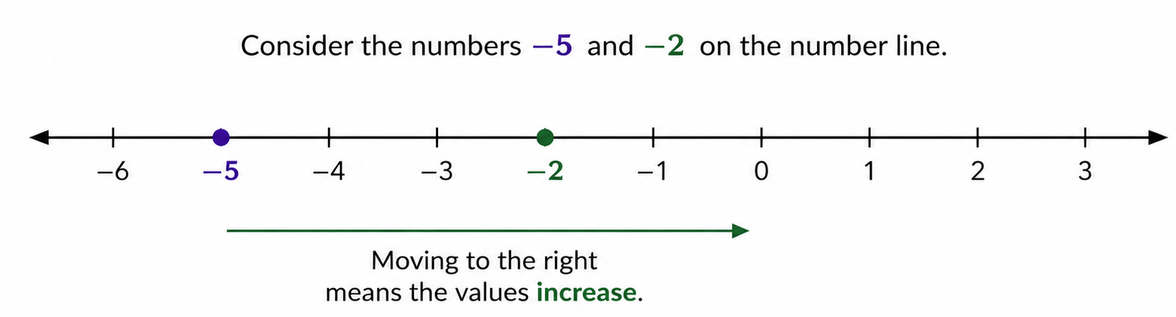
On a number line, a number farther to the right is greater. Therefore, \(-2>-5\), even though \(5>2\).
Operations with Integers
When adding or subtracting integers or multiplication and division, the signs of the numbers must be considered carefully.
➕ Adding Integers Using Rules
When adding integers, first look at the signs of the numbers.
| Situation | Rule | Example |
|---|---|---|
| Same signs | Add the absolute values and keep the common sign. | \((-6)+(-4)=-10\) |
| Different signs | Subtract the smaller absolute value from the larger and keep the sign of the number with the larger absolute value. | \((-9)+5=-4\) |
Same signs → Add and keep the sign.
Different signs → Subtract and keep the sign of the larger absolute value.
Examples:
- \(7+5=12\)
- \((-7)+(-5)=-12\)
- \(9+(-4)=5\)
- \((-9)+4=-5\)
➖ Subtracting Integers Using Rules
When subtracting integers, change subtraction into addition of the opposite. Then apply the rules for adding integers.
\(a-b=a+(-b)\)
Keep the first number, change subtraction to addition, and change the sign of the second number.
Examples:
- \(8-3=8+(-3)=5\)
- \(8-(-3)=8+3=11\)
- \((-6)-4=(-6)+(-4)=-10\)
- \((-6)-(-4)=(-6)+4=-2\)
Do not simply remove the subtraction sign. The sign of the second integer must also change.
For example:
\(5-(-2)\neq5-2\)
Instead, \(5-(-2)=5+2=7\).
✖️➗ Multiplying & Dividing Integers Using Rules
For multiplication and division, first determine whether the signs are the same or different.
| Signs | Result | Multiplication Example | Division Example |
|---|---|---|---|
| Same signs | Positive | \((-4)(-3)=12\) | \((-12)\div(-3)=4\) |
| Different signs | Negative | \((-4)(3)=-12\) | \(12\div(-3)=-4\) |
Same signs → Positive answer.
Different signs → Negative answer.
First calculate using the positive values, then determine the sign of the answer.
Examples:
- \(6\times4=24\)
- \((-6)\times(-4)=24\)
- \((-6)\times4=-24\)
- \(24\div6=4\)
- \((-24)\div(-6)=4\)
- \((-24)\div6=-4\)
For multiplication and division, you do not use the addition/subtraction sign rules. Simply check the signs:
Same → Positive
Different → Negative
Factors
A factor of a number is a whole number that divides exactly into that number with no remainder.
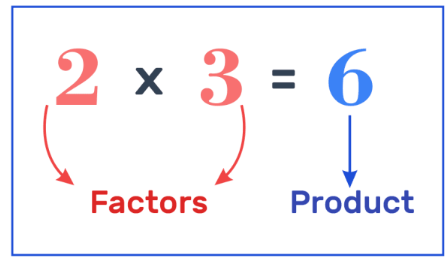
For example, \(5\) is a factor of \(65\) because \(65\div5=13\). Therefore, \(5\times13=65\), so \(5\) and \(13\) form a factor pair.
To find all factors of a number, look for pairs of whole numbers whose product gives the original number.
🧠 Example of Factor Pairs:
For \(24\):
\(1\times24,\;2\times12,\;3\times8,\;4\times6\)
Therefore, the factors of \(24\) are:
\(1,2,3,4,6,8,12,24\)
Prime and Composite Numbers
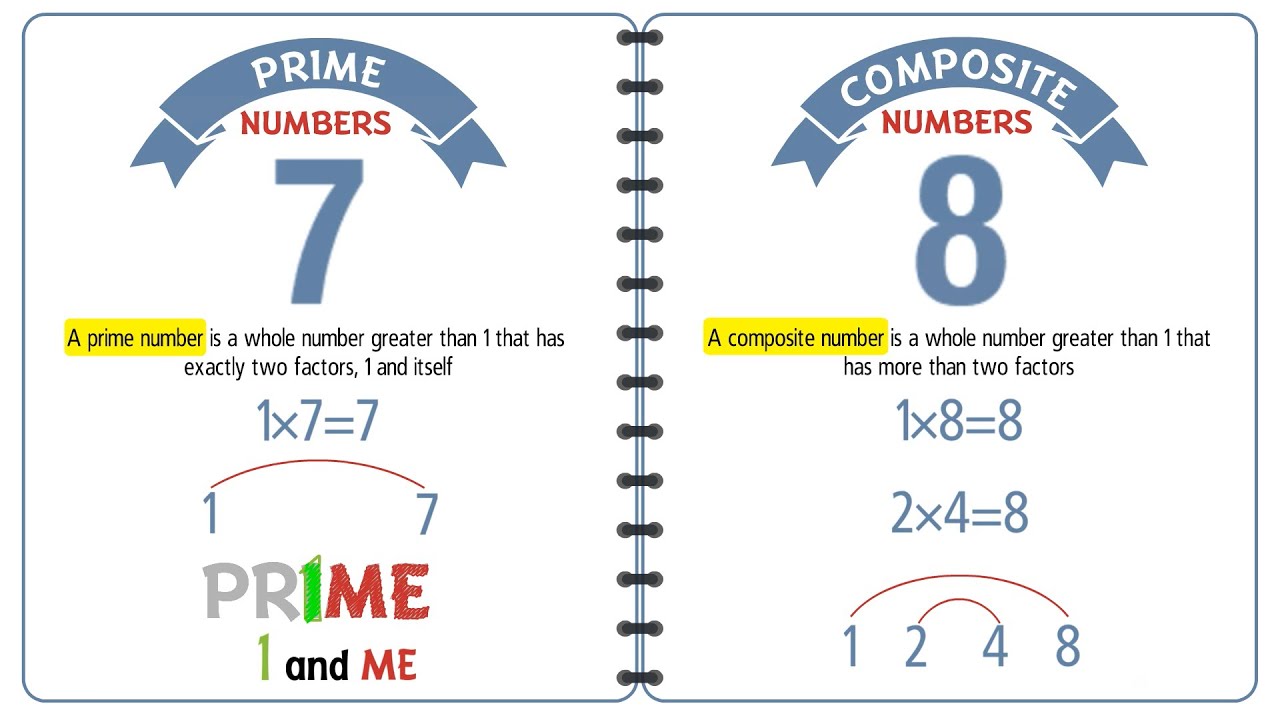
- A prime number is a natural number with exactly two distinct positive factors: \(1\) and itself.
- A composite number has more than two positive factors.
| Number | Type | Reason |
|---|---|---|
| \(7\) | Prime | Factors are \(1,7\) |
| \(12\) | Composite | Factors include \(1,2,3,4,6,12\) |
| \(1\) | Neither | It has only one positive factor |
The number \(1\) is neither prime nor composite because it has only one positive factor.
Prime Factorisation
Every composite number can be expressed as a product of prime numbers. This is called its prime factorisation.
Two useful methods for finding prime factorisation are:
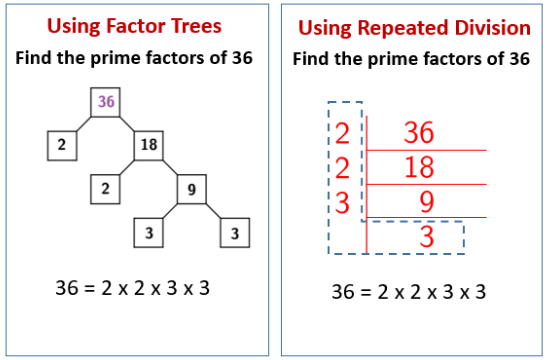
- Repeated division – repeatedly divide by prime factors until the result is \(1\).
- Factor tree – repeatedly split a number into factor pairs until only prime numbers remain.
For example:
\(60=2\times2\times3\times5=2^2\times3\times5\)
Exponent notation allows repeated prime factors to be written more efficiently.
Prime factorisation means writing a number as a product of prime numbers.
Prime factored form is the resulting expression, such as \(72=2^3\times3^2\).
Highest Common Factor (HCF)
The highest common factor (HCF) of two or more numbers is the greatest factor that they all have in common.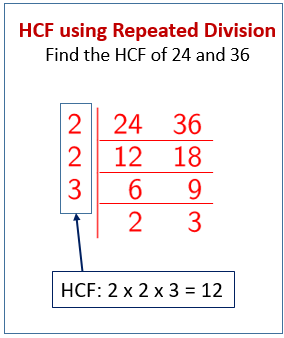
For small numbers, the HCF can be found by listing factors. For larger numbers, prime factorisation provides an efficient method.
For example:
\(180=2^2\times3^2\times5\)
\(324=2^2\times3^4\)
The common prime factors with the smallest powers are \(2^2\times3^2\).
Therefore,
\(\mathrm{HCF}=2^2\times3^2=36\)
To find the HCF, take only the common prime factors and use the smallest power of each.
Multiples and Lowest Common Multiple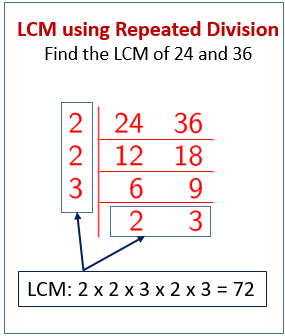
A multiple of a number is obtained by multiplying that number by a positive integer.
For example, the multiples of \(6\) are:
\(6,12,18,24,30,36,42,\ldots\)
The lowest common multiple (LCM) of two or more numbers is the smallest positive multiple that they have in common.
The LCM can be found by listing multiples or by using prime factorisation.
HCF → think factors and the largest common value.
LCM → think multiples and the smallest common value.
Exponent Notation
An exponent tells us how many times a number, called the base, is multiplied by itself.
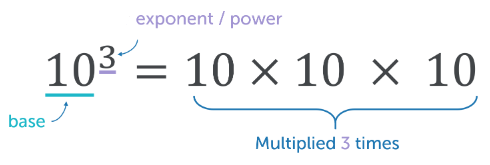
For example:
\(3^4=3\times3\times3\times3=81\)
| Expression | Base | Exponent | Value |
|---|---|---|---|
| \(5^2\) | \(5\) | \(2\) | \(25\) |
| \(2^5\) | \(2\) | \(5\) | \(32\) |
Exponent notation is particularly useful when writing prime factorisations because repeated prime factors can be written compactly.
Order of Operations
When an expression contains more than one operation, the operations must be performed in the correct order. The order of operations can be remembered using BEDMAS.
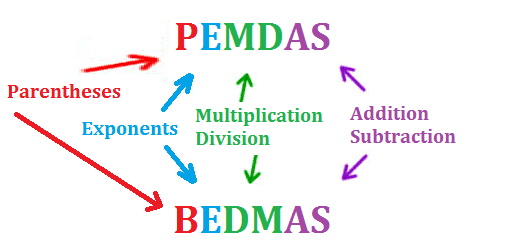
| Step | Operation |
|---|---|
| B | Brackets |
| E | Exponents |
| D/M | Division and Multiplication, working from left to right |
| A/S | Addition and Subtraction, working from left to right |
Multiplication does not always come before division. They have equal priority, so work from left to right. The same applies to addition and subtraction.
Problem-Solving with Numerical Expressions
Many real-world problems require more than one operation. Before calculating, identify what quantities need to be combined and decide which operations are required. Then write a mathematical expression before evaluating it.
For example, if two people buy \(2\) bags of \(50\) items and \(3\) bags of \(35\) items, the total number of items is \(2\times50+3\times35\). If these are shared equally among \(5\) people, the required expression is:
\(\dfrac{2\times50+3\times35}{5}=41\)
This type of problem requires both constructing an expression and applying the correct order of operations.
1. Identify the information given.
2. Decide what the question is asking you to find.
3. Choose the required operations.
4. Write a mathematical expression.
5. Apply BEDMAS correctly.
6. Check whether your answer is reasonable and includes the correct units when necessary.
Example 1:
A temperature is \(-7^\circ\text{C}\) in the morning. During the day, it increases by \(12^\circ\text{C}\), and later it decreases by \(5^\circ\text{C}\). What is the final temperature?
▶️ Answer/Explanation
Answer
Start with the morning temperature:
\(-7^\circ\text{C}\)
The temperature increases by \(12^\circ\text{C}\):
\(-7+12=5\)
It then decreases by \(5^\circ\text{C}\):
\(5-5=0\)
Final temperature = \(0^\circ\text{C}\)
Example 2:
A school has \(48\) red pencils and \(72\) blue pencils. The teacher wants to make identical packs using all the pencils, with the same number of red and blue pencils in every pack.
a) What is the greatest number of identical packs that can be made?
b) How many red and blue pencils will be in each pack?
▶️ Answer/Explanation
Answer
We need the greatest number of identical packs, so we need the HCF of \(48\) and \(72\).
Prime factorise each number:
\(48=2^4\times3\)
\(72=2^3\times3^2\)
Take the common prime factors using the smaller powers:
\(\mathrm{HCF}=2^3\times3=24\)
Therefore, the greatest number of packs is:
\(24\) packs
Now divide each type of pencil by \(24\):
Red pencils per pack: \(48\div24=2\)
Blue pencils per pack: \(72\div24=3\)
Each pack contains \(2\) red pencils and \(3\) blue pencils.
Example:3
Two positive integers are \(84\) and \(126\).
a) Write \(84\) and \(126\) as products of their prime factors.
b) Use your prime factorisations to find the HCF of \(84\) and \(126\).
c) Use your prime factorisations to find the LCM of \(84\) and \(126\).
d) Verify that your HCF and LCM satisfy
\(\mathrm{HCF}\times\mathrm{LCM}=84\times126\)
▶️ Answer/Explanation
Answer
a) Prime factorisation
For \(84\):
\(84=2\times42\)
\(=2\times2\times21\)
\(=2^2\times3\times7\)
Therefore,
\(84=2^2\times3\times7\)
For \(126\):
\(126=2\times63\)
\(=2\times3\times21\)
\(=2\times3^2\times7\)
Therefore,
\(126=2\times3^2\times7\)
b) Finding the HCF
For the HCF, take the common prime factors using the smallest power of each.
\(84=2^2\times3\times7\)
\(126=2\times3^2\times7\)
The common factors are:
\(2^1,\;3^1,\;7^1\)
Therefore,
\( \mathrm{HCF}=2\times3\times7=42 \)
HCF = \(42\)
c) Finding the LCM
For the LCM, take every prime factor using the largest power that appears.
Therefore,
\( \mathrm{LCM}=2^2\times3^2\times7 \)
Calculate:
\(4\times9\times7=252\)
LCM = \(252\)
d) Verification
Calculate the product of the HCF and LCM:
\(42\times252=10\,584\)
Now calculate:
\(84\times126=10\,584\)
Both sides are equal, so the result is verified.
For HCF → use common prime factors with the smallest powers.
For LCM → use all required prime factors with the largest powers.
Example: 4
Evaluate:
\(18-3\times(4+2)^2\div6\)
▶️ Answer/Explanation
Answer
Step 1: Brackets
\(4+2=6\)
So:
\(18-3\times6^2\div6\)
Step 2: Exponents
\(6^2=36\)
So:
\(18-3\times36\div6\)
Step 3: Multiplication and Division from left to right
\(3\times36=108\)
\(108\div6=18\)
So:
\(18-18\)
Step 4: Addition and Subtraction
\(18-18=0\)
Final Answer: \(0\)
Multiplication and division have the same priority, so work from left to right. Do not automatically perform all multiplication before division.