
1.2 – Fractions, Decimals and Rational Numbers
Fractions and decimals are two different ways of representing parts of a whole. A strong understanding of their relationship allows us to compare numbers, perform calculations, convert between forms and identify rational numbers.
Understanding Fractions
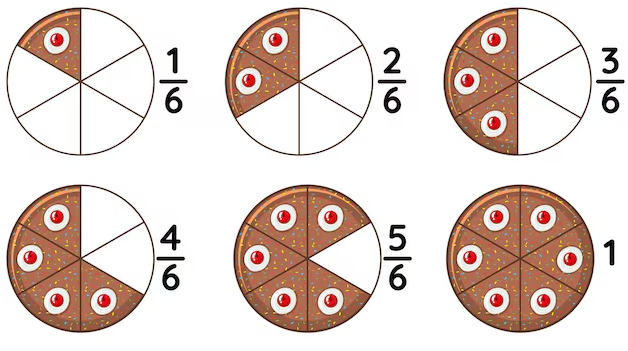
A fraction represents a part of a whole or a division of one number by another.
\(\dfrac{a}{b}\), where \(b\neq0\)
| Part | Meaning | Example |
|---|---|---|
| Numerator | Number of parts being considered | \(3\) in \(\dfrac{3}{5}\) |
| Denominator | Number of equal parts in the whole | \(5\) in \(\dfrac{3}{5}\) |
For example, \(\dfrac{3}{5}\) means that a whole has been divided into \(5\) equal parts and \(3\) of those parts are being considered.
Equivalent Fractions
Equivalent fractions have different numerators and denominators but represent the same value.
\(\dfrac{1}{2}=\dfrac{2}{4}=\dfrac{3}{6}=\dfrac{5}{10}\)
To create an equivalent fraction, multiply or divide both the numerator and denominator by the same non-zero number.
\(\dfrac{3}{4}\times\dfrac{2}{2}=\dfrac{6}{8}\)
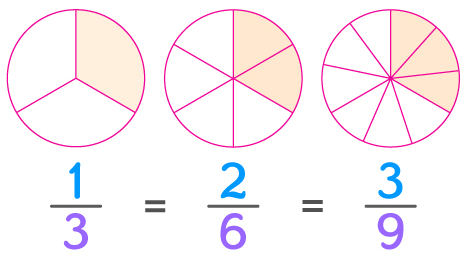
You must multiply or divide the numerator and denominator by the same number. Changing only one part changes the value of the fraction.
Simplifying Fractions
A fraction is in simplest form when the numerator and denominator have no common factor greater than \(1\).
To simplify a fraction, divide the numerator and denominator by their HCF.
\(\dfrac{18}{24}=\dfrac{18\div6}{24\div6}=\dfrac{3}{4}\)
The simplest form of a fraction has no common factor between its numerator and denominator other than \(1\).
Adding and Subtracting Fractions
To add or subtract fractions, the fractions must have a common denominator.
When the denominators are the same:
\(\dfrac{a}{c}+\dfrac{b}{c}=\dfrac{a+b}{c}\)
For example:
\(\dfrac{3}{8}+\dfrac{2}{8}=\dfrac{5}{8}\)
When the denominators are different:
First find a common denominator, usually the LCM of the denominators.
\(\dfrac{2}{3}+\dfrac{1}{4}\)
\(\dfrac{2}{3}=\dfrac{8}{12}\)
\(\dfrac{1}{4}=\dfrac{3}{12}\)
\(\dfrac{8}{12}+\dfrac{3}{12}=\dfrac{11}{12}\)
Never add or subtract the denominators. Find a common denominator first.
Multiplying Fractions
To multiply fractions, multiply the numerators together and multiply the denominators together.
\(\dfrac{a}{b}\times\dfrac{c}{d}=\dfrac{ac}{bd}\)
For example:
\(\dfrac{3}{5}\times\dfrac{10}{9}=\dfrac{30}{45}=\dfrac{2}{3}\)
Fractions can also be simplified before multiplying.
\(\dfrac{3}{5}\times\dfrac{10}{9}=\dfrac{3}{1}\times\dfrac{2}{9}=\dfrac{2}{3}\)
Dividing Fractions
To divide by a fraction, multiply by its reciprocal.
\(\dfrac{a}{b}\div\dfrac{c}{d}=\dfrac{a}{b}\times\dfrac{d}{c}\)
For example:
\(\dfrac{3}{4}\div\dfrac{2}{5}\)
\(=\dfrac{3}{4}\times\dfrac{5}{2}\)
\(=\dfrac{15}{8}=1\dfrac{7}{8}\)
Keep → Change → Flip
Keep the first fraction, change division to multiplication, and flip the second fraction.
Proper, Improper and Mixed Fractions
| Type | Definition | Example |
|---|---|---|
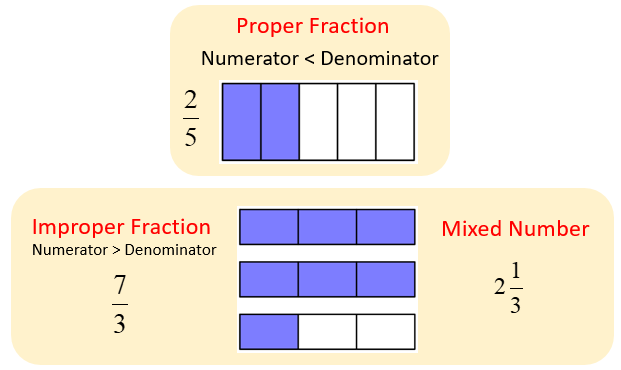
| Proper fraction | Numerator is less than denominator | \(\dfrac{3}{7}\) |
| Improper fraction | Numerator is greater than or equal to denominator | \(\dfrac{11}{4}\) |
| Mixed number | A whole number combined with a proper fraction | \(2\dfrac{3}{4}\) |
To convert an improper fraction into a mixed number, divide the numerator by the denominator.
\(\dfrac{11}{4}=2\dfrac{3}{4}\)
To convert a mixed number into an improper fraction:
\(2\dfrac{3}{4}=\dfrac{(2\times4)+3}{4}=\dfrac{11}{4}\)
Fractions as Division
A fraction can also represent division.
\(\dfrac{a}{b}=a\div b\)
For example:
\(\dfrac{3}{4}=3\div4=0.75\)
This connection is important because it provides a direct method for converting fractions into decimals.
Decimals
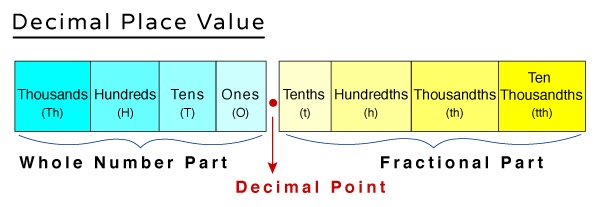
A decimal represents a number using place values based on powers of \(10\).
| Place | Value |
|---|---|
| Tenths | \(\dfrac{1}{10}=0.1\) |
| Hundredths | \(\dfrac{1}{100}=0.01\) |
| Thousandths | \(\dfrac{1}{1000}=0.001\) |
For example:
\(0.375=\dfrac{3}{10}+\dfrac{7}{100}+\dfrac{5}{1000}\)
Rounding Decimal Numbers
To round a decimal number:
- Identify the place value you are rounding to.
- Look at the digit immediately to its right.
- If that digit is \(5\) or greater, increase the rounding digit by \(1\).
- If that digit is less than \(5\), leave the rounding digit unchanged.
- Remove the remaining digits.
Example: Round \(7.4862\) to \(2\) decimal places.
\(7.4862\rightarrow7.49\)
The third decimal digit is \(6\), so the hundredths digit \(8\) increases to \(9\).
Adding and Subtracting Decimal Numbers
When adding or subtracting decimals, align the decimal points vertically.
\(12.45+3.708\)
\(12.450+3.708=16.158\)
Therefore:
\(12.45+3.708=16.158\)
Multiplying and Dividing by Powers of \(10\)
When multiplying by \(10\), \(100\), \(1000\), and so on, the decimal point moves to the right.
- \(4.56\times10=45.6\)
- \(4.56\times100=456\)
- \(4.56\times1000=4560\)
When dividing by powers of \(10\), the decimal point moves to the left.
- \(456\div10=45.6\)
- \(456\div100=4.56\)
- \(456\div1000=0.456\)
Multiplying Decimal Numbers
To multiply decimals:
- Multiply the numbers as if they were whole numbers.
- Count the total number of decimal places in both factors.
- Place the decimal point in the answer so that it has the same total number of decimal places.
Example:
\(2.4\times1.35\)
Ignore the decimal points:
\(24\times135=3240\)
There are \(3\) decimal places altogether, so:
\(2.4\times1.35=3.240=3.24\)
Dividing Decimal Numbers
When dividing by a decimal, multiply both the dividend and divisor by a suitable power of \(10\) so that the divisor becomes a whole number.
Example:
\(7.2\div0.6\)
Multiply both numbers by \(10\):
\(72\div6=12\)
Therefore, \(7.2\div0.6=12\).
• Add/subtract → align decimal points.
• Multiply by \(10^n\) → move the decimal point \(n\) places right.
• Divide by \(10^n\) → move the decimal point \(n\) places left.
• Multiply decimals → count total decimal places after multiplying.
• Divide by a decimal → make the divisor a whole number first.
Converting Fractions to Decimals
To convert a fraction to a decimal, divide the numerator by the denominator.
\(\dfrac{3}{5}=3\div5=0.6\)
Some fractions produce terminating decimals, while others produce recurring decimals.
| Fraction | Decimal | Type |
|---|---|---|
| \(\dfrac{1}{2}\) | \(0.5\) | Terminating |
| \(\dfrac{3}{4}\) | \(0.75\) | Terminating |
| \(\dfrac{1}{3}\) | \(0.333\ldots\) | Recurring |
| \(\dfrac{2}{11}\) | \(0.1818\ldots\) | Recurring |
Converting Decimals to Fractions
A terminating decimal can be converted into a fraction by using its place value.
For example:
\(0.45=\dfrac{45}{100}=\dfrac{9}{20}\)
The fraction should then be simplified to its lowest terms.
One decimal place → denominator \(10\)
Two decimal places → denominator \(100\)
Three decimal places → denominator \(1000\)
Then simplify the fraction.
Rational Numbers
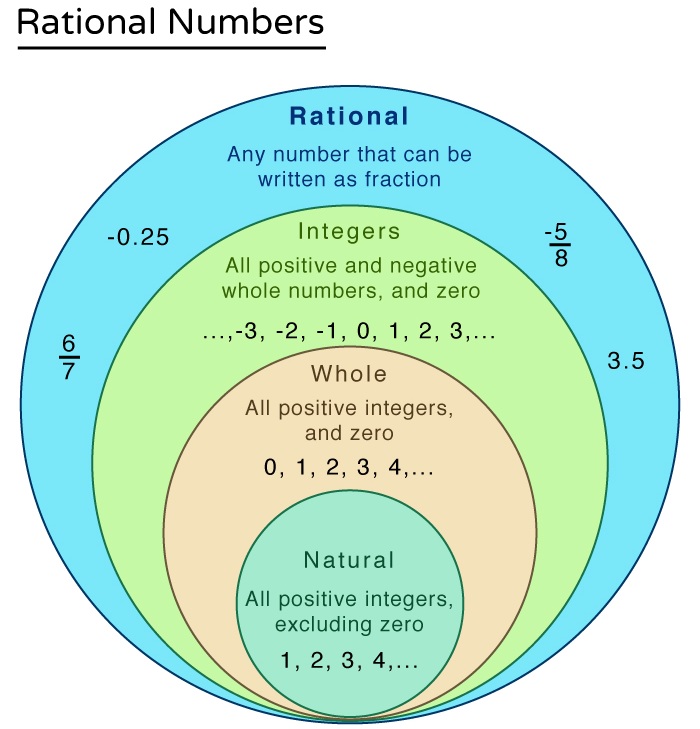
A rational number is any number that can be written in the form:
\(\dfrac{p}{q}\), where \(p\) and \(q\) are integers and \(q\neq0\).
Therefore, all integers, fractions and terminating or recurring decimals are rational numbers.
| Number | Rational? | Reason |
|---|---|---|
| \(5\) | Yes | \(5=\dfrac{5}{1}\) |
| \(\dfrac{7}{8}\) | Yes | Already written as a ratio of integers |
| \(0.25\) | Yes | \(0.25=\dfrac{1}{4}\) |
| \(0.777\ldots\) | Yes | Recurring decimal |
Terminating decimals → rational numbers
Recurring decimals → rational numbers
Integers → rational numbers
Fractions of integers → rational numbers
Comparing Fractions and Decimals
To compare numbers written in different forms, it is often useful to convert them to the same form.
For example, compare \(\dfrac{5}{8}\) and \(0.6\).
\(\dfrac{5}{8}=0.625\)
Since \(0.625>0.6\),
\(\dfrac{5}{8}>0.6\)
When comparing a fraction and a decimal, converting the fraction to a decimal is often the quickest method. However, using a common denominator can sometimes give an exact comparison without rounding.
Example 1:
Consider the number \(\dfrac{84}{120}\).
a) Simplify the fraction to its lowest terms.
b) Convert the simplified fraction to a decimal.
c) State whether the decimal is terminating or recurring.
d) Explain why the original number is rational.
▶️ Answer/Explanation
Answer
a) Simplify
The HCF of \(84\) and \(120\) is \(12\).
\(\dfrac{84}{120}=\dfrac{84\div12}{120\div12}=\dfrac{7}{10}\)
b) Convert to a decimal
\(\dfrac{7}{10}=0.7\)
c) Type of decimal
\(0.7\) ends after one decimal place, so it is a terminating decimal.
d) Rational number
The number is rational because it can be written as a ratio of two integers:
\(\dfrac{7}{10}\)
Final answers: \(\dfrac{7}{10}\), \(0.7\), terminating, rational.
Example 2:
Four students record their scores as follows:
| Student | Score |
|---|---|
| A | \(\dfrac{3}{4}\) |
| B | \(0.72\) |
| C | \(\dfrac{7}{10}\) |
| D | \(0.8\) |
a) Convert the fractions to decimals.
b) Arrange the four scores in ascending order.
c) Write \(0.72\) as a simplified fraction.
▶️ Answer/Explanation
Answer
a) Convert the fractions to decimals
\(\dfrac{3}{4}=3\div4=0.75\)
\(\dfrac{7}{10}=0.7\)
So the scores are:
\(0.75,\;0.72,\;0.70,\;0.80\)
b) Ascending order
Ascending means smallest to largest:
\(0.70<0.72<0.75<0.80\)
Therefore:
C, B, A, D
c) Convert \(0.72\) to a fraction
\(0.72=\dfrac{72}{100}\)
The HCF of \(72\) and \(100\) is \(4\).
\(\dfrac{72}{100}=\dfrac{72\div4}{100\div4}=\dfrac{18}{25}\)
Therefore, \(0.72=\dfrac{18}{25}\).