
1.4 – Powers, Exponents and Scientific Notation
Powers and exponents provide a shorter way to represent repeated multiplication. They are useful for working with very large and very small numbers and form the foundation of scientific notation.
Understanding Powers and Exponents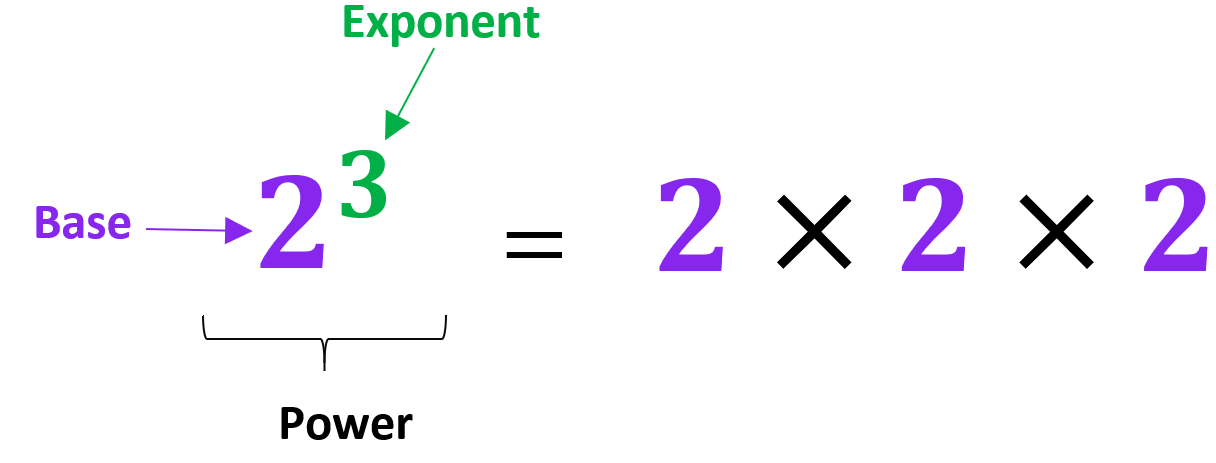
A power consists of a base and an exponent.
\(a^n\)
| Part | Meaning |
|---|---|
| Base | The number being multiplied |
| Exponent | The number of times the base is used as a factor |
For example:
\(2^5=2\times2\times2\times2\times2=32\)
Here, \(2\) is the base and \(5\) is the exponent.
Common Powers
| Power | Expanded Form | Value |
|---|---|---|
| \(3^2\) | \(3\times3\) | \(9\) |
| \(4^3\) | \(4\times4\times4\) | \(64\) |
| \(10^4\) | \(10\times10\times10\times10\) | \(10\,000\) |
Powers with Negative Bases
When a negative number is raised to a power, the brackets are important.
- \((-3)^2=(-3)(-3)=9\)
- \((-3)^3=(-3)(-3)(-3)=-27\)
An even exponent gives a positive result when the base is negative.
An odd exponent gives a negative result when the base is negative.
Laws of Exponents
The laws of exponents allow powers to be simplified without expanding every factor.
1. Multiplying Powers with the Same Base
When multiplying powers with the same base, add the exponents.
\(a^m\times a^n=a^{m+n}\)
Example:
\(2^3\times2^4=2^{3+4}=2^7\)
2. Dividing Powers with the Same Base
When dividing powers with the same base, subtract the exponents.
\(\dfrac{a^m}{a^n}=a^{m-n}\), where \(a\neq0\)
Example:
\(\dfrac{5^6}{5^2}=5^{6-2}=5^4\)
3. Power of a Power
When a power is raised to another power, multiply the exponents.
\((a^m)^n=a^{mn}\)
Example:
\((3^2)^4=3^{2\times4}=3^8\)
4. Power of a Product
An exponent applied to a product applies to each factor.
\((ab)^n=a^n b^n\)
Example:
\((2\times5)^3=2^3\times5^3\)
5. Power of a Quotient
An exponent applied to a quotient applies to both the numerator and denominator.
\(\left(\dfrac{a}{b}\right)^n=\dfrac{a^n}{b^n}\), where \(b\neq0\)
Example:
\(\left(\dfrac{2}{3}\right)^2=\dfrac{2^2}{3^2}=\dfrac{4}{9}\)
| Law | Rule |
|---|---|
| Multiply same bases | \(a^m\times a^n=a^{m+n}\) |
| Divide same bases | \(\dfrac{a^m}{a^n}=a^{m-n}\) |
| Power of a power | \((a^m)^n=a^{mn}\) |
| Power of a product | \((ab)^n=a^n b^n\) |
| Power of a quotient | \(\left(\dfrac{a}{b}\right)^n=\dfrac{a^n}{b^n}\) |
Zero and Negative Exponents
Zero Exponent
Any non-zero number raised to the power \(0\) equals \(1\).
\(a^0=1\), where \(a\neq0\)
For example:
\(7^0=1\)
Negative Exponents
A negative exponent means the reciprocal of the corresponding positive power.
\(a^{-n}=\dfrac{1}{a^n}\), where \(a\neq0\)
For example:
\(2^{-3}=\dfrac{1}{2^3}=\dfrac{1}{8}\)
A negative exponent does not make the value negative.
For example, \(2^{-3}=\dfrac{1}{8}\), not \(-8\).
Distributive Law
The distributive law is used to multiply a number or term by every term inside a bracket.
\(a(b+c)=ab+ac\)
For example:
\(3(x+4)\)
\(=3x+12\)
The same rule applies when subtracting:
\(a(b-c)=ab-ac\)
For example:
\(5(2x-3)\)
\(=10x-15\)
The term outside the bracket must be multiplied by every term inside the bracket.
Expansion Laws
Expanding means removing brackets by using multiplication and the distributive law.
Expanding a Single Bracket
\(a(b+c)=ab+ac\)
Example:
\(4(3x+2)\)
\(=12x+8\)
Expanding Two Brackets
When multiplying two brackets, each term in the first bracket must be multiplied by each term in the second bracket.
\((a+b)(c+d)\)
\(=ac+ad+bc+bd\)
For example:
\((x+3)(x+5)\)
\(=x^2+5x+3x+15\)
\(=x^2+8x+15\)
Expansion of a Difference
Be especially careful with negative signs.
\((x-4)(x+2)\)
\(=x^2+2x-4x-8\)
\(=x^2-2x-8\)
Special Expansion Laws
Some common expansions can be remembered as identities.
\((a+b)^2=a^2+2ab+b^2\)
\((a-b)^2=a^2-2ab+b^2\)
For example:
\((x+3)^2\)
\(=x^2+2(x)(3)+3^2\)
\(=x^2+6x+9\)
Difference of Two Squares
\(a^2-b^2=(a-b)(a+b)\)
For example:
\(x^2-25\)
\(=x^2-5^2\)
\(=(x-5)(x+5)\)
Factorisation
Factorisation is the reverse process of expansion. It involves writing an expression as a product of factors.
Factorising by Taking Out a Common Factor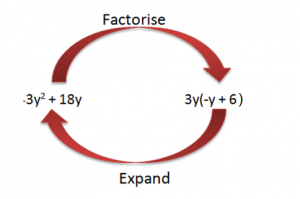
First identify the greatest common factor of all the terms, then take it outside the bracket.
For example:
\(6x+12\)
The common factor is \(6\).
\(6x+12=6(x+2)\)
Another example:
\(15x^2+10x\)
The greatest common factor is \(5x\).
\(15x^2+10x=5x(3x+2)\)
Factorising Quadratic Expressions
For a quadratic expression of the form:
\(x^2+bx+c\)
find two numbers whose:
- product is \(c\)
- sum is \(b\)
For example:
\(x^2+7x+12\)
We need two numbers whose product is \(12\) and whose sum is \(7\).
The numbers are \(3\) and \(4\).
\(x^2+7x+12=(x+3)(x+4)\)
Factorising a Difference of Squares
Use:
\(a^2-b^2=(a-b)(a+b)\)
For example:
\(x^2-16\)
\(=x^2-4^2\)
\(=(x-4)(x+4)\)
After factorising, expand your answer to check that it gives the original expression.
Scientific Notation
Scientific notation is used to represent very large or very small numbers in a compact form.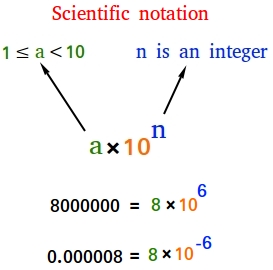
\(a\times10^n\)
where:
- \(1\leq a<10\)
- \(n\) is an integer.
The number \(a\) is called the coefficient, and \(n\) is the power of \(10\).
Large Numbers
For a large number, the exponent of \(10\) is positive.
\(450\,000=4.5\times10^5\)
The decimal point has moved \(5\) places to the left.
Small Numbers
For a number between \(0\) and \(1\), the exponent of \(10\) is negative.
\(0.00072=7.2\times10^{-4}\)
The decimal point has moved \(4\) places to the right.
| Number | Scientific Notation |
|---|---|
| \(72\,000\) | \(7.2\times10^4\) |
| \(3\,500\,000\) | \(3.5\times10^6\) |
| \(0.0048\) | \(4.8\times10^{-3}\) |
| \(0.000091\) | \(9.1\times10^{-5}\) |
Converting Scientific Notation to Ordinary Form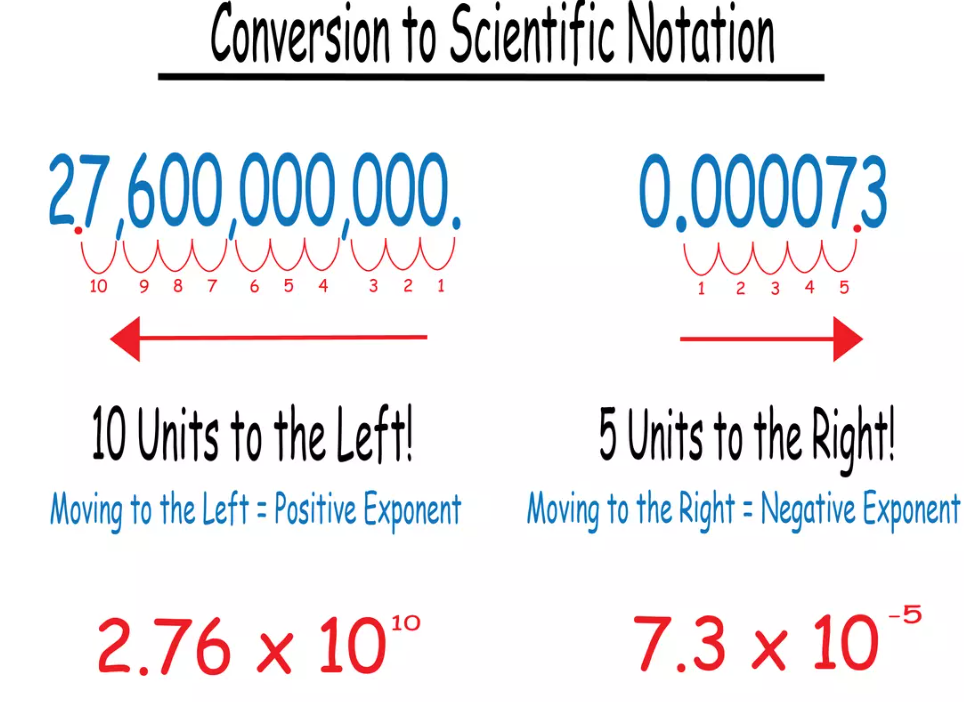
The exponent tells you how many places to move the decimal point.
Positive exponent → move right.
\(3.6\times10^4=36\,000\)
Negative exponent → move left.
\(3.6\times10^{-4}=0.00036\)
The first number must always satisfy \(1\leq a<10\).
For example, \(45\times10^3\) is not correctly written in scientific notation because \(45\) is greater than \(10\).
Rewrite it as:
\(45\times10^3=4.5\times10^4\)
Multiplying Numbers in Scientific Notation
To multiply numbers in scientific notation:
- Multiply the coefficients.
- Add the exponents.
- Rewrite the result in correct scientific notation if necessary.
\((3\times10^4)(2\times10^5)\)
\(=6\times10^9\)
Dividing Numbers in Scientific Notation
To divide numbers in scientific notation:
- Divide the coefficients.
- Subtract the exponent in the denominator from the exponent in the numerator.
- Rewrite the result in correct scientific notation if necessary.
\(\dfrac{8\times10^7}{2\times10^3}\)
\(=4\times10^{7-3}\)
\(=4\times10^4\)
Example 1:
Simplify and write each answer using positive exponents.
a) \(2^4\times2^3\)
b) \(\dfrac{5^7}{5^3}\)
c) \((3^2)^3\)
d) \(4^{-2}\)
e) \(\dfrac{2^5\times2^{-2}}{2^2}\)
▶️ Answer/Explanation
Answer
a)
\(2^4\times2^3=2^{4+3}=2^7\)
b)
\(\dfrac{5^7}{5^3}=5^{7-3}=5^4\)
c)
\((3^2)^3=3^{2\times3}=3^6\)
d)
\(4^{-2}=\dfrac{1}{4^2}=\dfrac{1}{16}\)
e)
\(\dfrac{2^5\times2^{-2}}{2^2}=2^{5+(-2)-2}\)
\(=2^1=2\)
Final answers: \(2^7,\;5^4,\;3^6,\;\dfrac{1}{16},\;2\)
Example 2:
A scientist records the mass of a microscopic particle as \(0.0000000048\) grams. Another measurement is \(3.2\times10^6\) grams.
a) Write \(0.0000000048\) in scientific notation.
b) Write \(3.2\times10^6\) in ordinary decimal form.
c) Calculate \((4.8\times10^{-9})(3.2\times10^6)\) and give your answer in scientific notation.
d) Calculate \(\dfrac{9.6\times10^8}{3.2\times10^4}\) and give your answer in scientific notation.
▶️ Answer/Explanation
Answer
a) Convert to scientific notation
Move the decimal point \(9\) places to the right:
\(0.0000000048=4.8\times10^{-9}\)
b) Convert to ordinary form
The exponent is positive, so move the decimal point \(6\) places to the right:
\(3.2\times10^6=3\,200\,000\)
c) Multiplication
Multiply the coefficients and add the exponents:
\((4.8\times10^{-9})(3.2\times10^6)\)
\(=(4.8\times3.2)\times10^{-9+6}\)
\(=15.36\times10^{-3}\)
The coefficient must be between \(1\) and \(10\), so:
\(15.36\times10^{-3}=1.536\times10^{-2}\)
Therefore, \(1.536\times10^{-2}\).
d) Division
\(\dfrac{9.6\times10^8}{3.2\times10^4}\)
\(=\dfrac{9.6}{3.2}\times10^{8-4}\)
\(=3\times10^4\)
Therefore, \(3\times10^4\).
Example 3:
a) Expand \(3(2x-5)\).
b) Expand \((x+4)(x+2)\).
c) Factorise \(8x+24\).
d) Factorise \(x^2+9x+20\).
▶️ Answer/Explanation
Answer
a)
\(3(2x-5)=6x-15\)
b)
\((x+4)(x+2)\)
\(=x^2+2x+4x+8\)
\(=x^2+6x+8\)
c)
\(8x+24=8(x+3)\)
d)
Two numbers with product \(20\) and sum \(9\) are \(4\) and \(5\).
\(x^2+9x+20=(x+4)(x+5)\)
Example 4:
Simplify or factorise each expression.
a) \(2^3\times2^4\)
b) \(5^{-2}\)
c) \(4(x+3)-2(x-1)\)
d) \(x^2-49\)
e) \(x^2+11x+24\)
▶️ Answer/Explanation
Answer
a)
\(2^3\times2^4=2^{3+4}=2^7\)
b)
\(5^{-2}=\dfrac{1}{5^2}=\dfrac{1}{25}\)
c)
\(4(x+3)-2(x-1)\)
\(=4x+12-2x+2\)
\(=2x+14\)
d)
\(x^2-49=x^2-7^2\)
\(=(x-7)(x+7)\)
e)
Two numbers with product \(24\) and sum \(11\) are \(3\) and \(8\).
\(x^2+11x+24=(x+3)(x+8)\)