
1.5 – Ratio, Proportion and Percentage
Ratios, proportions and percentages are different ways of describing relationships between quantities. They are widely used to compare amounts, scale quantities, solve problems and describe changes.
Ratios
A ratio compares two or more quantities measured in the same units.
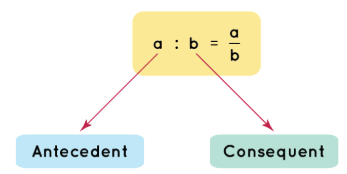
A ratio can be written using:
- a colon: \(3:5\)
- a fraction: \(\dfrac{3}{5}\)
- words: \(3\text{ to }5\)
For example, if a class contains \(12\) boys and \(18\) girls, the ratio of boys to girls is:
\(12:18\)
Divide both parts by their greatest common factor, \(6\):
\(12:18=2:3\)
Therefore, the simplest ratio of boys to girls is \(2:3\).
When simplifying a ratio, divide every part of the ratio by the same non-zero number.
Equivalent Ratios
Equivalent ratios represent the same relationship. 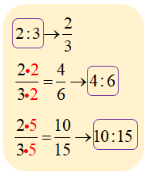
\(2:3=4:6=6:9=10:15\)
The ratio remains equivalent as long as both parts are multiplied or divided by the same number.
Example:
\(5:7\)
Multiplying both parts by \(4\):
\(5\times4:7\times4=20:28\)
Therefore:
\(5:7=20:28\)
Sharing a Quantity in a Given Ratio
To divide a quantity according to a ratio:
- Add the parts of the ratio.
- Divide the total quantity by the total number of parts.
- Multiply by each ratio part.
For example, divide \(84\) in the ratio \(3:4\).
\(3+4=7\)
Each part represents:
\(84\div7=12\)
Therefore:
\(3\times12=36\)
\(4\times12=48\)
Answer: \(36:48\)
Check:
\(36+48=84\)
Proportion
A proportion states that two ratios or fractions are equal.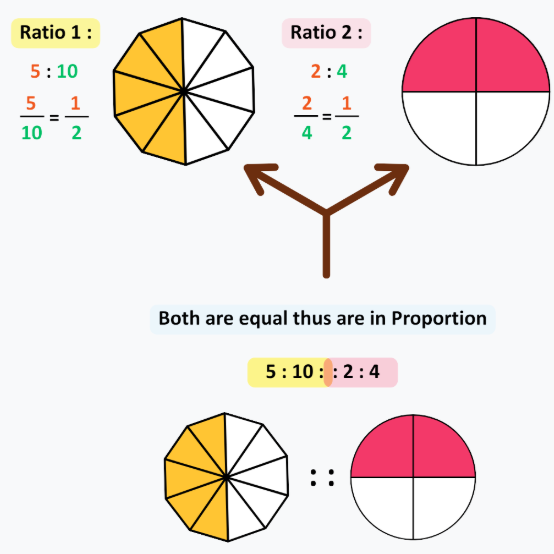
\(\dfrac{a}{b}=\dfrac{c}{d}\)
One useful method for solving a proportion is cross multiplication.
\(\dfrac{a}{b}=\dfrac{c}{d}\)
\(ad=bc\)
For example:
\(\dfrac{5}{8}=\dfrac{x}{24}\)
Cross multiply:
\(5\times24=8x\)
\(120=8x\)
\(x=15\)
Answer: \(x=15\)
Direct Proportion
Two quantities are in direct proportion when one quantity increases or decreases by a constant factor and the other changes by the same factor.
The relationship can be written as: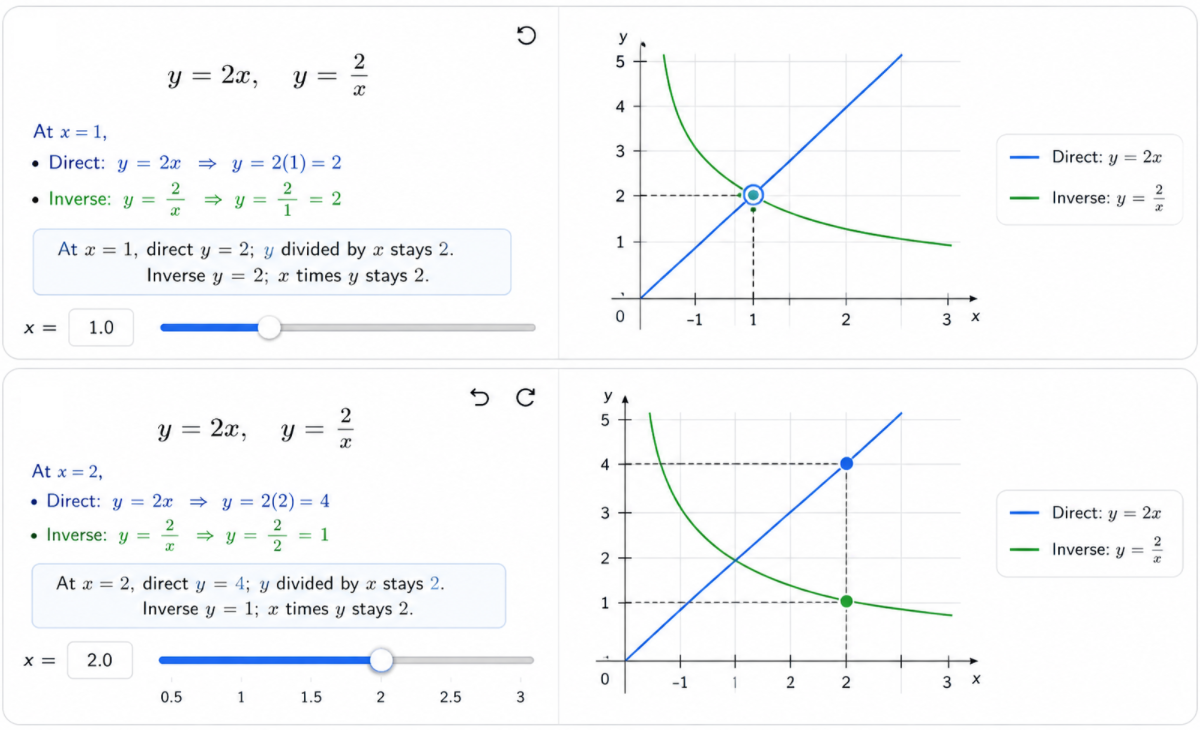
\(y=kx\)
where \(k\) is the constant of proportionality.
For example, if \(5\) notebooks cost \(\$20\), then the cost per notebook is:
\(20\div5=4\)
So the cost is directly proportional to the number of notebooks:
\(C=4n\)
Therefore, \(8\) notebooks cost:
\(C=4(8)=32\)
Answer: \(\$32\)
Percentages
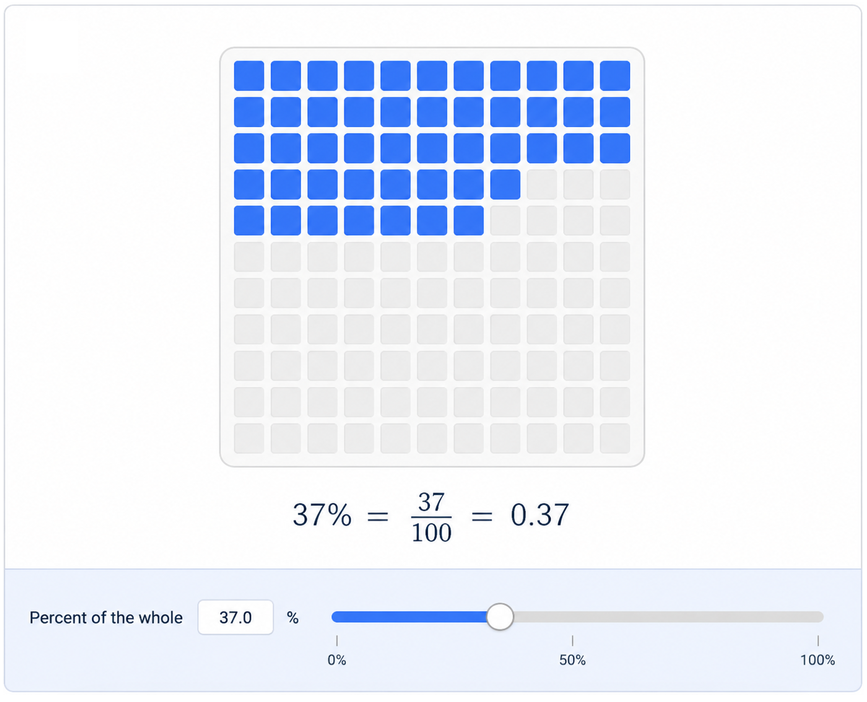
A percentage represents a quantity out of \(100\).
\(1\%=\dfrac{1}{100}=0.01\)
The three equivalent forms are:
| Percentage | Fraction | Decimal |
|---|---|---|
| \(25\%\) | \(\dfrac{25}{100}=\dfrac14\) | \(0.25\) |
| \(50\%\) | \(\dfrac{50}{100}=\dfrac12\) | \(0.5\) |
| \(75\%\) | \(\dfrac{75}{100}=\dfrac34\) | \(0.75\) |
| \(10\%\) | \(\dfrac{10}{100}=\dfrac{1}{10}\) | \(0.1\) |
Converting Percentages into Decimals and Fractions
A percentage means “out of \(100\)”. Therefore, a percentage can be converted into a fraction by placing it over \(100\), and into a decimal by dividing by \(100\).
Percentage → Fraction
\(35\%=\dfrac{35}{100}=\dfrac{7}{20}\)
Percentage → Decimal
\(35\%=0.35\)
To convert a percentage to a decimal, divide by \(100\) or move the decimal point two places to the left.
Converting Decimals and Fractions into Percentages
Decimal → Percentage
Multiply the decimal by \(100\%\).
\(0.42\times100\%=42\%\)
Fraction → Percentage
Convert the fraction to a decimal or multiply by \(100\%\).
\(\dfrac{3}{5}\times100\%=60\%\)
Example:
\(\dfrac{7}{8}\times100\%=87.5\%\)
The Unitary Method for Percentages
The unitary method finds the value of \(1\%\) first and then uses it to find the required percentage.
For example, find \(18\%\) of \(450\).
First find \(1\%\):
\(450\div100=4.5\)
Then find \(18\%\):
\(4.5\times18=81\)
Answer: \(81\)
Find \(1\%\) → multiply by the required percentage.
Finding a Percentage Change
Percentage change measures how much a quantity has changed compared with its original value.
\(\text{Percentage change}=\dfrac{|\text{New value}-\text{Original value}|}{\text{Original value}}\times100\%\)
- If the new value is greater, the result is a percentage increase.
- If the new value is smaller, the result is a percentage decrease.
For example, a quantity changes from \(80\) to \(92\).
\(\text{Change}=92-80=12\)
\(\text{Percentage change}=\dfrac{12}{80}\times100\%=15\%\)
Answer: \(15\%\) increase.
Finding the Original Amount
When the final amount and percentage change are known, the original amount can be found using the percentage multiplier.
After an increase of \(p\%\):
\(\text{Original}=\dfrac{\text{Final}}{1+\frac{p}{100}}\)
After a decrease of \(p\%\):
\(\text{Original}=\dfrac{\text{Final}}{1-\frac{p}{100}}\)
Example: A jacket costs \(\$144\) after a \(20\%\) discount. Find its original price.
\(\text{Multiplier}=1-0.20=0.80\)
\(\text{Original}=\dfrac{144}{0.80}=\$180\)
Answer: \(\$180\)
Profit and Loss
When an item is bought and then sold, the difference between the selling price and cost price determines whether there is a profit or loss.
Profit: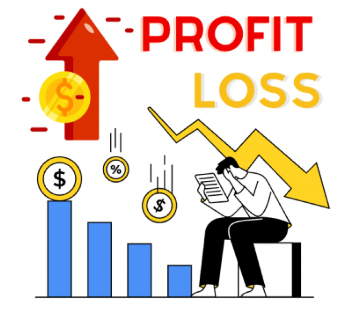
\(\text{Profit}=\text{Selling Price}-\text{Cost Price}\)
Loss:
\(\text{Loss}=\text{Cost Price}-\text{Selling Price}\)
Profit Percentage:
\(\text{Profit\%}=\dfrac{\text{Profit}}{\text{Cost Price}}\times100\%\)
Loss Percentage:
\(\text{Loss\%}=\dfrac{\text{Loss}}{\text{Cost Price}}\times100\%\)
Example: An item is bought for \(\$240\) and sold for \(\$300\).
\(\text{Profit}=300-240=60\)
\(\text{Profit\%}=\dfrac{60}{240}\times100\%=25\%\)
Answer: \(25\%\) profit.
Discount
A discount is a reduction in the marked or original price of an item.
Discount amount:
\(\text{Discount}=\dfrac{\text{Discount\%}}{100}\times\text{Original Price}\)
Sale price:
\(\text{Sale Price}=\text{Original Price}-\text{Discount}\)
Alternatively:
\(\text{Sale Price}=\text{Original Price}\times\left(1-\dfrac{\text{Discount\%}}{100}\right)\)
Example: A phone costs \(\$800\) and is discounted by \(15\%\).
\(\text{Discount}=0.15\times800=\$120\)
\(\text{Sale Price}=800-120=\$680\)
Answer: \(\$680\)
VAT and GST
VAT (Value Added Tax) and GST (Goods and Services Tax) are taxes added to the price of goods or services. The calculation is the same percentage method; the tax rate depends on the situation.
Tax amount:
\(\text{Tax}=\dfrac{\text{Tax Rate}}{100}\times\text{Price}\)
Price including tax:
\(\text{Final Price}=\text{Price}+\text{Tax}\)
Or using a multiplier:
\(\text{Final Price}=\text{Price}\times\left(1+\dfrac{\text{Tax Rate}}{100}\right)\)
Example: A service costs \(\$500\) before tax and the applicable tax rate is \(10\%\).
\(\text{Tax}=0.10\times500=\$50\)
\(\text{Final Price}=500+50=\$550\)
Answer: \(\$550\)
For profit and loss percentages, the reference amount is normally the cost price.
For percentage increase or decrease, the reference amount is the original value.
For discounts, the reference amount is the marked/original price.
For VAT or GST, the tax is calculated from the pre-tax price.
Finding a Percentage of a Quantity
To find a percentage of a quantity, convert the percentage to a decimal and multiply.
\(\text{Percentage of quantity}=\dfrac{p}{100}\times\text{quantity}\)
For example, find \(35\%\) of \(240\).
\(35\%=\dfrac{35}{100}=0.35\)
\(0.35\times240=84\)
Answer: \(84\)
Finding What Percentage One Quantity Is of Another
To find what percentage one quantity represents of another:
\(\text{Percentage}=\dfrac{\text{part}}{\text{whole}}\times100\%\)
For example, \(18\) students out of \(30\) completed a task.
\(\dfrac{18}{30}\times100\%=60\%\)
Therefore, \(60\%\) of the students completed the task.
Percentage increase and percentage decrease are always calculated relative to the original value.
Reverse Percentages
Sometimes the final value is known and the original value must be found.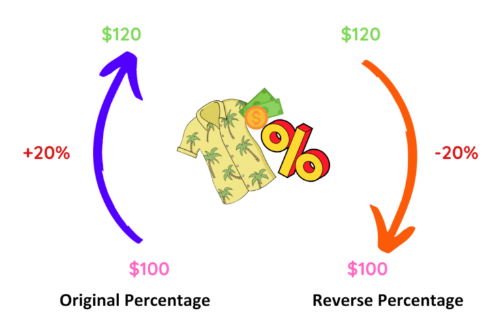
If a quantity has increased by \(20\%\), the final value is \(120\%\) of the original:
\(\text{Final value}=1.20\times\text{Original value}\)
Therefore:
\(\text{Original value}=\dfrac{\text{Final value}}{1.20}\)
For example, after a \(20\%\) increase, a price is \(\$180\). Find the original price.
\(\text{Original}=\dfrac{180}{1.20}=150\)
Answer: \(\$150\)
📌 MYP Problem-Solving Strategy
When solving a ratio, proportion or percentage problem:
1. Identify the quantities being compared.
2. Make sure the units are consistent.
3. Simplify ratios where appropriate.
4. Use equivalent ratios or a proportion to find an unknown quantity.
5. For percentage change, always use the original value as the reference.
6. Check whether your answer is reasonable.
Example 1:
A school has \(360\) students. The ratio of students who participate in sports to students who do not participate is \(5:4\).
a) Find the number of students who participate in sports.
b) Find the percentage of students who participate in sports.
c) The school wants to increase the number of sports participants by \(15\%\). How many students would participate after the increase?
d) If \(414\) students participate after the increase, determine whether this is a \(15\%\) increase from the original number.
▶️ Answer/Explanation
Answer
a) Find the number of sports participants.
Total parts:
\(5+4=9\)
Each part represents:
\(360\div9=40\)
Sports participants:
\(5\times40=200\)
Answer: \(200\) students.
b) Find the percentage.
\(\dfrac{200}{360}\times100\%=55.555\ldots\%\)
Answer: approximately \(55.6\%\).
c) Increase by \(15\%\).
The multiplier is:
\(1+\dfrac{15}{100}=1.15\)
Therefore:
\(200\times1.15=230\)
Answer: \(230\) students.
d) Check whether \(414\) represents a \(15\%\) increase.
The increase is:
\(414-360=54\)
Percentage increase:
\(\dfrac{54}{360}\times100\%=15\%\)
Therefore, yes, \(414\) represents a \(15\%\) increase from \(360\).
Example 2:
A recipe uses flour and sugar in the ratio \(7:3\). A baker uses \(420\) g of flour.
a) Find the amount of sugar required.
b) Find the total mass of flour and sugar.
c) The baker increases the total recipe by \(25\%\). Find the new total mass.
d) The new total mass is later reduced by \(20\%\). Find the final mass.
▶️ Answer/Explanation
Answer
a) Find the amount of sugar.
The ratio is \(7:3\).
If \(7\) parts represent \(420\) g, then one part is:
\(420\div7=60\text{ g}\)
Sugar represents \(3\) parts:
\(3\times60=180\text{ g}\)
Answer: \(180\) g.
b) Find the total mass.
\(420+180=600\text{ g}\)
Answer: \(600\) g.
c) Increase the total by \(25\%\).
Multiplier:
\(1+\dfrac{25}{100}=1.25\)
New mass:
\(600\times1.25=750\text{ g}\)
Answer: \(750\) g.
d) Reduce the new mass by \(20\%\).
Multiplier:
\(1-\dfrac{20}{100}=0.80\)
Final mass:
\(750\times0.80=600\text{ g}\)
Answer: \(600\) g.
⭐ Important Observation:
A \(25\%\) increase followed by a \(20\%\) decrease does not mean the quantity has returned to its original value in every situation. Here it does because the multipliers are \(1.25\) and \(0.80\):
\(1.25\times0.80=1\)