
2.2 – Union, Intersection and Complement of Sets
Sets can be combined and compared using three important operations: intersection, union, and complement. These operations help us describe which elements belong to one set, both sets, or neither set.
Intersection of Sets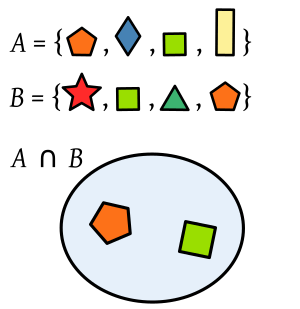
The intersection of two sets contains the elements that are found in both sets.
The symbol for intersection is:
\(A\cap B\)
Read this as “A intersection B” or “A and B”.
For example:
\(A=\{2,4,6,8,10\}\)
\(B=\{4,8,12,16\}\)
The elements common to both sets are \(4\) and \(8\).
\(A\cap B=\{4,8\}\)
Intersection means BOTH.
Look only for elements that occur in every set being considered.
Disjoint Sets
Two sets are disjoint if they have no elements in common.
Therefore, their intersection is the empty set:
\(A\cap B=\varnothing\)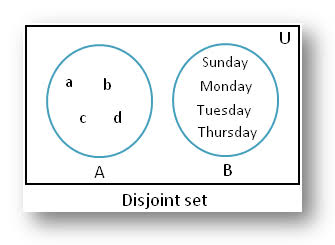
For example:
\(A=\{1,3,5,7\}\)
\(B=\{2,4,6,8\}\)
There are no common elements, so:
\(A\cap B=\varnothing\)
Union of Sets
The union of two sets contains all elements that are in A, B, or both.
The symbol for union is: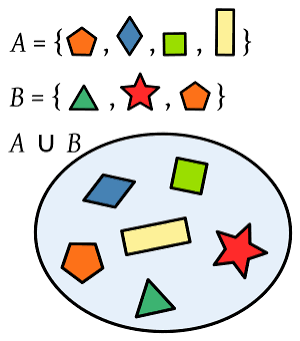
\(A\cup B\)
Read this as “A union B” or “A or B”.
For example:
\(A=\{2,4,6,8\}\)
\(B=\{4,8,10,12\}\)
Collect all distinct elements from both sets:
\(A\cup B=\{2,4,6,8,10,12\}\)
Notice that \(4\) and \(8\) are written only once, even though they occur in both sets.
Union means EVERYTHING in either set.
“Or” in set notation includes the possibility of both.
Universal Set
The universal set contains every element being considered in a particular problem.
It is usually represented by \(U\).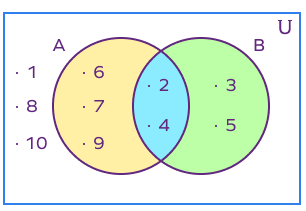
For example, if we are considering the whole numbers from \(1\) to \(10\):
\(U=\{1,2,3,4,5,6,7,8,9,10\}\)
A set \(A\) must be considered within its universal set \(U\).
Complement of a Set
The complement of a set \(A\) contains all the elements in the universal set \(U\) that are not in \(A\).
The complement of \(A\) is written as: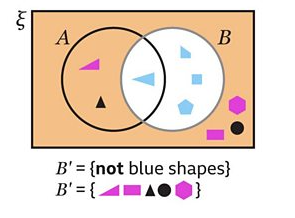
\(A’\)
For example:
\(U=\{1,2,3,4,5,6,7,8,9,10\}\)
\(A=\{2,4,6,8,10\}\)
The elements of \(U\) that are not in \(A\) are \(1,3,5,7,9\).
\(A’=\{1,3,5,7,9\}\)
The complement depends on the universal set. Always identify \(U\) before finding \(A’\).
Number of Elements in a Union
When counting the number of elements in \(A\cup B\), elements in the intersection would otherwise be counted twice.
Therefore:
\(n(A\cup B)=n(A)+n(B)-n(A\cap B)\)
For example, suppose:
\(n(A)=18\)
\(n(B)=15\)
\(n(A\cap B)=6\)
Then:
\(n(A\cup B)=18+15-6\)
\(n(A\cup B)=27\)
Answer: \(27\) elements.
Complement and Number of Elements
Since every element of the universal set is either in \(A\) or in \(A’\):
\(n(A)+n(A’)=n(U)\)
Therefore:
\(n(A’)=n(U)-n(A)\)
For example, if \(n(U)=50\) and \(n(A)=32\):
\(n(A’)=50-32=18\)
Answer: \(18\) elements are outside \(A\).
Comparing the Three Operations
| Operation | Symbol | Meaning | Key Word |
|---|---|---|---|
| Intersection | \(A\cap B\) | Elements in both \(A\) and \(B\) | AND / BOTH |
| Union | \(A\cup B\) | Elements in \(A\), \(B\), or both | OR |
| Complement | \(A’\) | Elements in \(U\) but not in \(A\) | NOT |
When reading a question, identify the key words first:
“and” / “both” → \(A\cap B\)
“or” / “either” → \(A\cup B\)
“not” / “outside” → complement \(A’\)
“A but not B” → elements in \(A\) excluding the intersection.
Example 1:
Let the universal set be:
\(U=\{1,2,3,4,5,6,7,8,9,10,11,12\}\)
Let:
\(A=\{2,4,6,8,10,12\}\)
\(B=\{3,6,9,12\}\)
a) Find \(A\cap B\).
b) Find \(A\cup B\).
c) Find \(A’\).
d) Find \(B’\).
e) State whether \(A\) and \(B\) are disjoint.
▶️ Answer/Explanation
Answer
a) Find \(A\cap B\).
The elements common to both sets are \(6\) and \(12\).
\(A\cap B=\{6,12\}\)
[B1] Correctly identifies the common elements.
b) Find \(A\cup B\).
Collect every distinct element from both sets:
\(A\cup B=\{2,3,4,6,8,9,10,12\}\)
[B1] Includes every distinct element only once.
c) Find \(A’\).
The elements of \(U\) that are not in \(A\) are:
\(A’=\{1,3,5,7,9,11\}\)
[B1] Correctly finds the complement within \(U\).
d) Find \(B’\).
The elements of \(U\) that are not in \(B\) are:
\(B’=\{1,2,4,5,7,8,10,11\}\)
e) Are \(A\) and \(B\) disjoint?
No. They have common elements \(6\) and \(12\).
\(A\cap B\neq\varnothing\)
[B1] Correctly concludes that the sets are not disjoint.
Example 2:
In a group of \(40\) students:
- \(24\) students play football.
- \(18\) students play basketball.
- \(10\) students play both football and basketball.
Let \(F\) be the set of students who play football and \(B\) the set of students who play basketball.
a) Find the number of students who play football or basketball.
b) Find the number of students who play football only.
c) Find the number of students who play basketball only.
d) Find the number of students who play neither sport.
e) Find the number of students who do not play football.
▶️ Answer/Explanation
Answer
a) Number who play football or basketball.
Use the union formula:
\(n(F\cup B)=n(F)+n(B)-n(F\cap B)\)
\(=24+18-10\)
\(=32\)
[M1] Correctly applies the union formula.
Answer: \(32\) students.
b) Football only.
There are \(24\) football players, including the \(10\) who also play basketball.
\(24-10=14\)
[B1] Correctly removes the intersection.
Answer: \(14\) students.
c) Basketball only.
\(18-10=8\)
Answer: \(8\) students.
d) Neither sport.
There are \(32\) students in at least one of the two sets.
\(40-32=8\)
Answer: \(8\) students.
e) Do not play football.
The complement of \(F\) contains everyone who is not in \(F\):
\(n(F’)=40-24=16\)
Answer: \(16\) students.
✅ Check:
Football only \(=14\)
Both \(=10\)
Basketball only \(=8\)
Neither \(=8\)
\(14+10+8+8=40\) ✓