
2.3 – Venn Diagrams and Regions
A Venn diagram is a diagram used to represent sets and show the relationships between them. It makes it easier to identify elements that belong to one set, both sets, neither set, or a particular region.
Parts of a Venn Diagram
| Part | Meaning |
|---|---|
| Rectangle | Represents the universal set \(U\). |
| Circle | Represents a set. |
| Overlap | Represents elements common to two sets. |
| Outside the circles | Represents elements in the universal set that belong to neither set. |
One-Set Venn Diagram
A single set \(A\) is represented by a circle inside the universal set \(U\).
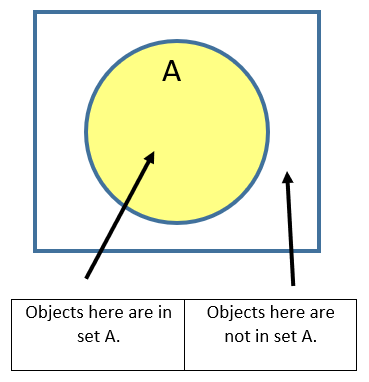
The elements inside the circle belong to \(A\), while elements outside the circle but inside the rectangle belong to \(A’\).
Inside \(A\) → elements in \(A\)
Outside \(A\), but inside \(U\) → elements in \(A’\)
Two-Set Venn Diagrams
Two sets \(A\) and \(B\) are represented by two circles inside the universal set.
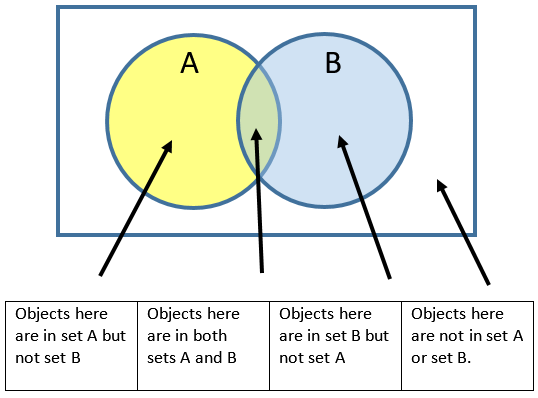
There are four important regions:
| Region | Meaning |
|---|---|
| A only | Elements in \(A\) but not in \(B\). |
| A and B | Elements in both sets: \(A\cap B\). |
| B only | Elements in \(B\) but not in \(A\). |
| Neither | Elements in \(U\) that are in neither \(A\) nor \(B\). |
Overlapping Sets
When two sets have elements in common, their circles overlap.
The overlapping region represents: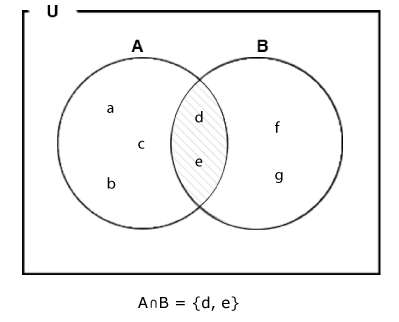
\(A\cap B\)
For example, suppose:
\(A=\{1,2,3,4,5\}\)
\(B=\{4,5,6,7\}\)
Then:
\(A\cap B=\{4,5\}\)
Therefore, \(4\) and \(5\) must be placed in the overlapping region.
Subset Venn Diagram
If every element of \(A\) is also an element of \(B\), then \(A\) is a subset of \(B\):
\(A\subseteq B\)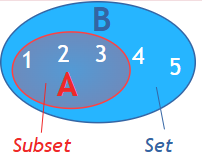
In a Venn diagram, \(A\) is drawn completely inside \(B\).
For example:
\(A=\{2,4\}\)
\(B=\{2,4,6,8\}\)
Since every element of \(A\) is in \(B\):
\(A\subseteq B\)
In this case, there is no separate \(A\)-only region because everything in \(A\) is also in \(B\).
Disjoint Sets
If two sets have no elements in common, they are disjoint.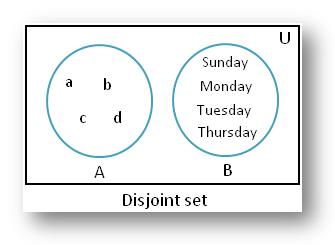
Their circles do not overlap.
\(A\cap B=\varnothing\)
For example:
\(A=\{1,3,5,7\}\)
\(B=\{2,4,6,8\}\)
No element belongs to both sets, so they are disjoint.
Shading Regions in Venn Diagrams
Venn-diagram questions may ask you to shade a particular set or combination of sets.
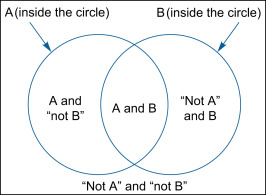
| Expression | Region to Shade |
|---|---|
| \(A\) | The entire \(A\) circle. |
| \(B\) | The entire \(B\) circle. |
| \(A\cap B\) | Only the overlapping region. |
| \(A\cup B\) | Both circles, including the overlap. |
| \(A’\) | Everything outside \(A\), but inside \(U\). |
| A but not B | The part of \(A\) outside the overlap. |
| B but not A | The part of \(B\) outside the overlap. |
| Neither A nor B | The region outside both circles. |
\(A\cup B\) includes the overlap.
\(A\cap B\) includes only the overlap.
“\(A\) but not \(B\)” excludes the overlap.
Placing Numbers in the Correct Regions
When a question gives a list of numbers and asks you to place them in a Venn diagram, check each number against the definitions of the sets.
For example, let \(U\) contain the whole numbers from \(1\) to \(12\).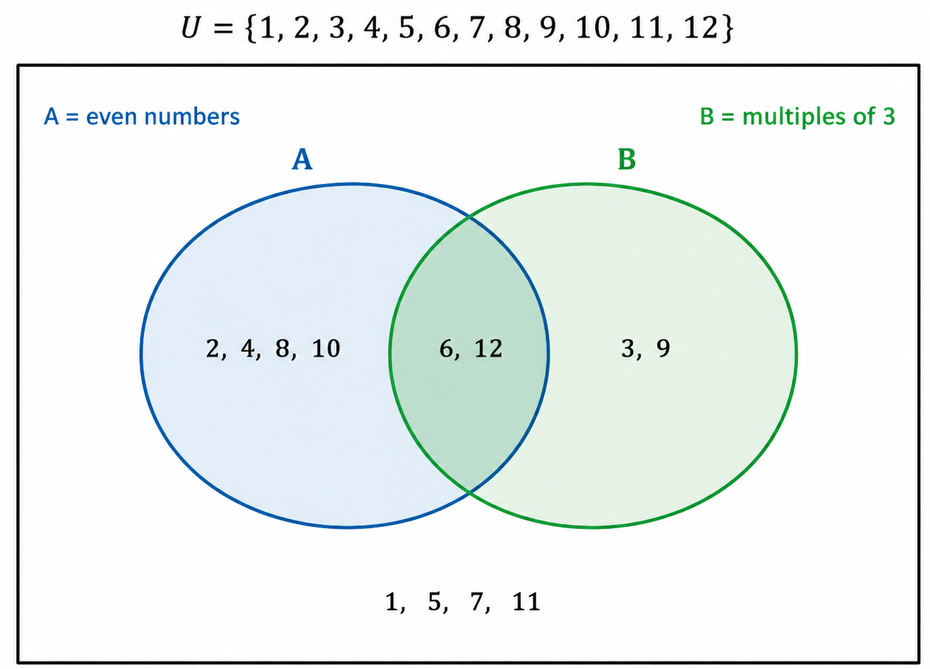
Let:
\(A=\text{even numbers}\)
\(B=\text{multiples of }3\)
A number belongs in the overlap if it is both even and a multiple of \(3\).
The numbers \(6\) and \(12\) satisfy both conditions, so:
\(A\cap B=\{6,12\}\)
The remaining even numbers go in the \(A\)-only region, while the remaining multiples of \(3\) go in the \(B\)-only region.
Number of Elements in Each Region
For two sets, the total number of elements can be divided into four regions:
If \(n(A)\), \(n(B)\), and \(n(A\cap B)\) are known:
\(\text{A only}=n(A)-n(A\cap B)\)
\(\text{B only}=n(B)-n(A\cap B)\)
And:
\(\text{Neither}=n(U)-n(A\cup B)\)
This allows a Venn diagram to be completed even when some regions are initially unknown.
Step 1: Identify the universal set.
Step 2: Identify what each circle represents.
Step 3: Fill the intersection first when the overlap is known.
Step 4: Find the \(A\)-only and \(B\)-only regions.
Step 5: Find the outside/neither region if required.
Step 6: Check that all regions add to \(n(U)\).
Example 1:
The universal set is:
\(U=\{1,2,3,\ldots,15\}\)
Let \(A\) be the set of even numbers and \(B\) be the set of multiples of \(3\).
a) List \(A\cap B\).
b) List the elements in \(A\) only.
c) List the elements in \(B\) only.
d) List the elements in neither \(A\) nor \(B\).
e) State \(n(A\cup B)\).
▶️ Answer/Explanation
Answer
a) Intersection
The even multiples of \(3\) between \(1\) and \(15\) are \(6\) and \(12\).
\(A\cap B=\{6,12\}\)
b) A only
The even numbers are \(2,4,6,8,10,12,14\). Remove \(6\) and \(12\):
\(A\text{ only}=\{2,4,8,10,14\}\)
c) B only
The multiples of \(3\) are \(3,6,9,12,15\). Remove \(6\) and \(12\):
\(B\text{ only}=\{3,9,15\}\)
d) Neither
The numbers not appearing in either circle are:
\(\{1,5,7,11,13\}\)
e) Union
There are \(5\) elements in \(A\) only, \(2\) in both, and \(3\) in \(B\) only:
\(n(A\cup B)=5+2+3=10\)
Answer: \(10\)
Example 2:
There are \(50\) students in a year group.
- \(28\) study French.
- \(22\) study Spanish.
- \(9\) study both French and Spanish.
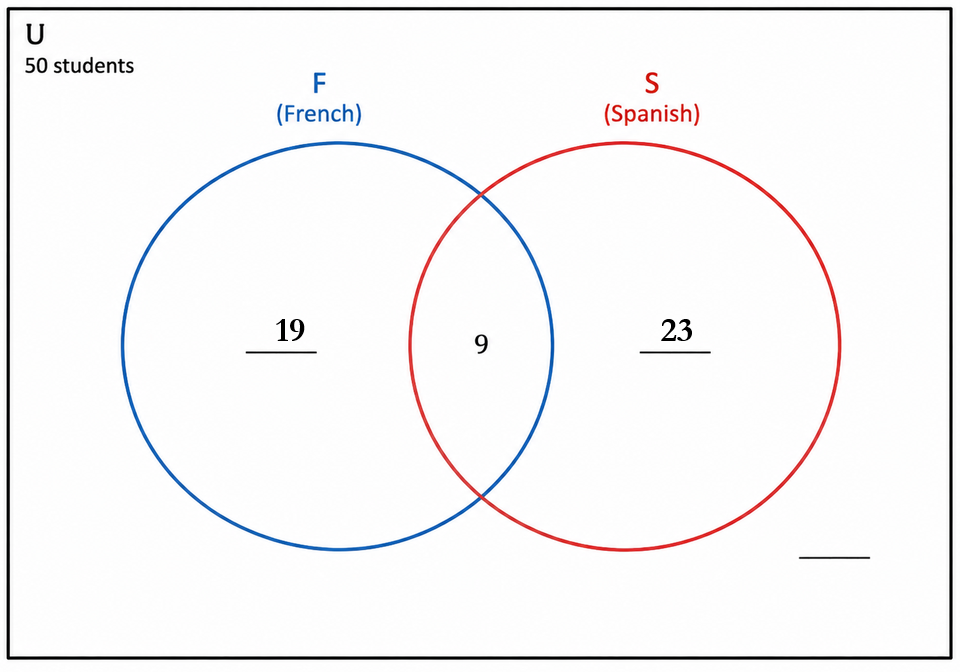
Let \(F\) represent students studying French and \(S\) represent students studying Spanish.
a) Find the number of students in the \(F\)-only region.
b) Find the number in the \(S\)-only region.
c) Find the number studying at least one of the two languages.
d) Find the number studying neither language.
e) Find the number of students outside \(F\) but inside the universal set.
▶️ Answer/Explanation
Answer
a) French only
There are \(28\) French students, including \(9\) who study both.
\(28-9=19\)
Answer: \(19\) students.
b) Spanish only
\(22-9=13\)
Answer: \(13\) students.
c) At least one language
\(19+9+13=41\)
Alternatively:
\(n(F\cup S)=28+22-9=41\)
[M1] Correctly accounts for the overlap only once.
Answer: \(41\) students.
d) Neither language
\(50-41=9\)
Answer: \(9\) students.
e) Outside \(F\)
Outside \(F\) means the complement of \(F\):
\(n(F’)=50-28=22\)
Answer: \(22\) students.
✓ Final Check:
French only \(=19\)
Both \(=9\)
Spanish only \(=13\)
Neither \(=9\)
\(19+9+13+9=50\) ✓