
2.4 – Problem Solving with Sets and Venn Diagrams
Venn diagrams are useful for solving problems involving groups, categories, and overlapping information. The key is to translate the information in the question into the correct regions of the diagram and then use the regions to find the required values.
A Systematic Method
When solving a Venn diagram problem, follow these steps:
- Identify the universal set. Determine the total number of objects or people being considered.
- Identify each set. Decide what each circle represents.
- Place the intersection first. If the number belonging to both sets is given, put it in the overlapping region.
- Find the individual regions. Subtract the intersection from each set when necessary.
- Find the union. Add all regions inside at least one circle.
- Find the neither region. Subtract the union from the universal set.
- Check the answer. All regions should add to the total of the universal set.
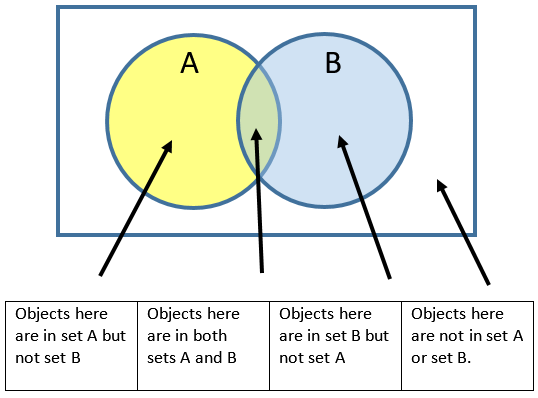
The Four Regions of a Two-Set Venn Diagram
| Region | Meaning | How to Find It |
|---|---|---|
| A only | In \(A\), but not in \(B\) | \(n(A)-n(A\cap B)\) |
| Both | In both \(A\) and \(B\) | \(n(A\cap B)\) |
| B only | In \(B\), but not in \(A\) | \(n(B)-n(A\cap B)\) |
| Neither | In neither \(A\) nor \(B\) | \(n(U)-n(A\cup B)\) |
This four-region structure is the foundation for most two-set Venn diagram problems. :contentReference[oaicite:0]{index=0}
Important Formulas
Number in the union:
\(n(A\cup B)=n(A)+n(B)-n(A\cap B)\)
The intersection is subtracted because it is counted once in \(n(A)\) and again in \(n(B)\).
Number in neither set:
\(\text{Neither}=n(U)-n(A\cup B)\)
Number in the complement:
\(n(A’)=n(U)-n(A)\)
Number in both sets:
\(n(A\cap B)=n(A)+n(B)-n(A\cup B)\)
Always be careful with the word “both”. The people or objects in both sets belong in the intersection and must not be counted twice when finding the union.
Translating Words into Set Notation
| Words in a Question | Set Notation |
|---|---|
| A and B | \(A\cap B\) |
| A or B | \(A\cup B\) |
| A but not B | A-only region |
| B but not A | B-only region |
| Neither A nor B | Outside \(A\cup B\) |
| Not A | \(A’\) |
| At least one of A or B | \(A\cup B\) |
| Both A and B | \(A\cap B\) |
Understanding this language is essential because many problems provide the information in words rather than directly giving the values of the Venn diagram regions. :contentReference[oaicite:1]{index=1}
Finding Unknown Regions
Suppose a Venn diagram contains the following information:
\(n(A)=30\)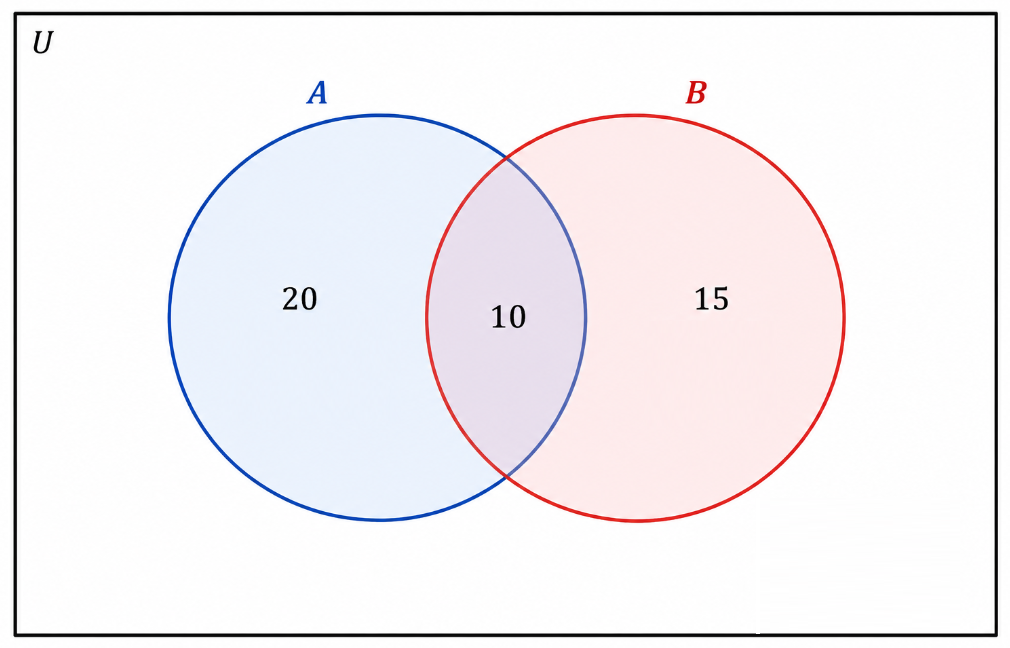
\(n(B)=25\)
\(n(A\cap B)=10\)
The \(A\)-only region is:
\(30-10=20\)
The \(B\)-only region is:
\(25-10=15\)
Therefore, the union contains:
\(20+10+15=45\)
So:
\(n(A\cup B)=45\)
This is equivalent to using the inclusion-exclusion formula:
\(n(A\cup B)=30+25-10=45\)
The same method is used in numerical-region problems involving Venn diagrams. :contentReference[oaicite:2]{index=2}
Checking a Completed Venn Diagram
A completed two-set Venn diagram should satisfy:
\(\text{A only}+\text{Both}+\text{B only}+\text{Neither}=n(U)\)
For example, if the four regions contain \(14\), \(8\), \(12\), and \(6\) objects:
\(14+8+12+6=40\)
Therefore, the universal set must contain \(40\) objects.
🎯 Exam Tip:
Do not immediately start calculating. First identify what each number represents. In particular, distinguish between:
“in A” → includes the overlap
“A only” → excludes the overlap
“in A or B” → includes the overlap
“in both” → only the overlap
“neither” → outside both circles
Example 1:
A school surveys \(60\) students about two activities. \(35\) students play football, \(28\) students play basketball, and \(12\) students play both sports.
Let \(F\) represent students who play football and \(B\) represent students who play basketball.
a) Find the number of students who play football only.
b) Find the number of students who play basketball only.
c) Find the number who play at least one of the two sports.
d) Find the number who play neither sport.
e) Find the number who do not play football.
▶️ Answer/Explanation
Answer
a) Football only
There are \(35\) football players, but \(12\) play both sports.
\(35-12=23\)
Answer: \(23\) students.
b) Basketball only
\(28-12=16\)
Answer: \(16\) students.
c) At least one sport
“At least one” means the union.
\(n(F\cup B)=35+28-12 \)
\(n(F\cup B)=51 \)
[M1] Correctly uses inclusion-exclusion.
Answer: \(51\) students.
d) Neither sport
There are \(60\) students in total.
\(\text{Neither}=60-51=9\)
Answer: \(9\) students.
e) Do not play football
“Do not play football” means \(F’\).
\(n(F’)=60-35=25\)
Answer: \(25\) students.
✓ Check:
Football only \(=23\)
Both \(=12\)
Basketball only \(=16\)
Neither \(=9\)
\(23+12+16+9=60\) ✓
Example 2:
In a group of \(80\) students, some students study French \(F\), Spanish \(S\), or both.
The following information is known:
- \(n(F)=46\)
- \(n(S)=38\)
- \(n(F\cup S)=65\)
a) Find \(n(F\cap S)\).
b) Find the number studying French only.
c) Find the number studying Spanish only.
d) Find the number studying neither language.
e) Find the number of students who study French or Spanish but not both.
▶️ Answer/Explanation
Answer
a) Find \(n(F\cap S)\).
Use:
\(n(F\cup S)=n(F)+n(S)-n(F\cap S)\)
Substitute the known values:
\(65=46+38-n(F\cap S)\)
\(65=84-n(F\cap S)\)
Therefore:
\(n(F\cap S)=84-65=19\)
[M1] Correctly rearranges the union formula.
Answer: \(19\) students study both languages.
b) French only
\(46-19=27\)
Answer: \(27\) students.
c) Spanish only
\(38-19=19\)
Answer: \(19\) students.
d) Neither language
The union contains \(65\) students.
\(80-65=15\)
Answer: \(15\) students.
e) French or Spanish but not both
This means the two non-overlapping regions only:
\(27+19=46\)
Answer: \(46\) students.
✓ Final Check:
French only \(=27\)
Both \(=19\)
Spanish only \(=19\)
Neither \(=15\)
\(27+19+19+15=80\) ✓