
3.1 – Algebraic Expressions, Substitution and Like Terms
Algebra is a way of representing unknown or changing quantities using letters, numbers and mathematical operations. Algebraic expressions allow relationships and calculations to be written in a compact form.
Algebraic Expressions
An algebraic expression is a combination of numbers, variables and operations. An expression does not contain an equals sign.
Examples include: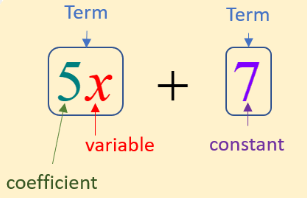
- \(3x+5\)
- \(7a-2\)
- \(4x^2+3x-8\)
- \(\dfrac{x}{5}+2\)
An expression has no equals sign: \(3x+5\).
An equation contains an equals sign: \(3x+5=20\).
Terms
A term is a number, variable, or product of numbers and variables separated by \(+\) or \(-\) signs.
Consider:
\(5x+3y-7\)
The terms are:
- \(5x\)
- \(3y\)
- \(-7\)
The sign belongs to the term that follows it.
Example:
\(4x-6y+9\)
The terms are \(4x\), \(-6y\), and \(9\).
Variables
A variable is a letter or symbol used to represent a value that can change or is unknown.
Common variables include \(x\), \(y\), \(a\), \(b\), and \(n\).
For example, in:
\(7x+4\)
\(x\) is the variable.
Coefficients
A coefficient is the numerical factor multiplying a variable.
For example, in:
\(8x\)
the coefficient of \(x\) is \(8\).
In:
\(-3y\)
the coefficient of \(y\) is \(-3\).
If no number is written, the coefficient is \(1\) or \(-1\).
\(x=1x\)
\(-x=-1x\)
Constants
A constant is a number whose value does not change.
For example, in:
\(6x+11\)
\(6\) is the coefficient and \(11\) is the constant.
Parts of an Algebraic Expression
| Expression | Variable | Coefficient | Constant |
|---|---|---|---|
| \(5x+7\) | \(x\) | \(5\) | \(7\) |
| \(-3y+4\) | \(y\) | \(-3\) | \(4\) |
| \(2a^2-5a+9\) | \(a\) | \(2,-5\) | \(9\) |
Writing Algebraic Expressions
Words can be translated into algebraic expressions.
| Words | Expression |
|---|---|
| \(5\) more than \(x\) | \(x+5\) |
| \(7\) less than \(x\) | \(x-7\) |
| \(4\) times \(x\) | \(4x\) |
| \(x\) divided by \(3\) | \(\dfrac{x}{3}\) |
| Twice \(x\) plus \(9\) | \(2x+9\) |
“\(5\) less than \(x\)” means \(x-5\), not \(5-x\).
Substitution
Substitution means replacing a variable with a known value.
For example, evaluate: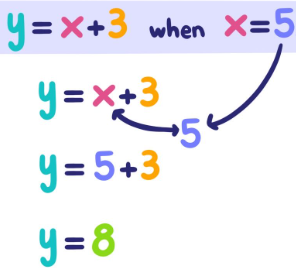
\(3x+7\)
when \(x=5\).
Replace \(x\) with \(5\):
\(3(5)+7\)
\(=15+7\)
\(=22\)
Answer: \(22\)
Substitution with Negative Numbers
When substituting a negative number, use brackets.
Evaluate \(x^2+4x-3\) when \(x=-2\).
\((-2)^2+4(-2)-3\)
\(=4-8-3\)
\(=-7\)
Answer: \(-7\)
Always put a negative value inside brackets when substituting into an expression containing powers.
For example, if \(x=-3\):
\((-3)^2=9\), but \(-3^2=-9\).
Like Terms
Like terms have exactly the same variables raised to the same powers.
Examples of like terms: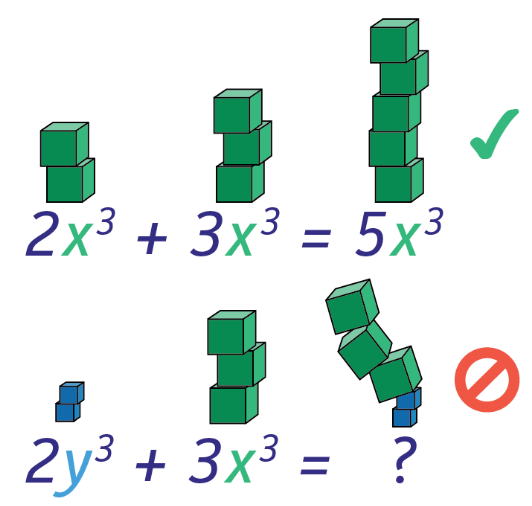
- \(3x\) and \(7x\)
- \(5a^2\) and \(-2a^2\)
- \(4xy\) and \(9xy\)
- \(6\) and \(-3\)
Examples of unlike terms:
- \(3x\) and \(3y\)
- \(x\) and \(x^2\)
- \(2ab\) and \(2a\)
Collecting Like Terms
Only like terms can be added or subtracted.
For example:
\(5x+3x=8x\)
Another example:
\(7a-2a+5\)
\(=5a+5\)
With several terms:
\(4x+7-2x+5\)
\(=4x-2x+7+5\)
\(=2x+12\)
You cannot combine unlike terms.
\(3x+4y\) cannot be simplified further because \(x\) and \(y\) are different variables.
Simplifying Algebraic Expressions
To simplify an algebraic expression:
- Identify the terms.
- Group like terms.
- Add or subtract their coefficients.
- Write the simplified expression.
Example:
\(6x+4y-2x+3y-8\)
\(=6x-2x+4y+3y-8\)
\(=4x+7y-8\)
Answer: \(4x+7y-8\)
Variable: A letter representing an unknown or changing value.
Term: A number, variable, or product separated by \(+\) or \(-\).
Coefficient: The numerical factor multiplying a variable.
Constant: A number whose value does not change.
Like terms: Terms with exactly the same variables and powers.
Substitution: Replacing a variable with a known value.
Simplify: Combine like terms to write an equivalent expression in a simpler form.
Example 1:
Consider the expression:
\(4x^2-3x+7\)
a) State the variable, coefficients and constant.
b) Evaluate the expression when \(x=2\).
c) Evaluate the expression when \(x=-2\).
▶️ Answer/Explanation
Answer
a)
Variable: \(x\)
Coefficients: \(4\) and \(-3\)
Constant: \(7\)
b) When \(x=2\):
\(4(2)^2-3(2)+7\)
\(=16-6+7\)
\(=17\)
Answer: \(17\)
c) When \(x=-2\):
\(4(-2)^2-3(-2)+7\)
\(=16+6+7\)
\(=29\)
Answer: \(29\)
Example 2:
A rectangle has length \(x+5\) cm and width \(3x-2\) cm.
a) Write an expression for the perimeter of the rectangle.
b) Simplify your expression.
c) Find the perimeter when \(x=4\).
▶️ Answer/Explanation
Answer
a) Write the perimeter expression.
The perimeter of a rectangle is:
\(P=2(\text{length})+2(\text{width})\)
Therefore:
\(P=2(x+5)+2(3x-2)\)
b) Simplify.
\(P=2x+10+6x-4\)
\(P=8x+6\)
Answer: \(P=8x+6\) cm.
c) When \(x=4\):
\(P=8(4)+6\)
\(=38\)
Answer: \(38\) cm.