
3.3 – Sequences, Patterns and Functions
Sequences and patterns describe how numbers or quantities change from one term to the next. By identifying the rule of a pattern, we can find missing terms, predict future terms and describe the relationship between the term number and its value.
Sequences
A sequence is an ordered list of numbers that follows a particular pattern or rule. Each number in a sequence is called a term.
For example:
\(4,\ 7,\ 10,\ 13,\ 16,\ldots\)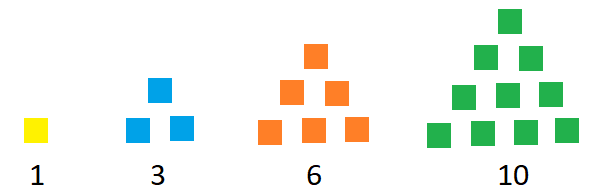
The terms are:
- 1st term: \(4\)
- 2nd term: \(7\)
- 3rd term: \(10\)
- 4th term: \(13\)
- 5th term: \(16\)
The dots \(\ldots\) indicate that the sequence continues.
Finding the Pattern
To identify a sequence rule, compare consecutive terms and look for a consistent change.
Consider: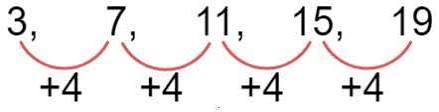
\(5,\ 9,\ 13,\ 17,\ 21,\ldots\)
Each term increases by \(4\).
\(5\rightarrow9\rightarrow13\rightarrow17\rightarrow21\)
Therefore, the term-to-term rule is:
Add \(4\).
A term-to-term rule tells you how to move from one term to the next. It does not necessarily give a direct formula for any term.
Arithmetic Sequences
An arithmetic sequence is a sequence in which the difference between consecutive terms is constant.
The constant difference is called the common difference, usually written as \(d\).
Example: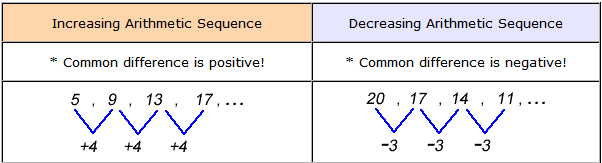
\(12,\ 17,\ 22,\ 27,\ 32,\ldots\)
The common difference is:
\(d=17-12=5\)
So the sequence increases by \(5\) each time.
Decreasing arithmetic sequence:
\(30,\ 26,\ 22,\ 18,\ 14,\ldots\)
Here:
\(d=26-30=-4\)
Therefore, the sequence decreases by \(4\) each time.
Finding the Next Terms of an Arithmetic Sequence
Once the common difference is known, continue adding or subtracting it.
For example:
\(7,\ 11,\ 15,\ 19,\ldots\)
The common difference is \(4\).
Therefore:
\(19+4=23\)
\(23+4=27\)
The next two terms are \(23\) and \(27\).
Term Number and Position
The position of a term tells us where it appears in the sequence.
| Position \(n\) | Term |
|---|---|
| \(1\) | \(5\) |
| \(2\) | \(8\) |
| \(3\) | \(11\) |
| \(4\) | \(14\) |
For an arithmetic sequence, the \(n\)th term can be found using:
\(\boxed{T_n=a+(n-1)d}\)
where:
- \(T_n\) = the \(n\)th term
- \(a\) = the first term
- \(n\) = the position of the term
- \(d\) = common difference
For the sequence \(5,8,11,14,\ldots\):
\(a=5,\quad d=3\)
Therefore:
\(T_n=5+(n-1)3\)
\(T_n=3n+2\)
The \(10\)th term is:
\(T_{10}=3(10)+2=32\)
Answer: \(32\)
Finding the Rule from the First Terms
A sequence can be represented by a rule involving its term number \(n\).
Consider:
\(4,\ 7,\ 10,\ 13,\ldots\)
The common difference is \(3\).
Using the arithmetic sequence formula:
\(T_n=4+(n-1)3\)
\(T_n=3n+1\)
Therefore, the position-to-term rule is:
\(T_n=3n+1\)
Finding a Missing Term
If a term is missing, use the common difference or the nth-term rule.
Example:
\(6,\ 10,\ \square,\ 18,\ 22\)
The common difference is \(4\).
\(10+4=14\)
Therefore, the missing term is \(14\).
Geometric Sequences
A geometric sequence is a sequence in which each term is obtained by multiplying the previous term by the same number.
The constant multiplier is called the common ratio, written as \(r\).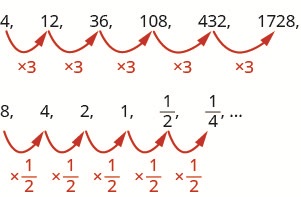
Example:
\(3,\ 6,\ 12,\ 24,\ 48,\ldots\)
Each term is multiplied by \(2\).
\(r=\dfrac{6}{3}=2\)
Another example:
\(80,\ 40,\ 20,\ 10,\ldots\)
The common ratio is:
\(r=\dfrac{40}{80}=\dfrac{1}{2}\)
Note: An arithmetic sequence has a constant difference, while a geometric sequence has a constant ratio.
Patterns
Patterns can involve numbers, shapes, diagrams or other quantities. A pattern rule describes how the pattern changes.
For example, suppose a pattern has:
| Figure | Number of tiles |
|---|---|
| 1 | 4 |
| 2 | 7 |
| 3 | 10 |
| 4 | 13 |
The number of tiles increases by \(3\) each time, so the rule is:
\(T_n=3n+1\)
This allows us to find the number of tiles in any figure without drawing all the previous figures.
Sequences as Functions
A sequence can be viewed as a function where the term number is the input and the term value is the output.
For example:
\(T_n=2n+3\)
| Input \(n\) | Output \(T_n\) |
|---|---|
| \(1\) | \(5\) |
| \(2\) | \(7\) |
| \(3\) | \(9\) |
| \(4\) | \(11\) |
For example, when \(n=8\):
\(T_8=2(8)+3=19\)
Answer: \(19\)
Sequence: An ordered list of terms following a pattern or rule.
Term: A number or value in a sequence.
Term-to-term rule: A rule describing how to obtain one term from the previous term.
Arithmetic sequence: A sequence with a constant difference.
Common difference: The amount added or subtracted between consecutive terms.
Geometric sequence: A sequence with a constant multiplier.
Common ratio: The multiplier between consecutive terms.
Position-to-term rule: A formula that gives the value of a term from its position.
Function: A rule that assigns an output to each allowed input.
Example 1:
Consider the sequence:
\(7,\ 12,\ 17,\ 22,\ldots\)
a) Find the common difference.
b) Find the next two terms.
c) Find the \(n\)th term.
d) Find the \(25\)th term.
▶️ Answer/Explanation
Answer
a)
\(d=12-7=5\)
Common difference: \(5\)
b)
\(22+5=27\)
\(27+5=32\)
Next two terms: \(27,\ 32\)
c)
\(T_n=a+(n-1)d\)
\(T_n=7+(n-1)5\)
\(T_n=5n+2\)
Answer: \(T_n=5n+2\)
d)
\(T_{25}=5(25)+2\)
\(=127\)
Answer: \(127\)
Example 2:
A sequence is given by:
\(3,\ 7,\ 11,\ 15,\ldots\)
a) Complete the table for the first four terms.
b) Find a rule for the \(n\)th term.
c) Find the \(50\)th term.
d) Determine whether \(83\) is a term of the sequence. Explain your answer.
▶️ Answer/Explanation
Answer
a)
| \(n\) | \(T_n\) |
|---|---|
| \(1\) | \(3\) |
| \(2\) | \(7\) |
| \(3\) | \(11\) |
| \(4\) | \(15\) |
b)
The common difference is \(4\).
\(T_n=3+(n-1)4\)
\(T_n=4n-1\)
Answer: \(T_n=4n-1\)
c)
\(T_{50}=4(50)-1\)
\(=199\)
Answer: \(199\)
d)
Set the rule equal to \(83\):
\(4n-1=83\)
\(4n=84\)
\(n=21\)
Since \(21\) is a positive whole-number position, \(83\) is a term of the sequence.
Answer: Yes, \(83\) is the \(21\)st term.