
4.1 – Solving Linear Equations
A linear equation is an equation in which the variable has a highest power of \(1\). Solving a linear equation means finding the value of the variable that makes the equation true.
Equations are useful for finding unknown quantities in mathematical and real-life problems. The main idea is to isolate the variable while keeping both sides of the equation balanced.
What Is an Equation?
An equation states that two expressions have the same value. The two expressions are connected by the equal sign \(=\).
Key Terms
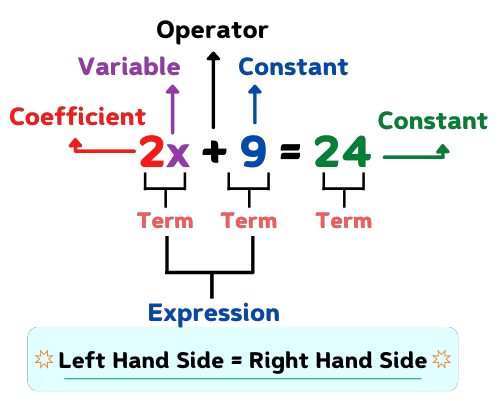
- Variable: a letter used to represent an unknown value.
- Left-hand side (LHS): the expression on the left of \(=\).
- Right-hand side (RHS): the expression on the right of \(=\).
- Solution: the value of the variable that makes the equation true.
For example, in \(5x-3=17\), the expression \(5x-3\) is the LHS and \(17\) is the RHS. The solution is \(x=4\) because both sides have the same value when \(x=4\).
Maintaining Balance
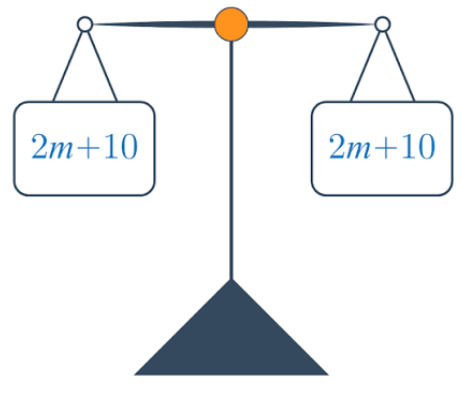
An equation can be thought of as a balanced set of scales. Whatever operation is performed on one side must also be performed on the other side.
| Operation | What must be done? |
|---|---|
| Add | Add the same amount to both sides. |
| Subtract | Subtract the same amount from both sides. |
| Multiply | Multiply both sides by the same non-zero number. |
| Divide | Divide both sides by the same non-zero number. |
Whatever you do to one side of an equation, you must do exactly the same thing to the other side.
Inverse Operations
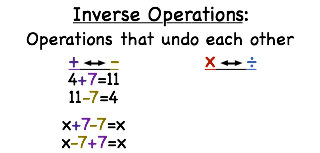
Inverse operations are operations that undo each other. They are used to isolate the variable.
| Operation | Inverse operation |
|---|---|
| Addition \(+\) | Subtraction \(-\) |
| Subtraction \(-\) | Addition \(+\) |
| Multiplication \(\times\) | Division \(\div\) |
| Division \(\div\) | Multiplication \(\times\) |
For example, if a variable has \(+7\) attached to it, subtract \(7\) to undo it. If a variable is multiplied by \(5\), divide by \(5\) to undo it.
Solving One-Step Equations
A one-step equation can be solved using one inverse operation.
Example: Solve \(x+8=15\).
\(x+8-8=15-8\)
\(x=7\)
The \(+8\) is undone by subtracting \(8\) from both sides.
Another example: Solve \(6x=42\).
\(\dfrac{6x}{6}=\dfrac{42}{6}\)
\(x=7\)
The multiplication by \(6\) is undone by dividing both sides by \(6\).
Solving Two-Step Equations
A two-step equation requires two inverse operations. The operations should normally be undone in reverse order.
For \(3x+5=20\):
\(3x+5-5=20-5\)
\(3x=15\)
\(\dfrac{3x}{3}=\dfrac{15}{3}\)
\(x=5\)
First undo addition or subtraction.
Then undo multiplication or division.
Checking a Solution
Always check a solution by substituting the value back into the original equation.
For example, if \(x=5\) is obtained from \(3x+5=20\):
RHS \(=20\)
Since LHS \(=\) RHS, \(x=5\) is correct.
Algebraic Flowcharts
A flowchart can show how an expression is built from the variable. To solve an equation, we undo the operations in reverse order.
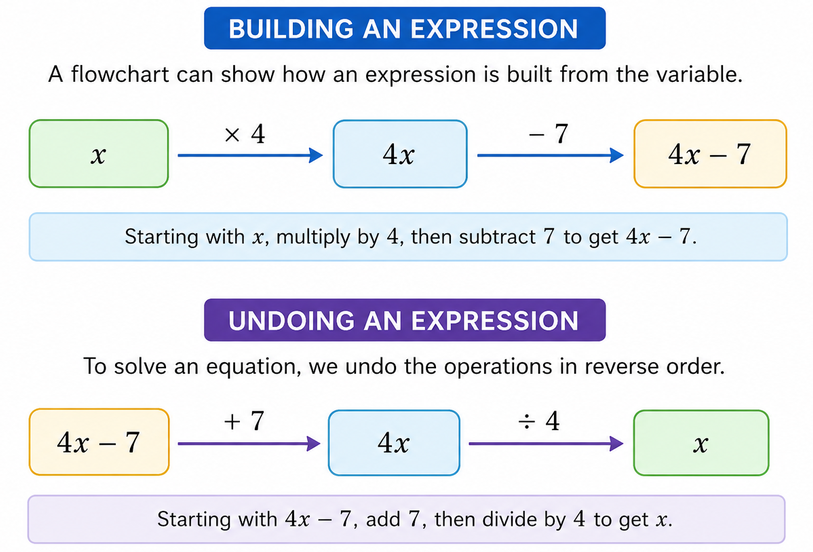
The order used to undo an expression is the reverse of the order used to build it.
Solving Equations from Word Problems
Many real-life problems can be represented using equations.
- Identify the unknown quantity.
- Choose a variable to represent it.
- Translate the information into an equation.
- Solve the equation.
- Check that the answer makes sense.
- State the answer with appropriate units.
⚠️ Common Mistakes
- Performing an operation on only one side of the equation.
- Using the wrong inverse operation.
- Forgetting to divide by the coefficient of the variable.
- Changing signs incorrectly when subtracting a negative number.
- Not checking the final answer in the original equation.
- Giving a numerical answer without units in a word problem.
Example 1:
a) Solve \(7x-9=40\).
b) Check your answer by substitution.
c) A number is multiplied by \(7\), and then \(9\) is subtracted. The result is \(40\). Find the number.
▶️ Answer/Explanation
Answer
a)
\(7x-9+9=40+9\)
\(7x=49\)
\(\dfrac{7x}{7}=\dfrac{49}{7}\)
\(x=7\)
b)
RHS \(=40\)
Therefore, LHS \(=\) RHS, so \(x=7\) is correct.
c) Let the unknown number be \(x\).
\(x=7\)
Therefore, the number is 7.
Example 2:
A school club is buying identical notebooks for its members. The club has a fixed discount of \$12 from the total cost. After the discount, the club pays \$48 for \(4\) notebooks.
a) Let \(x\) represent the price of one notebook before the discount. Write an equation.
b) Solve the equation to find the price of one notebook before the discount.
c) Check your answer.
d) Explain what the solution means in this situation.
▶️ Answer/Explanation
Answer
a) Four notebooks cost \(4x\). After subtracting the \$12 discount, the total is \$48.
b)
\(4x-12+12=48+12\)
\(4x=60\)
\(\dfrac{4x}{4}=\dfrac{60}{4}\)
\(x=15\)
c)
RHS \(=48\)
Since LHS \(=\) RHS, the solution is correct.
d) The solution \(x=15\) means that each notebook costs \$15 before the discount.