
4.3 – Simultaneous Linear Equations
Sometimes a problem contains two unknown quantities. One equation is usually not enough to determine both unknowns. In such situations, we use simultaneous linear equations.
A system of simultaneous equations consists of two or more equations that must be true at the same time.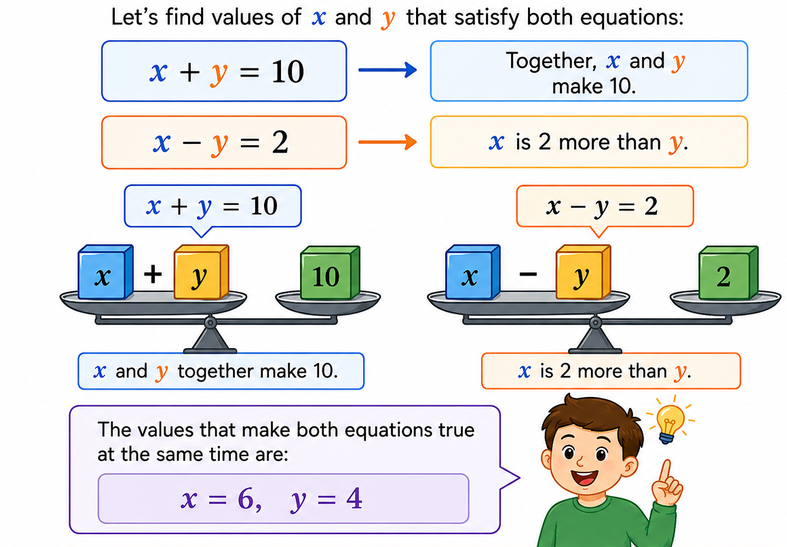
For example:
\(x-y=2\)
The values of \(x\) and \(y\) must satisfy both equations simultaneously.
What Does “Simultaneous” Mean?
Simultaneous means happening or being true at the same time.
When solving simultaneous equations, we are looking for values of the variables that make every equation in the system true at the same time.
A solution to simultaneous equations must satisfy all the equations, not just one of them.
Why Do We Need Two Equations?
Suppose we know that:
There are many possible pairs of values:
| \(x\) | \(y\) | Check |
|---|---|---|
| 2 | 10 | \(2+10=12\) |
| 5 | 7 | \(5+7=12\) |
| 8 | 4 | \(8+4=12\) |
So one equation does not give us a unique answer.
Now add a second equation:
\(x-y=4\)
The second equation gives us the additional information needed to find one pair of values.
A System of Two Linear Equations
A typical system can be written as:
\(a_2x+b_2y=c_2\)
where \(x\) and \(y\) are the unknown variables and the coefficients are constants.
| Term | Meaning |
|---|---|
| Variable | An unknown quantity, such as \(x\) or \(y\). |
| Linear equation | An equation in which the variables have highest power \(1\). |
| System | A collection of equations considered together. |
| Solution | The values of the variables that satisfy all equations. |
The Solution Is an Ordered Pair
When there are two variables, the solution is normally written as an ordered pair:
\((x,y)\)
For example, if \(x=7\) and \(y=3\), the solution is:
\((7,3)\)
\((7,3)\) means \(x=7,\ y=3\).
It is different from \((3,7)\), which means \(x=3,\ y=7\).
Checking a Solution
A proposed solution must be checked in both equations.
Consider:
\(x-y=3\)
Suppose the proposed solution is \((6,3)\).
First equation:
Second equation:
Therefore, \((6,3)\) is a solution to the system.
Substitute the values into every equation. If all equations are true, the ordered pair is a valid solution.
Solving by Inspection
Some simple systems can be solved by looking for values that satisfy both equations.
Consider:
\(x-y=5\)
We need two numbers whose:
- sum is \(11\), and
- difference is \(5\).
The numbers \(8\) and \(3\) work:
\(8-3=5\)
Therefore:
\((x,y)=(8,3)\)
For more complicated systems, systematic methods are more efficient. These include graphing, substitution, and elimination, which are developed in the next section.
Simultaneous Equations and Graphs
Each linear equation can be represented by a straight line on a coordinate plane.
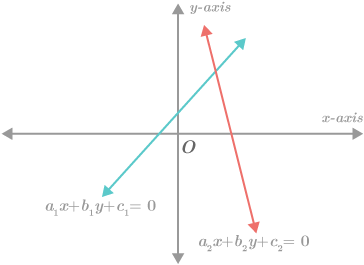
The solution of the simultaneous equations is the point where the two lines have the same \(x\)-value and the same \(y\)-value.
The solution of two simultaneous linear equations corresponds to the intersection point of their two straight-line graphs.
For example:
\(y=-x+5\)
The solution is the point where the two lines cross.
This gives an important connection between algebra and coordinate geometry.
Three Possible Outcomes
Two linear equations can produce different types of systems.
| Graph | Number of Solutions | Meaning |
|---|---|---|
| Lines intersect once | One solution | There is one common point. |
| Parallel lines | No solution | The lines never meet. |
| Same line | Infinitely many solutions | Every point on the line satisfies both equations. |
At MYP 3 level, it is important to understand that the number of solutions is connected to the relationship between the two lines.
Forming Simultaneous Equations from a Problem
Many real-life problems involve two unknown quantities. The information can be translated into two equations.
Example situation: A cinema sells adult and student tickets. A total of \(20\) tickets are sold.
Let:
\(s=\) number of student tickets
The total number of tickets gives:
If adult tickets cost \$12 and student tickets cost \$8, and the total revenue is \$208, then:
The two equations together form a simultaneous system.
Define the variables clearly before writing the equations. This makes it easier to translate each piece of information correctly.
General Problem-Solving Process
- Identify the two unknown quantities.
- Define a variable for each unknown.
- Translate the information into two equations.
- Solve the simultaneous equations using an appropriate method.
- Check both equations.
- Interpret the values in the context of the problem.
- Give the final answer clearly, including units when appropriate.
Two unknowns generally require two independent equations. The equations must describe the same situation, and the final values must satisfy both equations.
⚠️ Common Mistakes
- Using only one equation when there are two unknowns.
- Defining the variables unclearly.
- Writing an equation that does not represent the information in the problem.
- Giving \((y,x)\) instead of \((x,y)\).
- Checking the solution in only one equation.
- Forgetting to interpret the answer in the context of the problem.
Example 1:
Consider the simultaneous equations:
\(x-y=4\)
a) Explain what the solution must represent.
b) Find \(x\) and \(y\).
c) Write the solution as an ordered pair.
d) Check your answer in both equations.
▶️ Answer/Explanation
Answer
a) The solution must be a pair of values for \(x\) and \(y\) that makes both equations true at the same time.
b) We need two numbers whose sum is \(14\) and whose difference is \(4\).
The numbers are \(9\) and \(5\).
\(9-5=4\)
Therefore:
\(y=5\)
c)
d)
\(x-y=9-5=4\) ✓
Therefore, \((9,5)\) satisfies both equations.
Example 2:
A school sells adult and student tickets for a performance.
A total of \(30\) tickets are sold. Adult tickets cost \$10 each and student tickets cost \$6 each. The total amount collected is \$246.
a) Define two variables.
b) Write two simultaneous equations.
c) Determine the number of adult and student tickets sold.
d) Check your answer using both equations.
▶️ Answer/Explanation
Answer
a) Let:
\(s=\) number of student tickets
b) The total number of tickets is \(30\):
The total revenue is \$246:
So the system is:
\(10a+6s=246\)
c) From the first equation:
Substitute this into the second equation:
\(10a+180-6a=246\)
\(4a=66\)
\(a=16.5\)
This is not possible because the number of tickets must be a whole number.
Therefore, the given information does not produce a physically possible ticket solution.
d) The algebra correctly shows that the system gives \(a=16.5\), so the conditions are inconsistent with whole-number ticket quantities. This is an important example of why a mathematical solution must also be checked against the context of the problem.