
4.4 – Solving Linear Systems by Graphing, Substitution and Elimination
A system of two linear equations can be solved using different methods. The three main methods are:
- Graphing – find the point where the two lines intersect.
- Substitution – replace one variable using an expression from the other equation.
- Elimination – add or subtract equations to eliminate one variable.
All three methods find the same thing: the values of \(x\) and \(y\) that make both equations true at the same time.
1. Solving by Graphing
Each linear equation represents a straight line. When both equations are graphed on the same coordinate plane, the point of intersection gives the solution.
For example: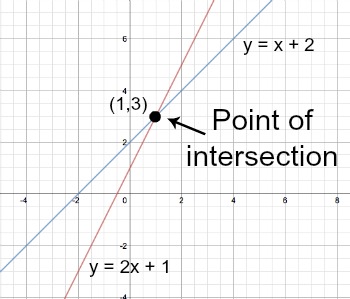
\(y=2x+1\)
The solution is the point where these two lines meet.
Steps for graphing:
- Write each equation in a form that can be graphed, such as \(y=mx+b\), if necessary.
- Graph both equations on the same coordinate plane.
- Find the point where the two lines intersect.
- Read the coordinates of the intersection.
- Check the coordinates in both original equations.
Graphing is useful for seeing the solution visually, but the intersection may sometimes be difficult to read accurately, especially when the coordinates are not whole numbers.
2. Solving by Substitution
The substitution method is useful when one equation already has a variable by itself, or when it is easy to make a variable the subject.
Consider: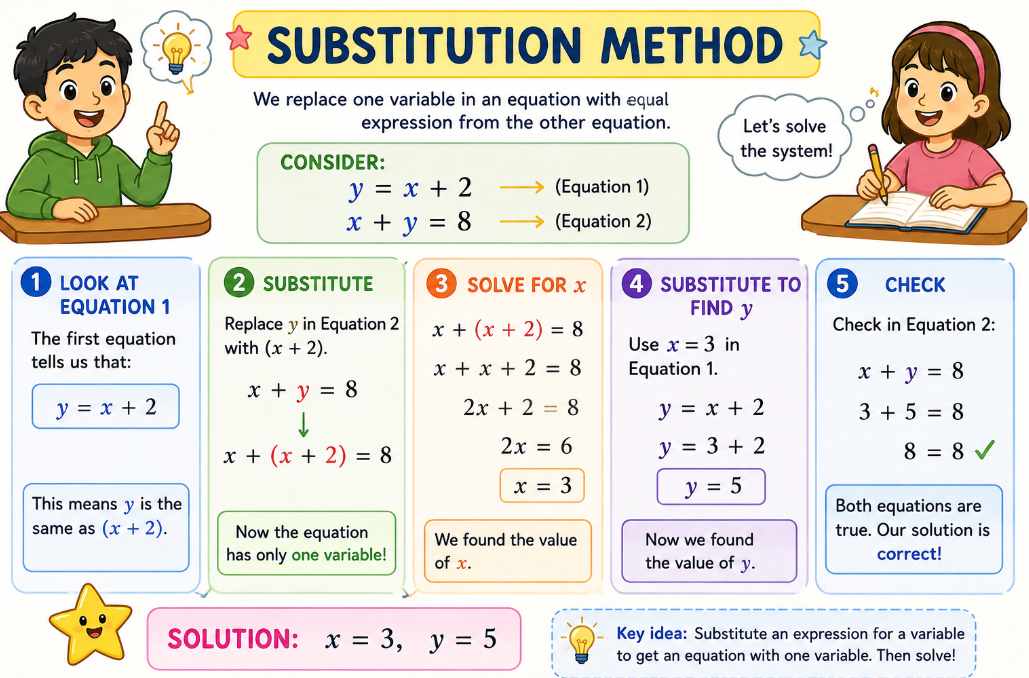
\(x+y=8\)
The first equation tells us that:
Since \(y\) is equal to \(x+2\), we can replace \(y\) in the second equation with \(x+2\).
Now there is only one variable, so the equation can be solved.
Substitution method:
- Make one variable the subject of one equation.
- Substitute that expression into the other equation.
- Solve the resulting equation for one variable.
- Substitute the value back into one of the original equations.
- Find the second variable.
- Check both original equations.
If \(y=x+2\), then anywhere you see \(y\), you can replace it with \(x+2\).
3. Solving by Elimination
The elimination method solves a system by combining the equations so that one variable disappears.
For example: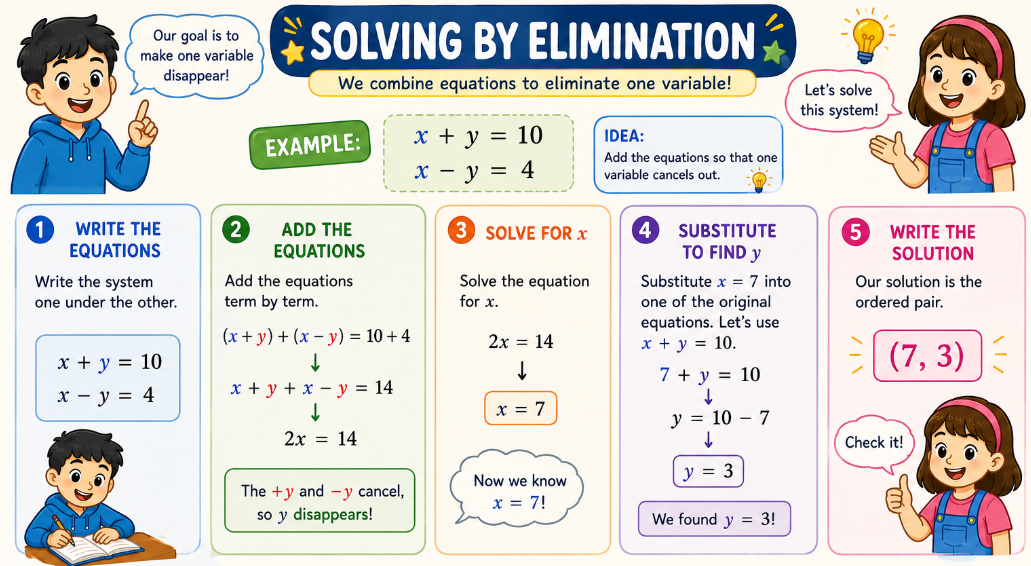
\(x-y=4\)
Add the equations:
The \(+y\) and \(-y\) cancel:
Therefore:
Substitute \(x=7\) into one of the original equations:
\(y=3\)
Therefore:
Steps for elimination:
- Write the equations in a consistent form.
- Look for a variable whose coefficients can be eliminated.
- If necessary, multiply one or both equations so that the coefficients match.
- Add or subtract the equations to eliminate one variable.
- Solve for the remaining variable.
- Substitute the value into an original equation.
- Find the second variable.
- Check the solution in both equations.
Elimination When Coefficients Do Not Match
Sometimes the variables cannot be eliminated immediately.
For example:
\(x+2y=10\)
We can multiply the first equation by \(2\):
Now subtract the second equation:
\(3x=12\)
\(x=4\)
Substitute \(x=4\):
\(8+y=11\)
\(y=3\)
Therefore:
You may multiply an entire equation by a non-zero number. Every term on both sides must be multiplied.
Choosing the Best Method
| Method | When It Is Useful | Main Idea |
|---|---|---|
| Graphing | When a visual solution is useful or the equations are easy to graph. | Find the intersection. |
| Substitution | When one variable is already isolated or can easily be isolated. | Replace one variable with an equivalent expression. |
| Elimination | When coefficients are equal, opposites, or can easily be made so. | Add or subtract equations to cancel a variable. |
Comparing the Three Methods
Suppose the system is:
\(y=-x+5\)
The three methods all lead to the same solution:
| Method | What happens? |
|---|---|
| Graphing | The two lines intersect at the solution. |
| Substitution | One expression for \(y\) is substituted into the other equation. |
| Elimination | The equations can be combined to eliminate a variable. |
The method may change, but the solution does not. A correct solution should give the same ordered pair regardless of which valid method is used.
Number of Solutions
A pair of linear equations can have:
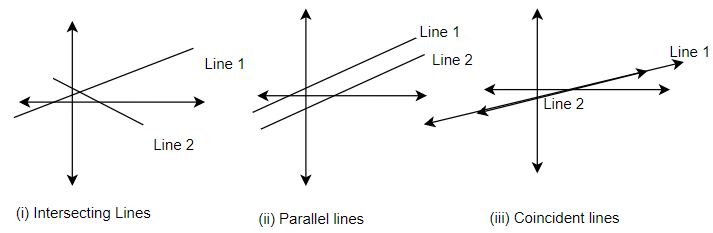
- One solution – the lines intersect at one point.
- No solution – the lines are parallel and never meet.
- Infinitely many solutions – both equations represent the same line.
| Situation | Graph | Solutions |
|---|---|---|
| Different gradients | Lines intersect | One |
| Same gradient, different intercepts | Parallel lines | None |
| Same line | Lines overlap | Infinitely many |
🧠 Checking Your Answer
Always substitute the values of \(x\) and \(y\) into the original equations.
For example, if your answer is:
Check both equations rather than checking only the equation used during the final step.
⚠️ Common Mistakes
- Changing only one side of an equation when multiplying.
- Forgetting to multiply every term when preparing for elimination.
- Substituting an expression without using brackets.
- Reading an inaccurate intersection from a graph.
- Finding \(x\) but forgetting to find \(y\).
- Giving the ordered pair in the wrong order.
- Not checking the answer in both original equations.
Example 1:
Solve the simultaneous equations:
\(x+y=10\)
a) Solve the system using substitution.
b) Check your answer in both equations.
c) Solve the same system using elimination.
▶️ Answer/Explanation
Answer
a) Substitution
We know:
Substitute this into \(x+y=10\):
\(3x+1=10\)
\(3x=9\)
\(x=3\)
Now substitute \(x=3\) into \(y=2x+1\):
\(y=7\)
Therefore:
b) Check:
\(7=2(3)+1\)
\(7=7\) ✓
\(3+7=10\) ✓
c) Elimination
Rewrite the first equation:
The system is now:
\(x+y=10\)
Add the equations:
\(x=3\)
Substitute \(x=3\):
\(y=7\)
Again:
Example 2:
A school sells adult and student tickets for a concert.
A total of \(40\) tickets are sold. Adult tickets cost $\$12$ and student tickets cost $\$7$. The total amount collected is $\$380$.
a) Define two variables.
b) Form a system of two simultaneous equations.
c) Solve the system using the elimination method.
d) State the number of adult and student tickets sold.
e) Check your answer in the context of the problem.
▶️ Answer/Explanation
Answer
a) Let:
\(s=\) number of student tickets
b) Total number of tickets:
Total cost:
Therefore:
\(12a+7s=380\)
c) Elimination
Multiply the first equation by \(7\):
Subtract this equation from the second equation:
\(5a=100\)
\(a=20\)
Substitute \(a=20\) into \(a+s=40\):
\(s=20\)
d) Therefore:
e) Check:
The solution satisfies both the number-of-tickets condition and the total-cost condition.