
4.6 – Equations Involving Powers
Some equations contain an unknown raised to a power, such as \(x^2=25\) or \(x^3=64\). These are called power equations.
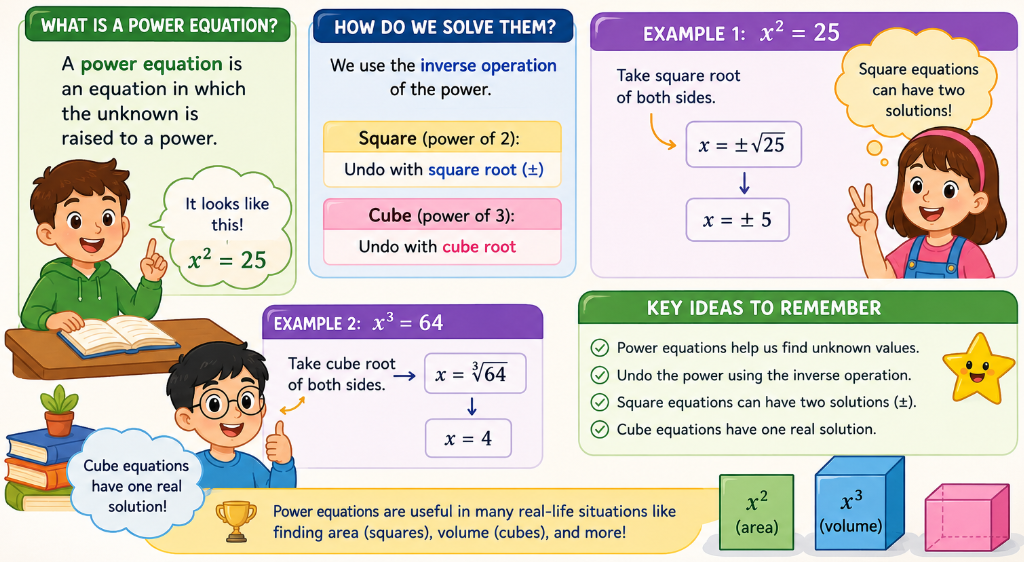
To solve them, we use the inverse operation of the power. The main idea is to undo the exponent while remembering that a square equation can have two solutions. The MYP 3 course specifically introduces power equations as a useful algebraic skill.
What Is a Power Equation?
A power equation is an equation in which the unknown is raised to a power.
| Equation | Power |
|---|---|
| \(x^2=36\) | Square |
| \(x^3=125\) | Cube |
| \(x^4=81\) | Fourth power |
Inverse Operations
Just as addition and subtraction are inverse operations, and multiplication and division are inverse operations, squaring and square roots are inverse operations.
| Operation | Inverse |
|---|---|
| Add \(a\) | Subtract \(a\) |
| Multiply by \(a\) | Divide by \(a\) |
| Square | Square root |
| Cube | Cube root |
Solving Equations of the Form \(x^2=a\)
To solve:
take the square root of both sides.
When solving \(x^2=a\), remember the \(\pm\) symbol because both a positive and a negative number can have the same square.
For example:
Therefore:
\(x=\pm7\)
So the two solutions are:
Solving Equations of the Form \(x^3=a\)
For a cube equation, use the cube root.
Therefore:
Unlike a square equation, a cube equation normally has one real solution.
For example:
\(x=\sqrt[3]{-27}\)
\(\boxed{x=-3}\)
This works because:
Equations with a Coefficient
Sometimes the equation contains a number multiplied by the power.
For example:
First divide both sides by \(3\):
Then take the square root:
Therefore:
Equations with Brackets
The unknown may be inside a squared or cubed expression.
For example:
Take the square root of both sides:
This gives two equations:
\(x+2=-6\)
Solve each:
\(x=-8\)
Therefore:
⭐ Strategy:
For \((x+a)^2=b\):
1. Take the square root of both sides.
2. Include \(\pm\).
3. Solve the resulting two linear equations.
Checking Solutions
Checking is especially important for power equations. Substitute each possible solution into the original equation.
For example, for:
Check \(x=4\):
Check \(x=-8\):
Both values are therefore valid solutions.
Number of Solutions
| Equation | Solutions |
|---|---|
| \(x^2=25\) | \(x=5,-5\) |
| \(x^2=0\) | \(x=0\) |
| \(x^2=-9\) | No real solution |
| \(x^3=27\) | \(x=3\) |
For a square equation \(x^2=a\), a negative value of \(a\) has no real solution because the square of every real number is non-negative.
⚠️ Common Mistake:
Do not write \(x=\sqrt{25}=5\) and stop when solving \(x^2=25\).
Both \(5\) and \(-5\) satisfy the equation:
\(5^2=25\)
\((-5)^2=25\)
Power Equations — Quick Method
| Step | What to Do |
|---|---|
| 1 | Simplify the equation first. |
| 2 | Isolate the power containing the unknown. |
| 3 | Use the appropriate root. |
| 4 | For square equations, remember \(\pm\). |
| 5 | Solve for the variable. |
| 6 | Check every solution in the original equation. |
🎯 MYP 3 Key Takeaway
A power equation can be solved by using the inverse root operation.
For a square equation:
For a cube equation:
Always check the solutions and consider whether each solution makes sense in the real-world context.
Example 1:
Solve the following equations.
a) \(x^2=64\)
b) \(3x^2=75\)
c) \((x-4)^2=49\)
d) \(x^3=-125\)
▶️ Answer/Explanation
Answer
a)
\(x=\pm\sqrt{64}\)
\(\boxed{x=8\text{ or }x=-8}\)
b)
\(x^2=25\)
\(x=\pm5\)
\(\boxed{x=5\text{ or }x=-5}\)
c)
\(x-4=\pm7\)
So:
\(x-4=-7\Rightarrow x=-3\)
d)
\(x=\sqrt[3]{-125}\)
\(\boxed{x=-5}\)
Example 2:
The area of a square garden is \(36\text{ m}^2\).
a) Let the side length of the garden be \(x\) metres. Write an equation involving a power.
b) Solve the equation.
c) Explain why only one of the mathematical solutions is suitable for the context.
d) The volume of a cube is \(27\text{ cm}^3\). Find the length of one edge.
▶️ Answer/Explanation
Answer
a) The area of a square is side length squared:
b)
\(x=\pm6\)
So the mathematical solutions are:
c) A side length represents a physical length, so it cannot be negative.
d) The volume of a cube is:
Take the cube root:
\(\boxed{x=3\text{ cm}}\)