
5.1 – The Cartesian Plane and Plotting Coordinates
The Cartesian plane is a coordinate system used to locate points and describe their positions using pairs of numbers. It provides a visual way to represent relationships between numbers and is an important foundation for studying straight-line graphs and coordinate geometry.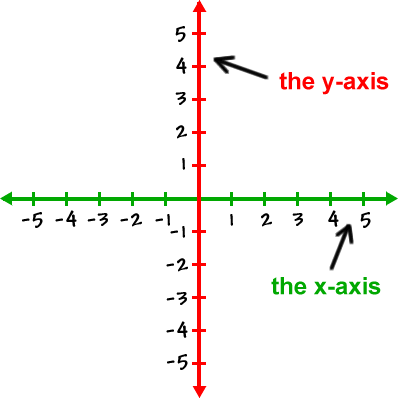
The Cartesian Plane
A Cartesian plane is formed by two perpendicular number lines:
- The x-axis is the horizontal axis.
- The y-axis is the vertical axis.
- The two axes meet at the origin.
The origin is represented by:
\((0,0)\)
| Feature | Description |
|---|---|
| x-axis | Horizontal number line |
| y-axis | Vertical number line |
| Origin | Point where the axes intersect: \((0,0)\) |
| Coordinate plane | The entire plane formed by the two axes |
Positive and Negative Directions
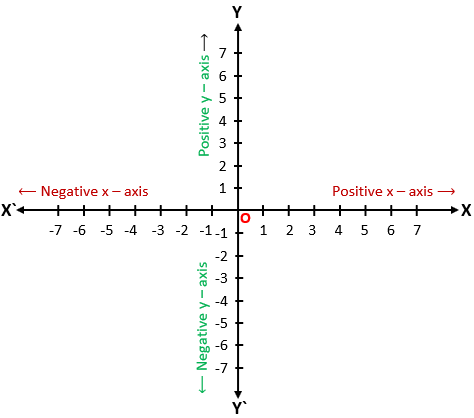
The direction on each axis determines whether a coordinate is positive or negative.
| Direction | Coordinate Sign |
|---|---|
| Right along the x-axis | Positive \(x\) |
| Left along the x-axis | Negative \(x\) |
| Up along the y-axis | Positive \(y\) |
| Down along the y-axis | Negative \(y\) |
Moving right increases the \(x\)-coordinate.
Moving left decreases the \(x\)-coordinate.
Moving up increases the \(y\)-coordinate.
Moving down decreases the \(y\)-coordinate.
Coordinates and Ordered Pairs
Every point on the Cartesian plane can be identified using an ordered pair: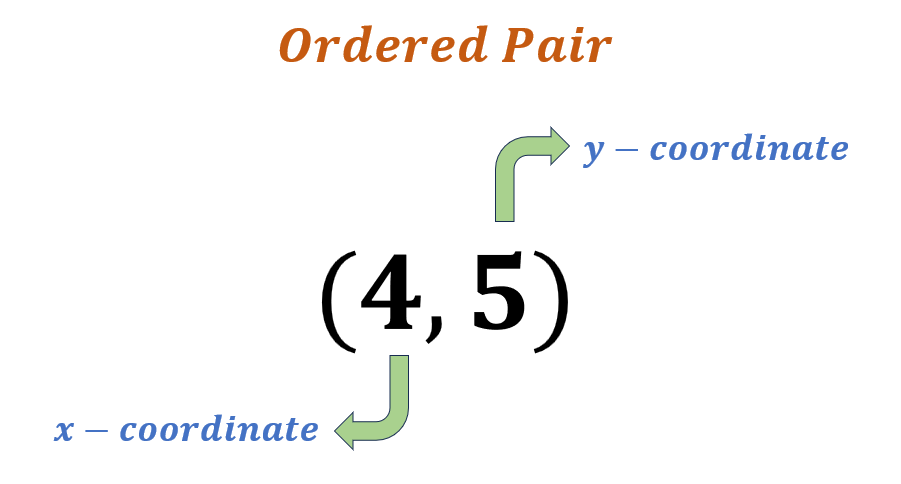
\((x,y)\)
The first number is the x-coordinate and the second number is the y-coordinate.
| Coordinate | x-coordinate | y-coordinate |
|---|---|---|
| \((4,7)\) | \(4\) | \(7\) |
| \((-3,5)\) | \(-3\) | \(5\) |
| \((2,-6)\) | \(2\) | \(-6\) |
| \((-4,-2)\) | \(-4\) | \(-2\) |
⚠️ Common Mistake:
The order of the coordinates matters.
\((3,5)\) and \((5,3)\) are different points.
Always remember: x first, y second.
The Four Quadrants
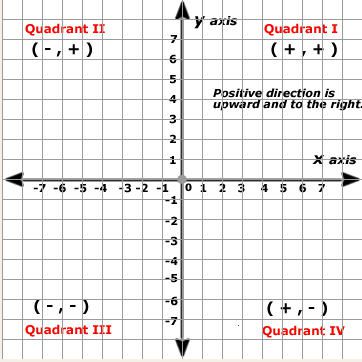
The two axes divide the Cartesian plane into four regions called quadrants.
| Quadrant | Sign of \(x\) | Sign of \(y\) | Example |
|---|---|---|---|
| I | Positive | Positive | \((3,4)\) |
| II | Negative | Positive | \((-3,4)\) |
| III | Negative | Negative | \((-3,-4)\) |
| IV | Positive | Negative | \((3,-4)\) |
🧠 Quadrant Sign Pattern:
I: \((+,+)\)
II: \((-,+)\)
III: \((-,-)\)
IV: \((+,-)\)
📌 Points on the Axes
A point lying directly on an axis is not in any quadrant.
If a point lies on the x-axis, its y-coordinate is \(0\).
\((5,0)\)
If a point lies on the y-axis, its x-coordinate is \(0\).
\((0,-4)\)
On the x-axis → \(y=0\)
On the y-axis → \(x=0\)
At the origin → \(x=0\) and \(y=0\)
Plotting Coordinates
To plot a point \((x,y)\), follow these steps:
- Start at the origin \((0,0)\).
- Move horizontally according to the \(x\)-coordinate.
- Move vertically according to the \(y\)-coordinate.
- Mark the point and label it if required.
For example, to plot \(A(-4,3)\):
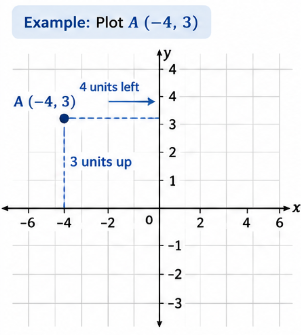
- Start at \((0,0)\).
- Move \(4\) units left because \(x=-4\).
- Move \(3\) units up because \(y=3\).
- Mark the point \(A\).
Since \(x\) is negative and \(y\) is positive, the point lies in Quadrant II.
Reading Coordinates from a Graph
When reading the coordinates of a point from a graph: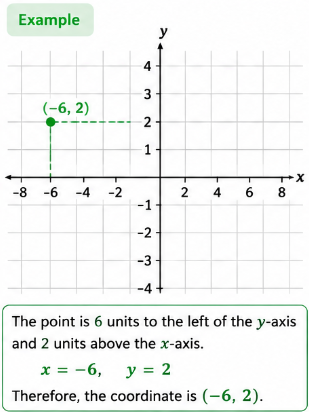
- Read the horizontal position first to find \(x\).
- Read the vertical position second to find \(y\).
- Write the coordinate as \((x,y)\).
For example, if a point is \(6\) units to the left of the y-axis and \(2\) units above the x-axis:
\(x=-6,\qquad y=2\)
Therefore, the coordinate is:
\((-6,2)\)
Choosing a Scale
The scale of a coordinate grid tells us the value represented by each grid interval.
For example, if each grid square represents \(2\) units, then moving three squares to the right represents:
\(3\times2=6\text{ units}\)
Always check the scale before plotting or reading a coordinate.
Do not assume that every grid square represents \(1\) unit. Check the labels on both axes first.
Reflections in the Coordinate Plane
Coordinates can be reflected across the axes.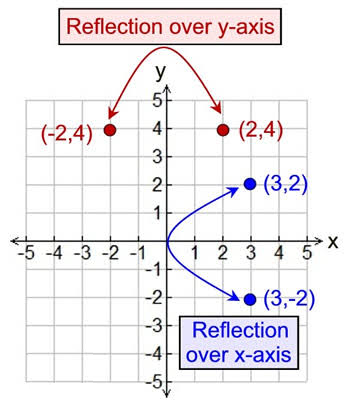
Reflection in the x-axis:
\((x,y)\rightarrow(x,-y)\)
Reflection in the y-axis:
\((x,y)\rightarrow(-x,y)\)
For example, reflecting \((3,5)\) in the x-axis gives:
\((3,5)\rightarrow(3,-5)\)
Reflecting the same point in the y-axis gives:
\((3,5)\rightarrow(-3,5)\)
Example 1:
The following points are given:
\(A(4,3),\quad B(-5,2),\quad C(-2,-4),\quad D(6,-3)\)
a) State the quadrant in which each point lies.
b) Which point is closest to the y-axis?
c) Which point is closest to the x-axis?
d) State the coordinates of a point \(E\) on the y-axis that is \(5\) units below the origin.
▶️ Answer/Explanation
Answer
a) Quadrants
\(A(4,3)\) has \(x>0\) and \(y>0\), so it is in Quadrant I.
\(B(-5,2)\) has \(x<0\) and \(y>0\), so it is in Quadrant II.
\(C(-2,-4)\) has \(x<0\) and \(y<0\), so it is in Quadrant III.
\(D(6,-3)\) has \(x>0\) and \(y<0\), so it is in Quadrant IV.
b) Closest to the y-axis
The distance from the y-axis depends on the absolute value of the \(x\)-coordinate.
\(|4|=4,\quad|-5|=5,\quad|-2|=2,\quad|6|=6\)
The smallest value is \(2\).
Therefore, \(C(-2,-4)\) is closest to the y-axis.
c) Closest to the x-axis
The distance from the x-axis depends on the absolute value of the \(y\)-coordinate.
\(|3|=3,\quad|2|=2,\quad|-4|=4,\quad|-3|=3\)
The smallest value is \(2\).
Therefore, \(B(-5,2)\) is closest to the x-axis.
d) Point on the y-axis
A point on the y-axis has \(x=0\). Five units below the origin means \(y=-5\).
\(E=(0,-5)\)
Example 2:
A point \(P\) has coordinates \((-4,7)\).
a) State the quadrant containing \(P\).
b) State the horizontal and vertical distances of \(P\) from the axes.
c) Find the coordinates of the reflection of \(P\) in the x-axis.
d) Find the coordinates of the reflection of \(P\) in the y-axis.
e) A second point \(Q\) is \((2,-7)\). State whether \(P\) and \(Q\) have the same distance from the x-axis.
▶️ Answer/Explanation
Answer
a) Quadrant
For \(P(-4,7)\), the x-coordinate is negative and the y-coordinate is positive.
Therefore, \(P\) lies in Quadrant II.
b) Distances from the axes
The distance from the y-axis is the absolute value of the x-coordinate:
\(|-4|=4\)
So \(P\) is \(4\) units from the y-axis.
The distance from the x-axis is the absolute value of the y-coordinate:
\(|7|=7\)
So \(P\) is \(7\) units from the x-axis.
c) Reflection in the x-axis
Reflection in the x-axis changes the sign of \(y\):
\((x,y)\rightarrow(x,-y)\)
\((-4,7)\rightarrow(-4,-7)\)
Therefore, the reflected point is \((-4,-7)\).
d) Reflection in the y-axis
Reflection in the y-axis changes the sign of \(x\):
\((x,y)\rightarrow(-x,y)\)
\((-4,7)\rightarrow(4,7)\)
Therefore, the reflected point is \((4,7)\).
e) Comparing distances from the x-axis
For \(P(-4,7)\):
\(|7|=7\)
For \(Q(2,-7)\):
\(|-7|=7\)
Therefore, yes, both points are \(7\) units from the x-axis.