
5.2 – Gradient and Straight-Line Graphs
A straight-line graph represents a linear relationship between two variables. One of the most important features of a straight line is its gradient, which describes how steep the line is and how much the \(y\)-value changes when the \(x\)-value changes.
Gradient
The gradient of a straight line measures its rate of change. It tells us how much \(y\) changes for a given change in \(x\).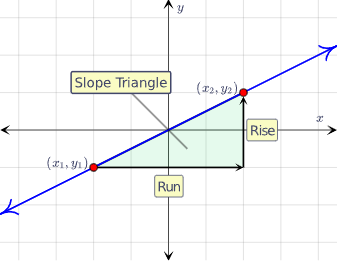
\(\text{Gradient}=\dfrac{\text{change in }y}{\text{change in }x}\)
The gradient is usually represented by the letter \(m\).
\(m=\dfrac{\Delta y}{\Delta x}\)
A positive gradient means that \(y\) increases as \(x\) increases. A negative gradient means that \(y\) decreases as \(x\) increases.
Finding the Gradient from Two Points
If two points on a straight line are:
\((x_1,y_1)\quad\text{and}\quad(x_2,y_2)\)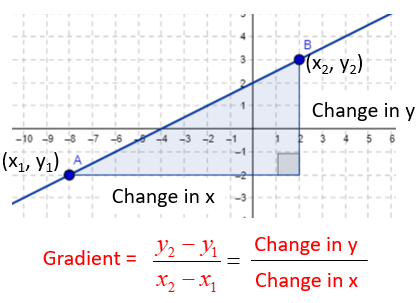
then the gradient is:
\(m=\dfrac{y_2-y_1}{x_2-x_1}\)
The order of the points does not matter as long as you use the same order in the numerator and denominator.
For example, using \(A(2,3)\) and \(B(6,11)\):
\(m=\dfrac{11-3}{6-2}\)
\(m=\dfrac{8}{4}=2\)
Therefore, the gradient is \(2\).
⚠️ Common Mistake:
Do not calculate \(\dfrac{\text{change in }x}{\text{change in }y}\).
Gradient is always:
\(\dfrac{\text{change in }y}{\text{change in }x}\)
Positive Gradient
A line has a positive gradient when it rises from left to right.
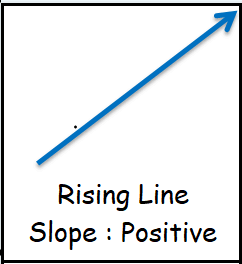
For example, consider the points \(A(1,2)\) and \(B(5,10)\).
\(m=\dfrac{10-2}{5-1}=\dfrac{8}{4}=2\)
Since \(m>0\), the line rises from left to right.
Negative Gradient
A line has a negative gradient when it falls from left to right.
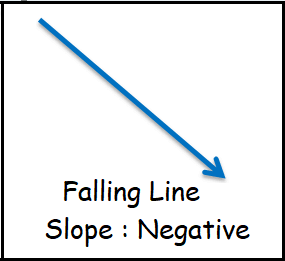
For example, consider \(A(1,8)\) and \(B(5,2)\).
\(m=\dfrac{2-8}{5-1}=\dfrac{-6}{4}=-\dfrac{3}{2}\)
Since \(m<0\), the line falls from left to right.
| Gradient | Appearance | Meaning |
|---|---|---|
| \(m>0\) | Rises left to right | As \(x\) increases, \(y\) increases |
| \(m<0\) | Falls left to right | As \(x\) increases, \(y\) decreases |
| \(m=0\) | Horizontal | \(y\) remains constant |
Steepness of a Line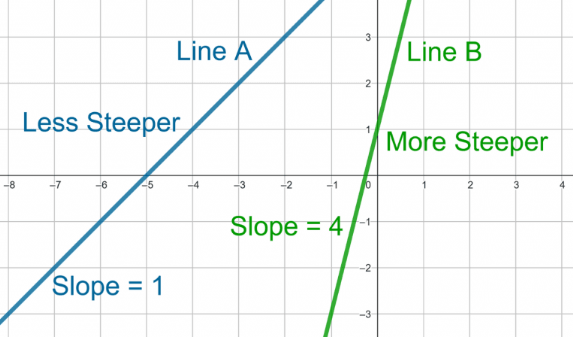
The absolute value of the gradient describes how steep a line is.
For example:
\(m=2\) has a greater steepness than: \(m=\dfrac{1}{2}\)
Similarly, \(m=-4\) is steeper than \(m=-1\) because:
\(|-4|>|-1|\)
The sign of the gradient tells you the direction.
The size of the gradient tells you the steepness.
Gradient from a Graph
When a line is shown on a coordinate grid, you can calculate its gradient by choosing two points that lie exactly on the line.
Then: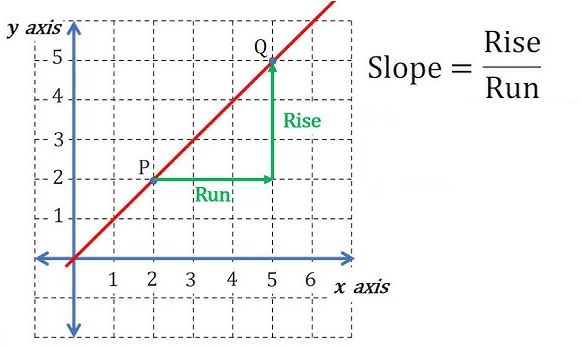
\(m=\dfrac{\text{rise}}{\text{run}}\)
where:
- Rise = change in the \(y\)-direction.
- Run = change in the \(x\)-direction.
For example, if moving \(3\) units to the right causes the line to rise \(6\) units:
\(m=\dfrac{6}{3}=2\)
If moving \(4\) units to the right causes the line to fall \(3\) units:
\(m=\dfrac{-3}{4}\)
1. Choose two clear points on the line.
2. Find the vertical change.
3. Find the horizontal change.
4. Calculate \(\dfrac{\text{rise}}{\text{run}}\).
5. Simplify the fraction if necessary.
Horizontal Lines
A horizontal line has no change in \(y\).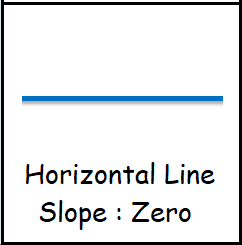
Therefore:
\(m=\dfrac{0}{\text{change in }x}=0\)
For example, the line passing through \((1,4)\) and \((7,4)\) has:
\(m=\dfrac{4-4}{7-1}=0\)
Its equation is:
\(y=4\)
Vertical Lines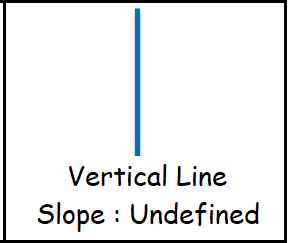
A vertical line has no change in \(x\). Its gradient would require division by zero:
\(m=\dfrac{\text{change in }y}{0}\)
Division by zero is undefined, so a vertical line has an undefined gradient.
For example, a vertical line through \(x=3\) has equation:
\(x=3\)
| Line | Gradient | Example Equation |
|---|---|---|
| Rising | Positive | \(y=2x+1\) |
| Falling | Negative | \(y=-2x+5\) |
| Horizontal | \(0\) | \(y=4\) |
| Vertical | Undefined | \(x=3\) |
Straight-Line Graphs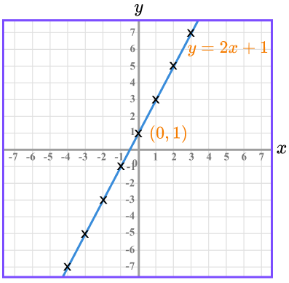
A straight-line graph represents a relationship where the rate of change is constant.
This means that equal changes in \(x\) produce equal changes in \(y\).
For example, consider:
\(y=2x+1\)
The gradient is \(2\). Therefore, whenever \(x\) increases by \(1\), \(y\) increases by \(2\).
| \(x\) | \(y=2x+1\) |
|---|---|
| \(0\) | \(1\) |
| \(1\) | \(3\) |
| \(2\) | \(5\) |
| \(3\) | \(7\) |
The points \((0,1)\), \((1,3)\), \((2,5)\) and \((3,7)\) all lie on the same straight line.
Gradient as Rate of Change
Gradient can also describe a real-world rate of change.
For example, suppose the distance travelled by a cyclist increases by \(15\) km every \(3\) hours.
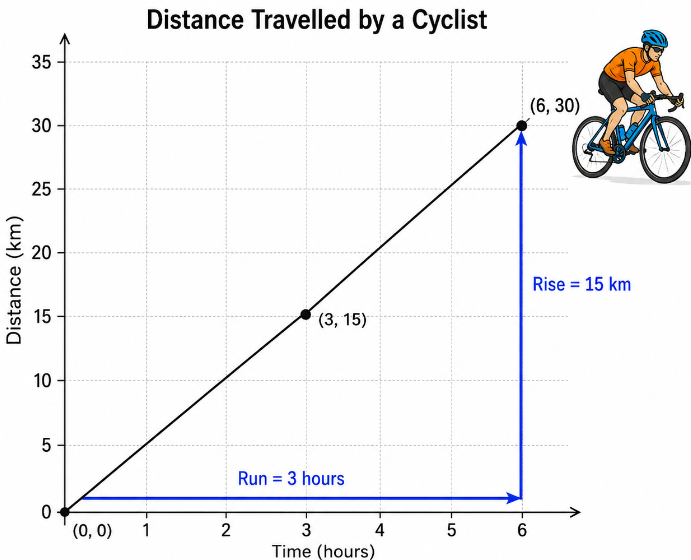
\(m=\dfrac{15}{3}=5\)
The gradient is \(5\text{ km/h}\).
This means the distance increases at a constant rate of \(5\) km for every hour.
💡 Units of Gradient:
The units of gradient are determined by:
\(\dfrac{\text{units of }y}{\text{units of }x}\)
For example, if \(y\) represents distance in kilometres and \(x\) represents time in hours, the gradient is measured in \(\text{km/h}\).
Comparing Gradients
When comparing two straight lines:
- A larger positive gradient means a steeper upward line.
- A smaller positive gradient means a less steep upward line.
- A more negative gradient means a steeper downward line.
- A gradient of \(0\) represents a horizontal line.
For example, compare:
\(m_1=3,\qquad m_2=\dfrac{1}{2}\)
Since:
\(3>\dfrac{1}{2}\)
the line with gradient \(3\) is steeper.
🎯 MYP Problem-Solving Strategy:
When working with gradients and straight-line graphs:
1. Identify two points on the line.
2. Write the coordinates carefully as \((x,y)\).
3. Use \(m=\dfrac{y_2-y_1}{x_2-x_1}\).
4. Keep the order of subtraction consistent.
5. Interpret the sign of the gradient.
6. If the situation has units, include the correct units for the rate of change.
Example 1:
A straight line passes through the points \(A(-2,5)\) and \(B(4,17)\).
a) Find the gradient of the line.
b) State whether the line rises or falls from left to right.
c) Explain what the gradient means if \(x\) represents time in minutes and \(y\) represents distance in metres.
▶️ Answer/Explanation
Answer
a) Find the gradient
Use:
\(m=\dfrac{y_2-y_1}{x_2-x_1}\)
\(m=\dfrac{17-5}{4-(-2)}\)
\(m=\dfrac{12}{6}=2\)
Therefore, the gradient is \(2\).
b) Direction of the line
The gradient is positive:
\(m=2>0\)
Therefore, the line rises from left to right.
c) Interpretation
The gradient is:
\(2\text{ m/min}\)
This means that for every \(1\) minute increase in time, the distance increases by \(2\) metres.
Example 2:
A water tank is being filled at a constant rate. The amount of water in the tank is recorded at two times:
| Time \(x\) (minutes) | Water \(y\) (litres) |
|---|---|
| \(5\) | \(18\) |
| \(13\) | \(42\) |
a) Find the gradient of the relationship.
b) Interpret the gradient in context.
c) How much additional water is added in \(10\) minutes if the rate remains constant?
▶️ Answer/Explanation
Answer
a) Find the gradient
The two points are \((5,18)\) and \((13,42)\).
\(m=\dfrac{42-18}{13-5}\)
\(m=\dfrac{24}{8}=3\)
Therefore, the gradient is \(3\text{ L/min}\).
b) Interpret the gradient
The water level increases by \(3\) litres every minute.
c) Additional water in \(10\) minutes
Use:
\(\text{Change in water}=\text{rate}\times\text{time}\)
\(=3\times10\)
\(=30\text{ L}\)
Therefore, \(30\) litres of additional water will be added.