
5.3 – Equations and Intercepts of Straight Lines
A straight-line graph can be represented using an equation. The equation allows us to determine the position of the line, its gradient, and where it crosses the coordinate axes.
Two important features of a straight line are its gradient and its intercepts.
The Equation of a Straight Line
The most common form of the equation of a straight line is:
\(y=mx+c\)
| Symbol | Meaning |
|---|---|
| \(y\) | The vertical coordinate |
| \(x\) | The horizontal coordinate |
| \(m\) | The gradient of the line |
| \(c\) | The \(y\)-intercept |
For example, in:
\(y=3x+2\)
the gradient is \(3\) and the \(y\)-intercept is \(2\).
Understanding the Gradient in \(y=mx+c\)
The value of \(m\) determines how the line behaves as \(x\) increases.
| Value of \(m\) | Line | Meaning |
|---|---|---|
| \(m>0\) | Rises from left to right | \(y\) increases as \(x\) increases |
| \(m<0\) | Falls from left to right | \(y\) decreases as \(x\) increases |
| \(m=0\) | Horizontal | \(y\) remains constant |
For example:
\(y=2x+1\)
m=2
The line rises \(2\) units vertically for every \(1\) unit moved horizontally.
For:
\(y=-\dfrac{1}{2}x+4\)
\(m=-\dfrac{1}{2}\)
The line falls \(1\) unit for every \(2\) units moved to the right.
The \(y\)-Intercept
The \(y\)-intercept is the point where the line crosses the \(y\)-axis.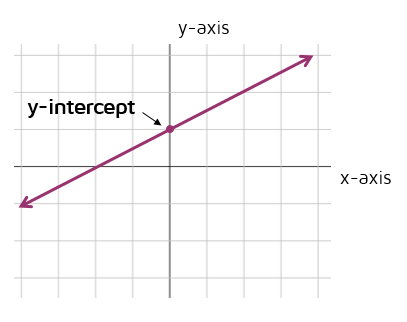
Every point on the \(y\)-axis has:
\(x=0\)
Therefore, in the equation:
\(y=mx+c\)
the \(y\)-intercept is:
\((0,c)\)
For example:
\(y=4x+7\)
has \(y\)-intercept:
\((0,7)\)
💡 Quick Rule:
In \(y=mx+c\), the number after \(x\) is the \(y\)-intercept.
\(y=5x+3\) → gradient \(=5\), \(y\)-intercept \(=3\).
\(y=-2x-4\) → gradient \(=-2\), \(y\)-intercept \(=-4\).
Finding the \(y\)-Intercept from a Graph
To find the \(y\)-intercept from a graph:
- Locate the \(y\)-axis.
- Find where the line crosses the \(y\)-axis.
- Read the \(y\)-coordinate.
- Write the point as \((0,c)\).
For example, if a line crosses the \(y\)-axis at \(6\), then:
\(c=6\)
and the intercept is:
\((0,6)\)
The \(x\)-Intercept
The \(x\)-intercept is the point where the line crosses the \(x\)-axis.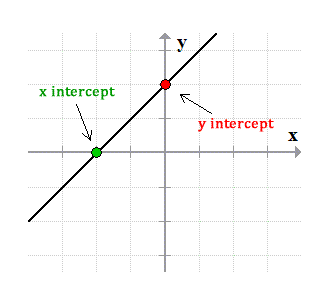
Every point on the \(x\)-axis has:
\(y=0\)
Therefore, to find the \(x\)-intercept, substitute \(y=0\) into the equation.
For example:
\(y=2x+6\)
Set \(y=0\):
\(0=2x+6\)
\(2x=-6\)
\(x=-3\)
Therefore, the \(x\)-intercept is:
\((-3,0)\)
For the \(y\)-intercept, set \(x=0\).
For the \(x\)-intercept, set \(y=0\).
Finding Both Intercepts
Consider:
\(y=3x-6\)
Step 1: Find the \(y\)-intercept.
The equation is already in \(y=mx+c\) form, so:
c=-6
Therefore:
\(y\text{-intercept}=(0,-6)\)
Step 2: Find the \(x\)-intercept.
Set \(y=0\):
\(0=3x-6\)
\(3x=6\)
\(x=2\)
Therefore:
\(x\text{-intercept}=(2,0)\)
Writing an Equation from a Gradient and \(y\)-Intercept
If you know the gradient \(m\) and the \(y\)-intercept \(c\), you can immediately write the equation:
\(y=mx+c\)
For example, if:
\(m=4,\qquad c=-3\)
then:
\(y=4x-3\)
If the gradient is \(-2\) and the \(y\)-intercept is \(5\):
\(y=-2x+5\)
Converting an Equation into \(y=mx+c\) Form
Sometimes a linear equation is not initially written in the form \(y=mx+c\). Rearrange the equation so that \(y\) is the subject.
For example:
\(2x+y=8\)
Subtract \(2x\) from both sides:
\(y=8-2x\)
Therefore:
\(y=-2x+8\)
So the gradient is \(-2\) and the \(y\)-intercept is \(8\).
Intercepts and Graphing a Straight Line
The \(x\)- and \(y\)-intercepts provide two points that can be used to draw a straight line.
For: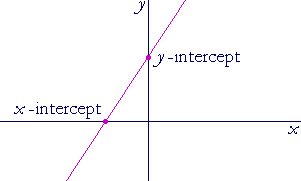
\(y=x+4\)
The \(y\)-intercept is:
\((0,4)\)
For the \(x\)-intercept, set \(y=0\):
\(0=x+4\)
\(x=-4\)
Therefore:
\((-4,0)\)
Plot the two points and draw a straight line through them.
Common Errors
| Mistake | Correct Approach |
|---|---|
| Confusing \(m\) and \(c\) | \(m\) is the gradient; \(c\) is the \(y\)-intercept. |
| Using \(x=0\) for the \(x\)-intercept | Use \(y=0\) for the \(x\)-intercept. |
| Using \(y=0\) for the \(y\)-intercept | Use \(x=0\) for the \(y\)-intercept. |
| Forgetting the negative sign | Keep the sign of the gradient and intercept. |
| Writing the intercept as a single number | As a coordinate, write \((0,c)\) or \((x,0)\). |
🎯 Problem-Solving Strategy:
To identify the gradient and \(y\)-intercept:
Look for \(y=mx+c\).
\(m\) → gradient.
\(c\) → \(y\)-intercept.
To find the (x)-intercept:
Set (y=0) and solve for (x).
To find the (y)-intercept:
Set (x=0) and solve for (y).
To find an equation from two points:
Find (m), substitute into (y=mx+c), then find (c).
Example 1:
Consider the straight line:
\(y=3x-9\)
a) State the gradient.
b) State the \(y\)-intercept.
c) Find the \(x\)-intercept.
d) State the coordinates of both intercepts.
e) Explain whether the line rises or falls from left to right.
▶️ Answer/Explanation
Answer
a) Gradient
Compare the equation with \(y=mx+c\):
\(y=3x-9\)
Therefore:
\(m=3\)
b) \(y\)-intercept
The constant term is \(-9\), so:
\(c=-9\)
The \(y\)-intercept is:
\((0,-9)\)
c) \(x\)-intercept
Set \(y=0\):
\(0=3x-9\)
\(3x=9\)
\(x=3\)
d) Intercepts
\(x\text{-intercept}=(3,0)\)
\(y\text{-intercept}=(0,-9)\)
e) Direction
Since:
\(m=3>0\)
the line rises from left to right.
Example 2:
A straight line passes through the points:
\(A(-2,7)\quad\text{and}\quad B(4,-5)\)
a) Find the gradient of the line.
b) Find the \(y\)-intercept.
c) Write the equation of the line in the form \(y=mx+c\).
d) Find the \(x\)-intercept.
▶️ Answer/Explanation
Answer
a) Find the gradient
Use:
\(m=\dfrac{y_2-y_1}{x_2-x_1}\)
\(m=\dfrac{-5-7}{4-(-2)}\)
\(m=\dfrac{-12}{6}=-2\)
Therefore, \(m=-2\).
b) Find the \(y\)-intercept
Start with:
\(y=-2x+c\)
Use the point \((-2,7)\):
\(7=-2(-2)+c\)
\(7=4+c\)
\(c=3\)
Therefore, the \(y\)-intercept is \((0,3)\).
c) Equation of the line
\(y=-2x+3\)
d) Find the \(x\)-intercept
Set \(y=0\):
\(0=-2x+3\)
\(2x=3\)
\(x=\dfrac{3}{2}\)
Therefore:
\(x\text{-intercept}=\left(\dfrac{3}{2},0\right)\)