
5.4 – Distance Between Two Points and Midpoint
The coordinate plane can be used to measure distances and locate points precisely. When two points are given by their coordinates, we can calculate the distance between them and find the midpoint of the line segment joining them.
These ideas are useful in coordinate geometry, maps, diagrams, and real-world situations where positions are represented using coordinates.
Distance Between Two Points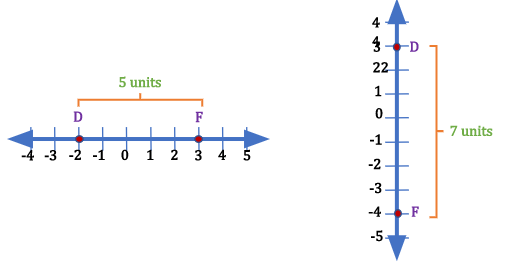
Suppose two points are:
\(A(x_1,y_1)\quad\text{and}\quad B(x_2,y_2)\)
The horizontal change between the points is:
\(x_2-x_1\)
The vertical change is:
\(y_2-y_1\)
These two changes form the horizontal and vertical sides of a right-angled triangle. The distance between the two points is the hypotenuse.
Distance Formula
For \(A(x_1,y_1)\) and \(B(x_2,y_2)\):
\(\displaystyle d=\sqrt{(x_2-x_1)^2+(y_2-y_1)^2}\)
The formula comes from Pythagoras’ theorem.
Why Does the Distance Formula Work?
Consider two points \(A(x_1,y_1)\) and \(B(x_2,y_2)\).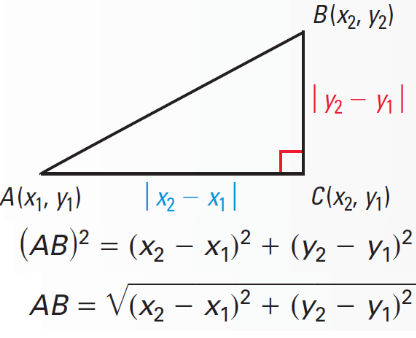
The horizontal distance is:
\(|x_2-x_1|\)
The vertical distance is:
\(|y_2-y_1|\)
Using Pythagoras’ theorem:
\(d^2=(x_2-x_1)^2+(y_2-y_1)^2\)
Taking the positive square root gives:
\(d=\sqrt{(x_2-x_1)^2+(y_2-y_1)^2}\)
Distance is always positive or zero. The square root in the formula gives the length of the line segment between the two points.
Finding Distance Step by Step
To find the distance between two points:
- Write the coordinates clearly.
- Find the change in \(x\).
- Find the change in \(y\).
- Square both changes.
- Add them together.
- Take the square root.
- Simplify the answer if possible.
For example, find the distance between:
\(A(1,2)\quad\text{and}\quad B(5,5)\)
Use the formula:
\(d=\sqrt{(x_2-x_1)^2+(y_2-y_1)^2}\)
Substitute the coordinates:
\(d=\sqrt{(5-1)^2+(5-2)^2}\)
\(d=\sqrt{4^2+3^2}\)
\(d=\sqrt{16+9}\)
\(d=\sqrt{25}\)
\(d=5\)
Therefore, the distance between the points is 5 units.
Horizontal and Vertical Distances
Some distances can be found without using the full distance formula.
Horizontal line:
If two points have the same \(y\)-coordinate, the distance is the difference between their \(x\)-coordinates.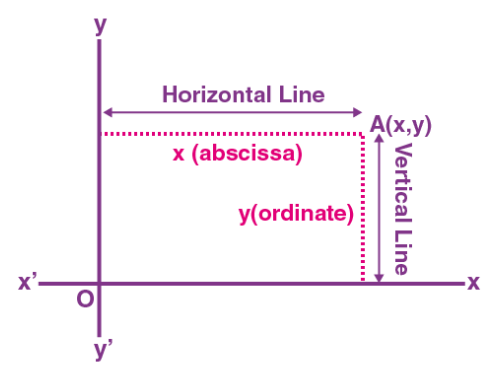
For example:
\(A(2,4),\quad B(9,4)\)
\(d=|9-2|=7\)
So the distance is \(7\) units.
Vertical line:
If two points have the same \(x\)-coordinate, the distance is the difference between their \(y\)-coordinates.
For example:
\(A(3,2),\quad B(3,10)\)
\(d=|10-2|=8\)
So the distance is \(8\) units.
| Type of Segment | Condition | Distance |
|---|---|---|
| Horizontal | Same \(y\)-coordinate | \(|x_2-x_1|\) |
| Vertical | Same \(x\)-coordinate | \(|y_2-y_1|\) |
| Diagonal | Different \(x\) and \(y\) | \(\sqrt{(x_2-x_1)^2+(y_2-y_1)^2}\) |
What Is a Midpoint?
The midpoint of a line segment is the point exactly halfway between its two endpoints. 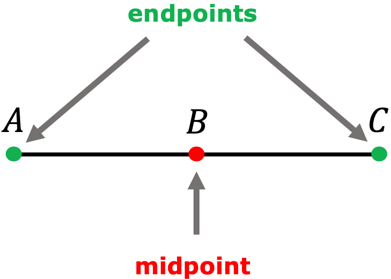
The midpoint has two important properties:
- It lies on the line segment joining the two points.
- It is the same distance from both endpoints.
If the endpoints are:
\(A(x_1,y_1)\quad\text{and}\quad B(x_2,y_2)\)
the midpoint is found by averaging the two \(x\)-coordinates and averaging the two \(y\)-coordinates.
Midpoint Formula
\(\displaystyle M\left(\frac{x_1+x_2}{2},\frac{y_1+y_2}{2}\right)\)
In simple terms:
Midpoint = average of the \(x\)-coordinates and average of the \(y\)-coordinates.
Finding a Midpoint Step by Step
Find the midpoint of: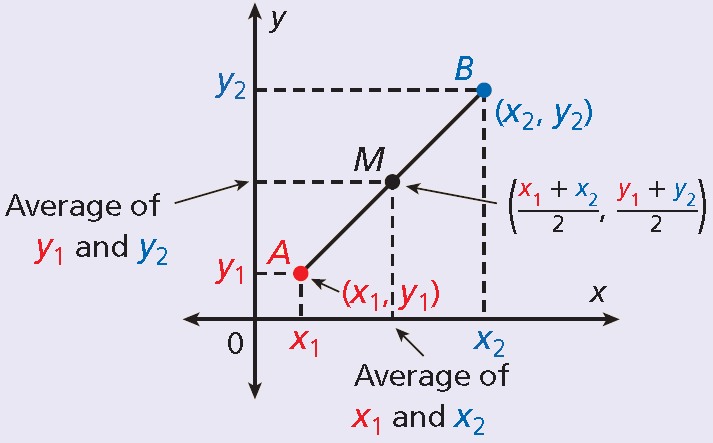
\(A(2,3)\quad\text{and}\quad B(8,9)\)
Use:
\(M\left(\frac{x_1+x_2}{2},\frac{y_1+y_2}{2}\right)\)
Substitute the coordinates:
\(M\left(\frac{2+8}{2},\frac{3+9}{2}\right)\)
\(M\left(\frac{10}{2},\frac{12}{2}\right)\)
\(M(5,6)\)
Therefore, the midpoint is \((5,6)\).
⚠️ Common Mistake:
Do not average all four numbers together.
Average the \(x\)-coordinates together and the \(y\)-coordinates together:
\(\displaystyle M\left(\frac{x_1+x_2}{2},\frac{y_1+y_2}{2}\right)\)
Midpoint as a Point Halfway Between Two Points
Suppose \(M\) is the midpoint of \(AB\).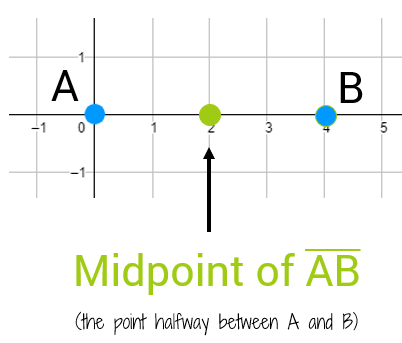
Then:
\(AM=MB\)
For example, if:
\(A(1,2),\quad B(7,8)\)
the midpoint is:
\(M(4,5)\)
The midpoint divides the segment into two equal parts.
🧠 Key Idea:
A midpoint is an average.
Average the two \(x\)-coordinates to get the midpoint’s \(x\)-coordinate.
Average the two \(y\)-coordinates to get the midpoint’s \(y\)-coordinate.
Distance and Midpoint Together
Distance and midpoint questions often appear together.
For two points:
\(A(x_1,y_1),\quad B(x_2,y_2)\)
you may need to find:
- The distance \(AB\).
- The midpoint of \(AB\).
- A missing endpoint.
- Whether a point is the midpoint.
| What You Need | Method |
|---|---|
| Distance | Use Pythagoras’ theorem / distance formula |
| Midpoint | Average the \(x\)-coordinates and \(y\)-coordinates |
| Missing endpoint | Use the midpoint equations and solve |
🎯 MYP 3 Problem-Solving Strategy
For distance:
1. Identify the two points.
2. Find the horizontal and vertical changes.
3. Apply the distance formula.
4. Simplify the answer.
For midpoint:
1. Add the two (x)-coordinates and divide by (2).
2. Add the two (y)-coordinates and divide by (2).
3. Write the result as an ordered pair.
Example 1:
The endpoints of a line segment are:
\(A(-2,3)\quad\text{and}\quad B(4,11)\)
a) Find the horizontal and vertical changes between \(A\) and \(B\).
b) Find the exact distance \(AB\).
c) Find the midpoint of \(AB\).
d) Explain why the midpoint is halfway between the two endpoints.
▶️ Answer/Explanation
Answer
a) Horizontal and vertical changes
Horizontal change:
\(4-(-2)=6\)
Vertical change:
\(11-3=8\)
b) Distance
Use:
\(d=\sqrt{(x_2-x_1)^2+(y_2-y_1)^2}\)
\(d=\sqrt{(4-(-2))^2+(11-3)^2}\)
\(d=\sqrt{6^2+8^2}\)
\(d=\sqrt{36+64}\)
\(d=\sqrt{100}\)
\(d=10\)
Therefore, \(AB=10\) units.
c) Midpoint
Use:
\(M\left(\frac{x_1+x_2}{2},\frac{y_1+y_2}{2}\right)\)
\(M\left(\frac{-2+4}{2},\frac{3+11}{2}\right)\)
\(M\left(\frac{2}{2},\frac{14}{2}\right)\)
\(M(1,7)\)
d) Explanation
The midpoint averages the coordinates of the two endpoints, so it lies exactly halfway along the segment.
Indeed, the distance from \(A\) to \(M\) and from \(M\) to \(B\) is the same:
\(AM=MB=5\text{ units}\)
Example 2:
Point \(M(3,5)\) is the midpoint of the line segment joining \(A(-1,2)\) and \(B(x,y)\).
a) Find the \(x\)-coordinate of \(B\).
b) Find the \(y\)-coordinate of \(B\).
c) State the coordinates of \(B\).
d) Find the distance \(AB\).
▶️ Answer/Explanation
Answer
a) Find the \(x\)-coordinate
Use the midpoint formula:
\(3=\frac{-1+x}{2}\)
Multiply both sides by \(2\):
\(6=-1+x\)
\(x=7\)
b) Find the \(y\)-coordinate
Use the \(y\)-coordinates:
\(5=\frac{2+y}{2}\)
Multiply both sides by \(2\):
\(10=2+y\)
\(y=8\)
c) Coordinates of \(B\)
\(B(7,8)\)
d) Distance \(AB\)
The points are \(A(-1,2)\) and \(B(7,8)\).
\(d=\sqrt{(7-(-1))^2+(8-2)^2}\)
\(d=\sqrt{8^2+6^2}\)
\(d=\sqrt{64+36}\)
\(d=\sqrt{100}\)
\(d=10\)
Therefore, \(AB=10\) units.