
5.5 – Parallel and Perpendicular Lines
Lines on the Cartesian plane can have different relationships with one another. Two important relationships are parallel lines and perpendicular lines.
These relationships can be identified by comparing the gradients of the lines.
Parallel Lines
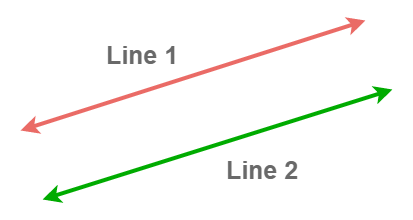
Parallel lines are lines in the same plane that remain the same distance apart and never meet, even if they are extended indefinitely.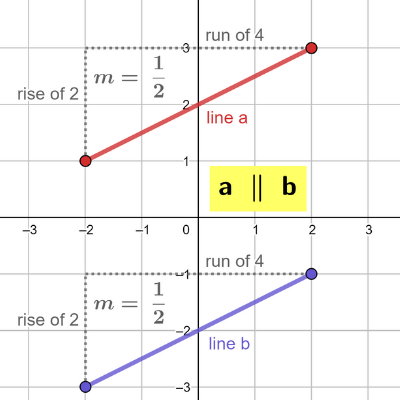
On a coordinate plane, non-vertical parallel lines have the same gradient.
For example:
\(y=\dfrac {1 }{2}x+3\) and \(y=\dfrac {1}{2}x-5\)
Both lines have gradient \(2\), so they are parallel.
| Line | Gradient | \(y\)-intercept |
|---|---|---|
| \(y=\dfrac {1 }{2}x+3\) | \(2\) | \(3\) |
| \(y=\dfrac {1}{2}x-5\) | \(2\) | \(-5\) |
The gradients are equal, but the \(y\)-intercepts are different. Therefore, the lines are distinct parallel lines.
💡 Key Rule for Parallel Lines
For two distinct non-vertical straight lines:
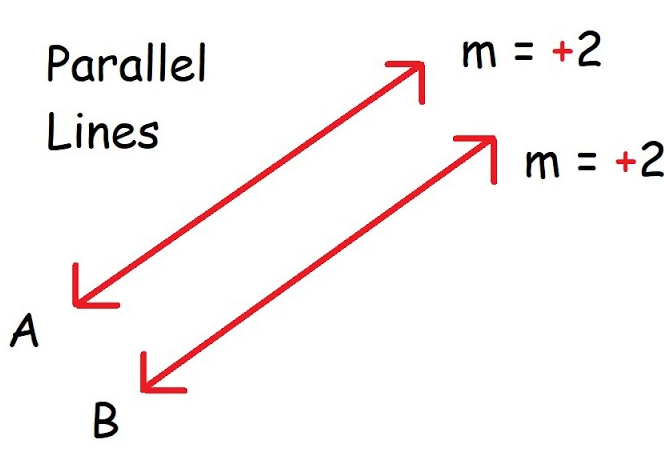
\(\boxed{m_1=m_2}\)
Same gradient → Parallel lines
How to Identify Parallel Lines
When given two equations:
- Write both equations in the form \(y=mx+c\), if necessary.
- Identify the gradient of each line.
- Compare the gradients.
- If the gradients are equal and the lines are different, the lines are parallel.
For example, consider:
\(y=-3x+4\)
and
\(y=-3x-7\)
Their gradients are:
\(m_1=-3,\qquad m_2=-3\)
Since:
\(m_1=m_2\)
the lines are parallel.
⚠️ Important:
Having the same gradient does not mean the equations are identical.
\(y=2x+3\) and \(y=2x-5\) have the same gradient but different \(y\)-intercepts, so they are different parallel lines.
Perpendicular Lines
Perpendicular lines intersect at a right angle of \(90^\circ\).
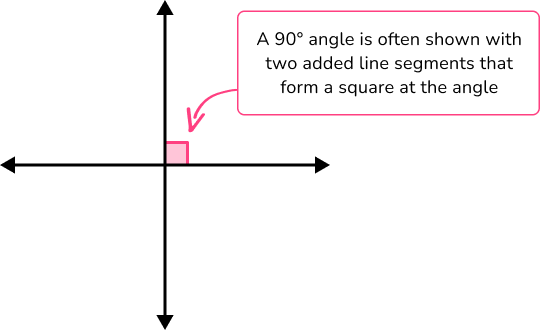
For non-horizontal and non-vertical lines, the gradients of perpendicular lines are related by negative reciprocals.
If one line has gradient:
\(m_1=2\)
then a perpendicular line has gradient:
\(m_2=-\frac{1}{2}\)
Notice that the sign changes and the fraction is inverted.
📌 Key Rule for Perpendicular Lines
For two non-vertical, non-horizontal perpendicular lines:
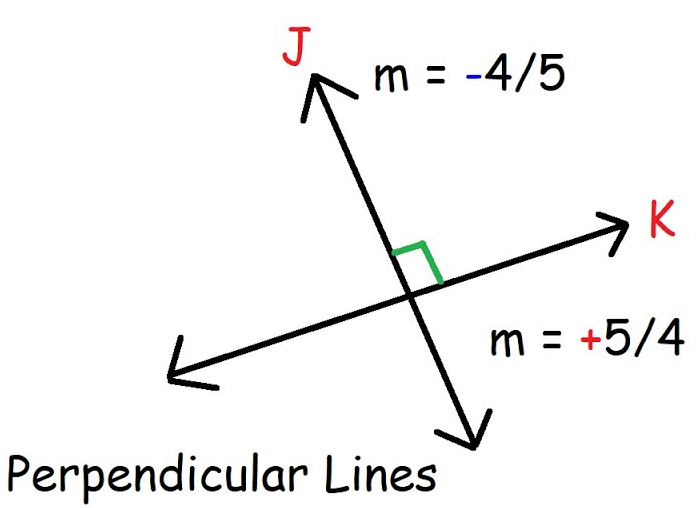
\(\boxed{m_1m_2=-1}\)
Equivalently:
\(\boxed{m_2=-\frac{1}{m_1}}\)
Finding the Negative Reciprocal
To find the negative reciprocal of a gradient:
- Change the sign.
- Turn the fraction upside down.
| Original Gradient | Perpendicular Gradient |
|---|---|
| \(2\) | \(-\frac{1}{2}\) |
| \(-3\) | \(\frac{1}{3}\) |
| \(\frac{4}{5}\) | \(-\frac{5}{4}\) |
| \(-\frac{2}{7}\) | \(\frac{7}{2}\) |
For example, if:
\(m=5\)
the perpendicular gradient is:
\(m=-\frac{1}{5}\)
If:
\(m=-\frac{3}{4}\)
the perpendicular gradient is:
\(m=\frac{4}{3}\)
⚠️ Common Mistake:
Do not simply change the sign.
The perpendicular gradient of \(2\) is \(-\frac{1}{2}\), not \(-2\).
Comparing Parallel and Perpendicular Lines
| Relationship | Gradient Relationship | Angle |
|---|---|---|
| Parallel | \(m_1=m_2\) | Lines do not intersect |
| Perpendicular | \(m_1m_2=-1\) | \(90^\circ\) |
Parallel Lines from an Equation
Suppose a line has equation: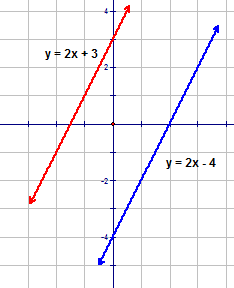
\(y=2x+3\)
Its gradient is \(2\).
Any distinct line parallel to it must also have gradient \(2\).
For example:
\(y=2x-4\)
is parallel to \(y=2x+3\).
Notice that the \(y\)-intercept can be different.
Perpendicular Lines from an Equation
Suppose a line has equation: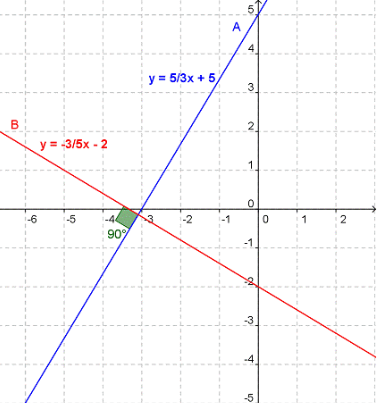
\(y=\dfrac{5}{3}x+5\)
Its gradient is:
\(m_1=\dfrac{5}{3}\)
The perpendicular gradient is:
\(m_2=-\frac{3}{5}\)
Therefore, any line with gradient \(-\frac{3}{5}\) will be perpendicular to the original line, provided that the two lines intersect.
For example:
\(y=-\frac{3}{5}x-2\)
is perpendicular to:
\(y=\dfrac{5}{3}x+5\)
Finding the Equation of a Parallel Line
Suppose we need to find the equation of a line parallel to:
\(y=2x+3\)
and passing through the point:
\((2,0)\)
Step 1: Identify the gradient.
\(m=2\)
A parallel line has the same gradient:
\(y=2x+c\)
Step 2: Substitute the given point.
\(0=2(2)+c\)
\(0=4+c\)
\(c=-4\)
Step 3: Write the equation.
\(y=2x-4\)
Therefore, the required line is \(y=2x-4\).
Finding the Equation of a Perpendicular Line
Suppose we need to find the equation of a line perpendicular to:
\(y=-2x+4\)
and passing through \((6,1)\).
Step 1: Identify the original gradient.
\(m_1=-2\)
Step 2: Find the negative reciprocal.
\(m_2=\frac{1}{2}\)
Step 3: Start the new equation.
\(y=\frac{1}{2}x+c\)
Step 4: Substitute \((6,1)\).
\(1=\frac{1}{2}(6)+c\)
\(1=3+c\)
\(c=-2\)
Step 5: Write the equation.
\(y=\frac{1}{2}x-2\)
Therefore, the required perpendicular line is \(y=\frac{1}{2}x-2\).
🎯 MYP 3 Strategy
Parallel: Keep the same gradient.
Perpendicular: Find the negative reciprocal of the gradient.
Then use the given point and \(y=mx+c\) to find the equation.
Horizontal and Vertical Lines
There is a special relationship between horizontal and vertical lines.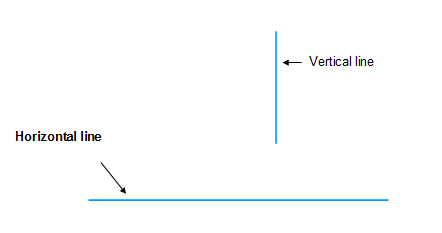
A horizontal line has gradient:
\(m=0\)
A vertical line has an undefined gradient.
A horizontal line and a vertical line intersect at \(90^\circ\), so they are perpendicular.
| Line | Gradient | Example |
|---|---|---|
| Horizontal | \(0\) | \(y=4\) |
| Vertical | Undefined | \(x=4\) |
Therefore, \(y=4\) and \(x=4\) are perpendicular lines.
⚠️ Remember:
The negative reciprocal rule is mainly used for ordinary non-horizontal, non-vertical lines.
For a horizontal line and a vertical line, simply recognise that they meet at a right angle.
Example 1:
Consider the following three lines:
\(L_1:y=3x+2\)
\(L_2:y=3x-7\)
\(L_3:y=-\frac{1}{3}x+5\)
a) Identify the gradients of the three lines.
b) Which two lines are parallel?
c) Which line is perpendicular to \(L_1\)?
d) Explain your answers using the relationship between gradients.
▶️ Answer/Explanation
Answer
a) Gradients
From \(y=mx+c\):
\(m_1=3\)
\(m_2=3\)
\(m_3=-\frac{1}{3}\)
b) Parallel lines
\(L_1\) and \(L_2\) have the same gradient:
\(m_1=m_2=3\)
Therefore, \(L_1\) and \(L_2\) are parallel.
c) Perpendicular line
The negative reciprocal of \(3\) is:
\(-\frac{1}{3}\)
Since \(L_3\) has gradient \(-\frac{1}{3}\), \(L_3\) is perpendicular to \(L_1\).
d) Explanation
Parallel lines have equal gradients.
Perpendicular lines have gradients whose product is \(-1\):
\(3\left(-\frac{1}{3}\right)=-1\)
Example 2:
The line \(L\) has equation:
\(y=-4x+6\)
a) Find the equation of the line parallel to \(L\) that passes through \((2,5)\).
b) Find the equation of the line perpendicular to \(L\) that passes through \((2,5)\).
c) State the gradients of all three lines.
d) Explain why your two new lines have the required relationships with \(L\).
▶️ Answer/Explanation
Answer
a) Parallel line
The original gradient is:
\(m=-4\)
A parallel line has the same gradient:
\(y=-4x+c\)
Use \((2,5)\):
\(5=-4(2)+c\)
\(5=-8+c\)
\(c=13\)
Therefore:
\(y=-4x+13\)
b) Perpendicular line
The negative reciprocal of \(-4\) is:
\(m=\frac{1}{4}\)
Therefore:
\(y=\frac{1}{4}x+c\)
Use \((2,5)\):
\(5=\frac{1}{4}(2)+c\)
\(5=\frac{1}{2}+c\)
\(c=\frac{9}{2}\)
Therefore:
\(y=\frac{1}{4}x+\frac{9}{2}\)
c) Gradients
L:\quad -4
\text{Parallel line}:\quad -4
\text{Perpendicular line}:\quad \frac{1}{4}
d) Explanation
The parallel line has the same gradient as \(L\), so they are parallel.
For the perpendicular line:
\((-4)\left(\frac{1}{4}\right)=-1\)
Therefore, the gradients satisfy the perpendicular relationship.