
6.1 – Angles, Parallel Lines and Transversals
Angles are formed when two lines or line segments meet. Understanding the relationships between angles allows us to calculate unknown angles, identify parallel and perpendicular lines, and solve geometric problems involving diagrams.
In this topic, we will learn how to classify angles, use basic angle properties, recognize parallel and perpendicular lines, and solve problems involving transversals.
What Is an Angle?
An angle is formed when two rays or line segments meet at a common endpoint.
The common endpoint is called the vertex, and the two rays forming the angle are called its arms.
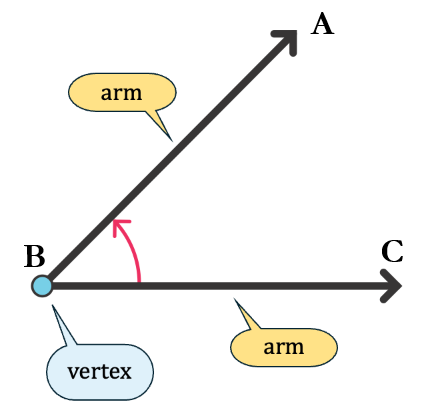
\(\angle ABC\)
In \(\angle ABC\), the middle letter \(B\) identifies the vertex.
When naming an angle using three letters, the vertex is always the middle letter.
Measuring Angles
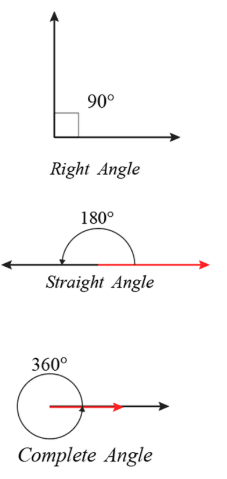
Angles are measured in degrees, written using the symbol \(^{\circ}\).
| Angle Type | Size | Description |
|---|---|---|
Acute | \(0^{\circ}<x<90^{\circ}\) | Smaller than a right angle |
Right
| \(x=90^{\circ}\) | Exactly a quarter turn |
Obtuse
| \(90^{\circ}<x<180^{\circ}\) | Between a right and straight angle |
Straight
| \(x=180^{\circ}\) | A half turn |
Reflex
| \(180^{\circ}<x<360^{\circ}\) | Greater than a straight angle |
Full turn
| \(x=360^{\circ}\) | One complete rotation |
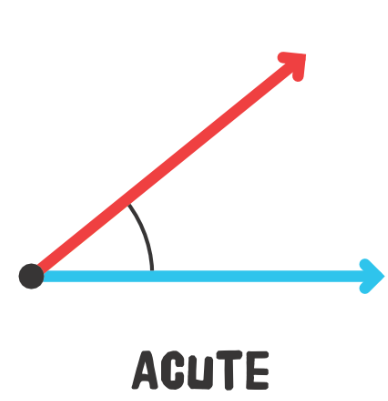
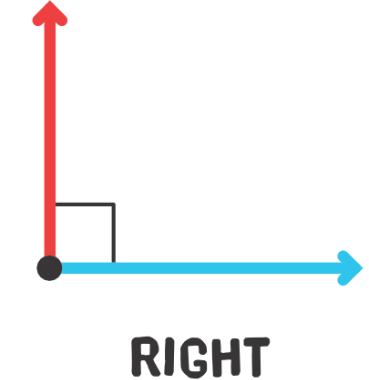
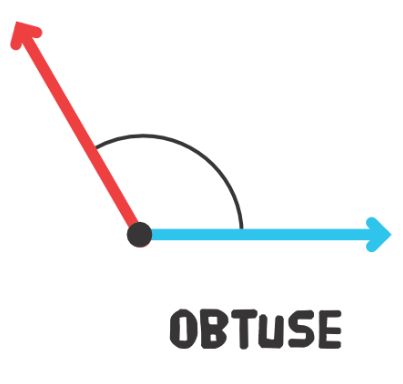
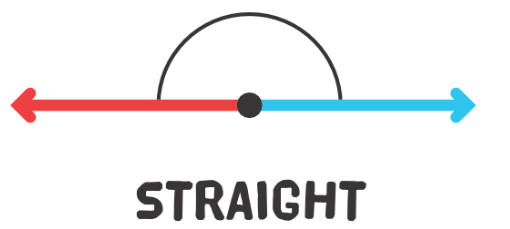
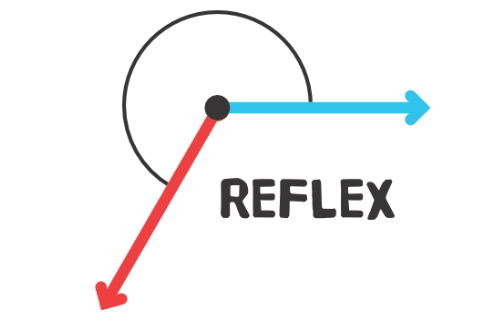
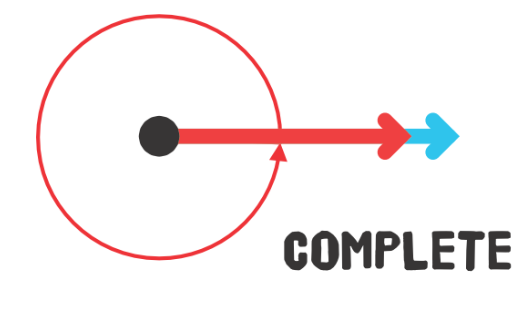
The size of an angle depends on the amount of turn between its arms, not on the lengths of the arms.
Complementary Angles
Two angles are complementary if their measures add to \(90^{\circ}\).
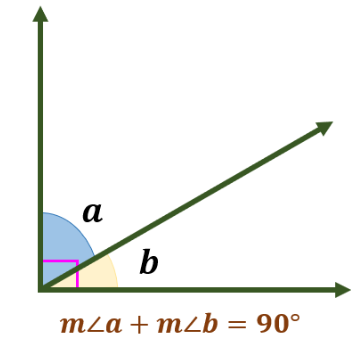
\(a+b=90^{\circ}\)
For example, if one angle is \(35^{\circ}\), its complement is:
\(90^{\circ}-35^{\circ}=55^{\circ}\)
If two angles form a right angle, they are complementary.
Supplementary Angles
Two angles are supplementary if their measures add to \(180^{\circ}\).
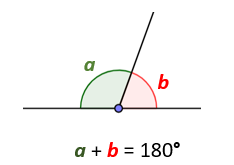
\(a+b=180^{\circ}\)
For example, if one angle is \(125^{\circ}\):
\(180^{\circ}-125^{\circ}=55^{\circ}\)
Therefore, the supplementary angle is \(55^{\circ}\).
| Relationship | Total |
|---|---|
| Complementary | \(90^{\circ}\) |
| Supplementary | \(180^{\circ}\) |
Angles at a Point
Angles around a single point make one complete turn.
\(\text{Angles at a point}=360^{\circ}\)
If three angles meet at a point:
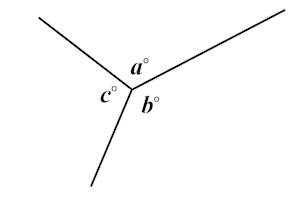
\(a+b+c=360^{\circ}\)
This property is useful when several angles surround the same point.
Angles on a Straight Line
Angles that lie on a straight line add to \(180^{\circ}\).
\(a+b=180^{\circ}\)
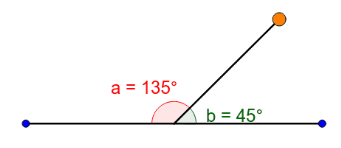
This is also called a linear pair when two adjacent angles form a straight line.
If you see a straight line in a diagram, immediately look for angles that add to \(180^{\circ}\).
Vertically Opposite Angles
When two straight lines intersect, they form two pairs of vertically opposite angles.
Vertically opposite angles are always equal.
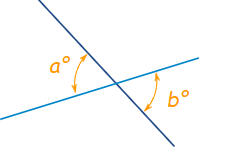
\(a=b\)
For example, if one angle formed by two intersecting lines is \(68^{\circ}\), the angle directly opposite it is also:
\(68^{\circ}\)
Vertically opposite angles are equal.
Adjacent angles on a straight line are supplementary.
Parallel Lines
Parallel lines are lines in the same plane that never meet, no matter how far they are extended.
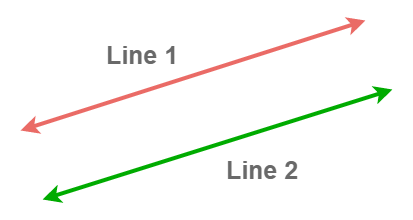
The symbol \(||\) means parallel to.
\((AB)||(CD)\)
Parallel lines are usually marked with matching arrowheads on a diagram.
Matching arrow marks on two lines indicate that the lines are parallel.
Perpendicular Lines
Perpendicular lines intersect at a right angle.
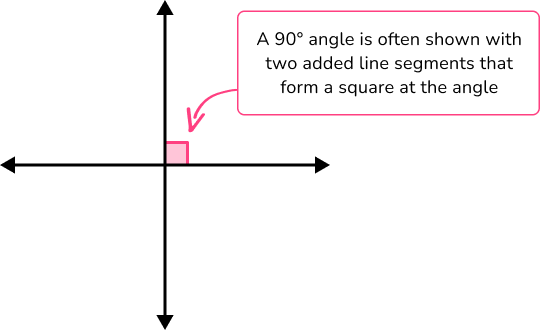
The symbol \(\perp\) means perpendicular to.
\((AB)\perp(CD)\)
A small square at an intersection is used to show that the angle is \(90^{\circ}\).
What Is a Transversal?
A transversal is a line that crosses two or more other lines at different points.
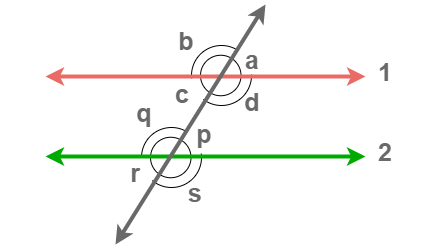
When a transversal crosses two parallel lines, it creates several important angle relationships.
The special angle relationships involving corresponding, alternate and co-interior angles depend on the two lines being parallel.
Corresponding Angles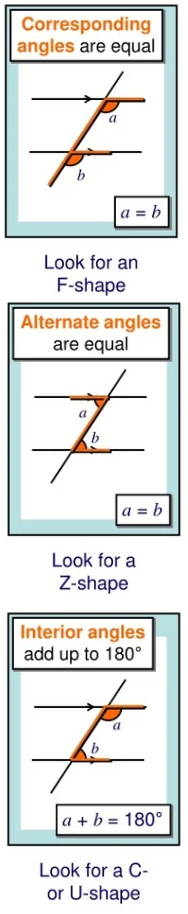
When a transversal crosses two parallel lines, corresponding angles are equal.
Corresponding angles occupy the same relative position at the two intersections.
\(a=b\)
For example, if a corresponding angle is \(72^{\circ}\), the other corresponding angle is also:
\(72^{\circ}\)
Alternate Angles
When a transversal crosses two parallel lines, alternate angles are equal.
They lie on opposite sides of the transversal.
\(a=b\)
A useful way to recognize them is to look for angles that form a zig-zag pattern between the parallel lines.
Co-interior Angles
Co-interior angles are angles lying between the two parallel lines and on the same side of the transversal.
They are supplementary.
\(a+b=180^{\circ}\)
For example, if one co-interior angle is \(115^{\circ}\):
\(b=180^{\circ}-115^{\circ}\)
\(b=65^{\circ}\)
| Angle Pair | Relationship | What to Remember |
|---|---|---|
| Corresponding | Equal | Same relative position |
| Alternate | Equal | Opposite sides of transversal |
| Co-interior | Add to \(180^{\circ}\) | Same side of transversal, between parallel lines |
Corresponding → Equal
Alternate → Equal
Co-interior → \(180^{\circ}\)
Using Angles to Prove Lines Are Parallel
The angle relationships can also be used in the opposite direction.
- If a pair of corresponding angles is equal, this can indicate that the two lines are parallel.
- Similarly, if alternate angles are equal, or co-interior angles add to \(180^{\circ}\), the two lines can be shown to be parallel.
Do not use corresponding, alternate or co-interior angle rules just because two lines look parallel. Look for parallel-line markings or use the given angle information to establish parallelism.
Solving Unknown-Angle Problems
When solving an unknown-angle problem, do not simply write the answer. Identify the angle relationship that allows you to calculate it.
🎯 MYP Problem-Solving Strategy
1. Identify the lines and angles in the diagram.
2. Look for a right angle, straight line, point, or intersecting lines.
3. Check whether any lines are parallel.
4. Identify the angle relationship being used.
5. Write an equation.
6. Solve for the unknown.
7. State the reason or theorem used.
Example 1:
Two adjacent angles on a straight line are \(3x^{\circ}\) and \(45^{\circ}\).
Find \(x\).
▶️ Answer/Explanation
Answer
Angles on a straight line add to \(180^{\circ}\).
\(3x+45=180\)
\(3x=135\)
\(x=45\)
Therefore, \(x=45\).
Example 2:
Two straight lines intersect. One angle is \(128^{\circ}\). Find the vertically opposite angle.
▶️ Answer/Explanation
Answer
Vertically opposite angles are equal.
\(x=128^{\circ}\)
Therefore, the vertically opposite angle is \(128^{\circ}\).
Example 3:
Two parallel lines are cut by a transversal. One angle is \(72^{\circ}\), and the corresponding angle is \(x^{\circ}\).
Find \(x\).
▶️ Answer/Explanation
Answer
The lines are parallel, so corresponding angles are equal.
\(x=72^{\circ}\)
Therefore, \(x=72^{\circ}\).
Example 4:
Two parallel lines are cut by a transversal. Two co-interior angles are \((2x+10)^{\circ}\) and \(70^{\circ}\).
Find \(x\).
▶️ Answer/Explanation
Answer
Co-interior angles on parallel lines are supplementary.
\((2x+10)+70=180\)
\(2x+80=180\)
\(2x=100\)
\(x=50\)
Therefore, \(x=50\).
Example 5:
Two parallel lines are cut by a transversal. One angle is \(115^{\circ}\). An angle \(x^{\circ}\) is adjacent to the corresponding angle.
Find \(x\).
▶️ Answer/Explanation
Answer
First, the corresponding angle is equal to \(115^{\circ}\).
\(\text{Corresponding angle}=115^{\circ}\)
The angle \(x\) forms a straight line with this angle, so the two angles are supplementary.
\(x+115=180\)
\(x=65\)
Therefore, \(x=65^{\circ}\).