
6.2 – Triangle Theorems, Quadrilaterals and Polygons
Triangles and polygons are important building blocks of geometry. By studying the relationships between their sides and angles, we can calculate unknown angles, classify shapes, and solve more complicated geometric problems.
The Angle Sum of a Triangle
A triangle has exactly three interior angles. No matter what type of triangle we have, the three interior angles always add to \(180^\circ\).
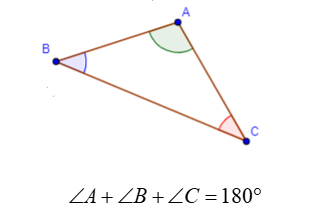
📌 Triangle Angle Sum Theorem
The sum of the interior angles of any triangle is \(180^\circ\).
Therefore, if two angles are known, the third angle can always be found by subtracting their sum from \(180^\circ\).
For example, if two angles are \(65^\circ\) and \(48^\circ\):
\(x+113^\circ=180^\circ\)
\(x=67^\circ\)
Example 1:
A triangle has angles \(72^\circ\), \(43^\circ\), and \(x^\circ\). Find \(x\).
▶️ Answer/Explanation
The interior angles of a triangle add to \(180^\circ\).
\(x+115=180\)
\(x=65^\circ\)
Therefore, \(x=65^\circ\).
Exterior Angles of a Triangle
An exterior angle is formed when one side of a triangle is extended. It lies outside the triangle.
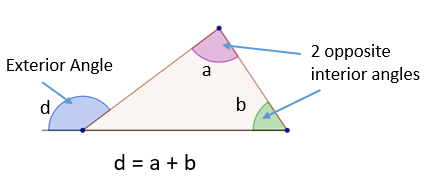
⭐ Exterior Angle Theorem
An exterior angle of a triangle is equal to the sum of the two opposite interior angles.
For example, if the two opposite interior angles are \(52^\circ\) and \(67^\circ\):
\(x=119^\circ\)
💡 Another Way to Think About It
The exterior angle and the adjacent interior angle form a straight line, so they add to \(180^\circ\).
Example 2:
An exterior angle of a triangle is \(132^\circ\). One of the opposite interior angles is \(58^\circ\). Find the other opposite interior angle \(x\).
▶️ Answer/Explanation
By the exterior angle theorem:
\(x=132-58\)
\(x=74^\circ\)
Therefore, \(x=74^\circ\).
Isosceles Triangles
An isosceles triangle has at least two equal sides.
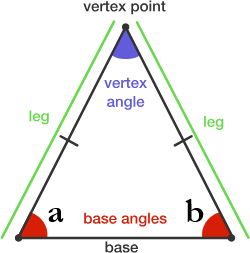
The important parts of an isosceles triangle are:
| Part | Meaning |
|---|---|
| Equal sides | Two sides have the same length. |
| Base | The side that is not one of the equal sides. |
| Apex | The vertex between the two equal sides. |
| Base angles | The two angles opposite the equal sides. |
⭐ Isosceles Triangle Theorem
The base angles of an isosceles triangle are equal.
This gives us a very useful two-step strategy:
- Use the equal sides to identify the equal base angles.
- Use the triangle angle sum to find any remaining angle.
Example 3:
An isosceles triangle has a vertex angle of \(46^\circ\). Find each base angle.
▶️ Answer/Explanation
The two base angles are equal. Let each one be \(x\).
\(2x+46=180\)
\(2x=134\)
\(x=67^\circ\)
Each base angle is \(67^\circ\).
🔍 Converse of the Isosceles Triangle Theorem
If a triangle has two equal angles, then the sides opposite those angles are equal. Therefore, the triangle is isosceles.
Longest Side and Largest Angle
There is an important relationship between the side lengths and angles of a triangle.
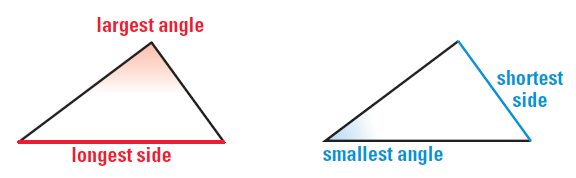
📌 Triangle Side-Angle Relationship
- The longest side is opposite the largest angle.
- The shortest side is opposite the smallest angle.
The word opposite is important. To find the side opposite an angle, look directly across the triangle from that angle.
🧠 Quick Strategy
Largest angle ↔ Longest side
Smallest angle ↔ Shortest side
What Is a Quadrilateral?
A quadrilateral is a polygon with four sides. It therefore has four vertices and four interior angles.
There are several important special quadrilaterals. They may share some properties, but each has its own defining characteristics.
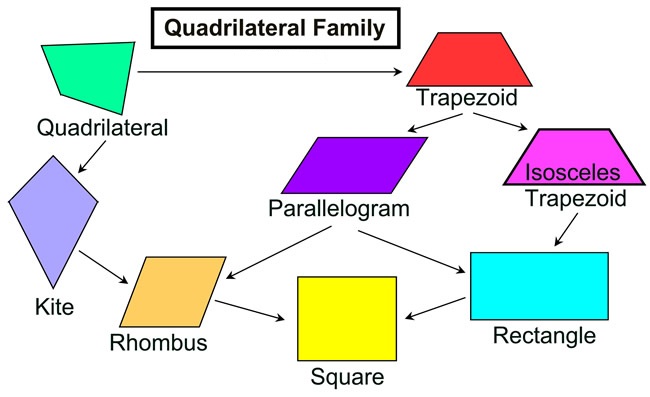
| Quadrilateral | Key Definition | Important Properties |
|---|---|---|
| Parallelogram | Both pairs of opposite sides are parallel. | Opposite sides are equal. Opposite angles are equal. Diagonals bisect each other. |
| Rectangle | A parallelogram with four right angles. | Opposite sides are equal and parallel. Diagonals are equal. Diagonals bisect each other. |
| Rhombus | All four sides are equal. | Opposite sides are parallel. Opposite angles are equal. Diagonals bisect each other at right angles. Diagonals bisect the vertex angles. |
| Square | A rectangle with all four sides equal. | Four equal sides. Four right angles. Equal diagonals. Diagonals bisect each other at right angles. |
| Trapezium | One pair of opposite sides is parallel. | The defining property is the single pair of parallel opposite sides. |
| Kite | Two pairs of adjacent sides are equal. | Diagonals intersect at right angles. One diagonal bisects the other. One diagonal acts as a line of symmetry. |
⚠️ Important Classification Idea
Some quadrilaterals belong to more than one category. For example, a square is also a rectangle, a rhombus, and a parallelogram.
Parallelogram Properties
A parallelogram has two pairs of parallel opposite sides. This creates several useful angle and length relationships.
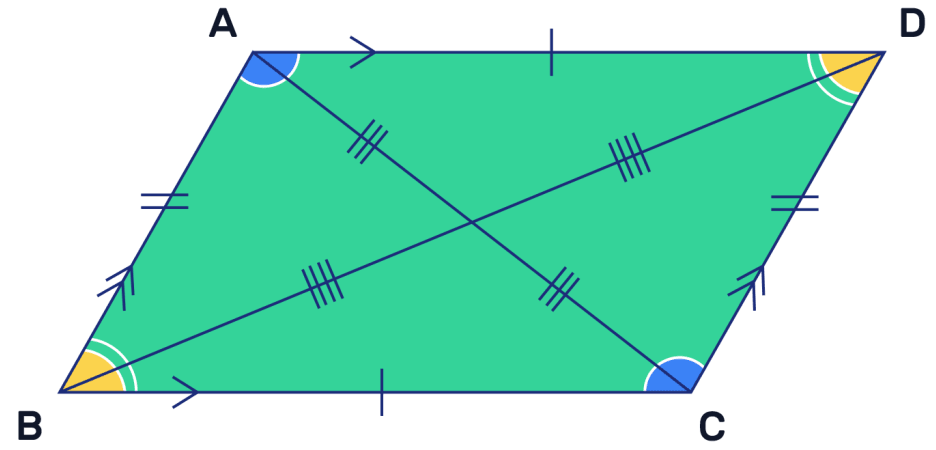
⭐ Properties of a Parallelogram
- Opposite sides are equal.
- Opposite sides are parallel.
- Opposite angles are equal.
- Adjacent angles add to \(180^\circ\).
- The diagonals bisect each other.
For example, if one angle of a parallelogram is \(68^\circ\), the opposite angle is also \(68^\circ\), while each adjacent angle is:
The Angle Sum of a Quadrilateral
A quadrilateral can be divided into two triangles by drawing one diagonal.
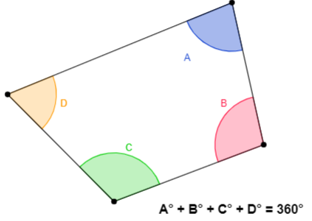
Since each triangle has an angle sum of \(180^\circ\):
📌 Quadrilateral Angle Sum Theorem
The sum of the interior angles of any quadrilateral is \(360^\circ\).
Example 4:
Three interior angles of a quadrilateral are \(82^\circ\), \(96^\circ\), and \(115^\circ\). Find the fourth angle \(x\).
▶️ Answer/Explanation
The interior angles of a quadrilateral add to \(360^\circ\).
\(293+x=360\)
\(x=67^\circ\)
Therefore, \(x=67^\circ\).
What Is a Polygon?
A polygon is a closed plane figure made only from straight line segments. Its sides do not cross each other.
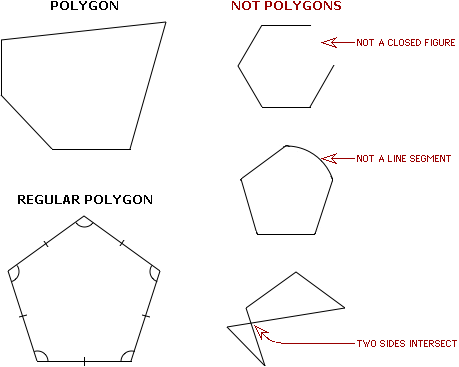
The corners of a polygon are called vertices.
| Number of Sides | Name |
|---|---|
| 3 | Triangle |
| 4 | Quadrilateral |
| 5 | Pentagon |
| 6 | Hexagon |
| 7 | Heptagon |
| 8 | Octagon |
| 9 | Nonagon |
| 10 | Decagon |
Interior Angle Sum of an \(n\)-Sided Polygon
We can find the angle sum of any polygon by dividing it into triangles.
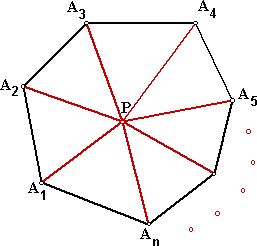
From one vertex, draw diagonals to all the non-adjacent vertices. This divides an \(n\)-sided polygon into:
Each triangle has an angle sum of \(180^\circ\), so:
⭐ Polygon Interior Angle Sum Formula
where \(n\) is the number of sides.
| Polygon | \(n\) | Interior Angle Sum |
|---|---|---|
| Triangle | 3 | \(180^\circ\) |
| Quadrilateral | 4 | \(360^\circ\) |
| Pentagon | 5 | \(540^\circ\) |
| Hexagon | 6 | \(720^\circ\) |
| Octagon | 8 | \(1080^\circ\) |
Example 5:
Find the sum of the interior angles of a decagon.
▶️ Answer/Explanation
A decagon has \(10\) sides, so \(n=10\).
\(=(10-2)\times180^\circ\)
\(=8\times180^\circ\)
\(=1440^\circ\)
Therefore, the interior angle sum is \(1440^\circ\).
Regular Polygons
A regular polygon has:
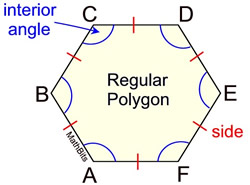
- all sides equal in length, and
- all interior angles equal in size.
Once we know the total interior angle sum, we can find the size of each interior angle by dividing by the number of sides.
📌 Interior Angle of a Regular Polygon
Example 6:
Find the size of each interior angle of a regular octagon.
▶️ Answer/Explanation
An octagon has \(8\) sides.
First find the total interior angle sum:
Since the polygon is regular, all eight angles are equal.
Therefore, each interior angle is \(135^\circ\).
Exterior Angles of a Polygon
An exterior angle is formed when one side of a polygon is extended. For a convex polygon, one exterior angle can be considered at each vertex.
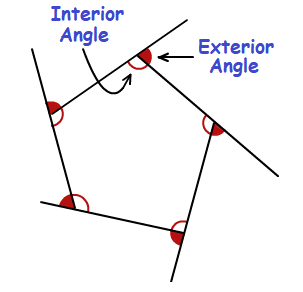
⭐ Exterior Angle Sum
The sum of one exterior angle at each vertex of a convex polygon is always \(360^\circ\).
This is true regardless of how many sides the polygon has.
For a regular polygon, all exterior angles are equal. Therefore:
📌 Exterior Angle of a Regular Polygon
Example 7:
Find each exterior angle of a regular decagon.
▶️ Answer/Explanation
A decagon has \(10\) sides.
Therefore, each exterior angle is \(36^\circ\).
Connecting Interior and Exterior Angles
At each vertex of a polygon, an interior angle and its adjacent exterior angle form a straight line.
Therefore, if the interior angle of a regular polygon is known, its exterior angle can be found by subtracting from \(180^\circ\).
Example 8:
A regular polygon has an exterior angle of \(30^\circ\). Find the number of sides.
▶️ Answer/Explanation
The exterior angles of a polygon add to \(360^\circ\). Since the polygon is regular, all exterior angles are equal.
\(n=\frac{360}{30}\)
\(n=12\)
Therefore, the polygon has \(12\) sides.
Solving Multi-Step Geometry Problems
Some MYP problems require more than one theorem. You may need to use a triangle theorem first and then use a parallel-line, quadrilateral, or polygon property.
🎯 MYP Problem-Solving Strategy
- Read all the information in the diagram.
- Look for equal-side markings, parallel-line markings, or right-angle markings.
- Identify the shape or shapes involved.
- Choose the theorem that connects the known information to the unknown.
- Write an equation.
- Solve carefully.
- State the theorem or reason used.
- Check that the answer is reasonable for the diagram.
⚠️ Do Not Rely on the Appearance of a Diagram
A geometry diagram may not be drawn to scale. Do not assume that two sides are equal or two angles are equal simply because they look equal.
Use only the information that is given or that can be logically deduced from a theorem.
Example 9:
An isosceles triangle has two equal sides. Its vertex angle is \((2x+10)^\circ\), and each base angle is \((3x-5)^\circ\). Find \(x\).
▶️ Answer/Explanation
The two base angles are equal, so the three angles are:
Simplify:
\(8x=180\)
\(x=22.5\)
Therefore:
\(\text{Base angle}=3(22.5)-5=62.5^\circ\)
Check:
Therefore, \(x=22.5\).