
6.3 – Congruent and Similar Triangles
Congruence and similarity allow us to compare geometric figures without measuring every part of them. Congruent figures have exactly the same size and shape, while similar figures have the same shape but may have different sizes.
In this section, we will develop tests for proving that triangles are congruent or similar, use congruence to justify geometric properties, and use similar triangles to calculate unknown lengths and solve practical problems.
Congruent Figures
Two figures are congruent if they are identical in size and shape.
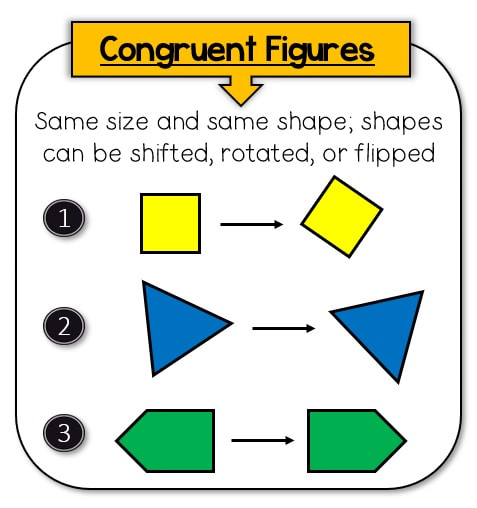
Congruent figures do not need to have the same position or orientation. One figure may be translated, rotated or reflected and still remain congruent to the original figure.
Definition
Congruent figures have exactly the same size and shape.
They can be placed exactly on top of each other using a combination of translations, rotations and reflections.
An enlargement or reduction changes the size of a figure, so the original figure and its image are generally similar, not congruent.
Example 1:
Two triangles have exactly the same side lengths and the same angle sizes, but one triangle has been rotated. Are the triangles congruent?
▶️ Answer/Explanation
Yes. Rotation changes the position or orientation of a figure but does not change its size or shape.
Therefore, the two triangles are congruent.
Congruent Triangles
Two triangles are congruent when they have exactly the same size and shape. However, we do not need to know every side and every angle to prove congruence.
There are specific sets of information that are sufficient to prove that two triangles are congruent. The source identifies four tests: SSS, SAS, AAcorS and RHS.
⭐ SSS — Side, Side, Side
If all three corresponding sides of two triangles are equal in length, the triangles are congruent.
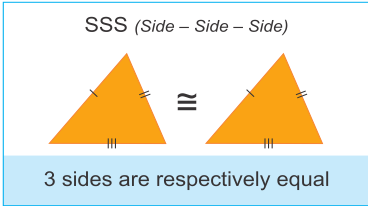
\(AB=XY\)
\(BC=YZ\)
\(AC=XZ\)
\(\therefore \triangle ABC\cong\triangle XYZ\quad\{SSS\}\)
⭐ SAS — Side, Angle, Side
If two corresponding sides and the included angle between them are equal, the triangles are congruent.
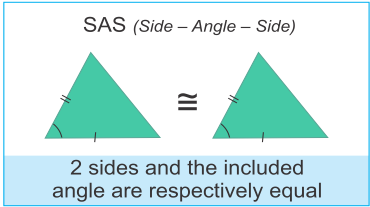
The word included is important: the angle must lie between the two given sides.
\(AB=XY\)
\(\angle B=\angle Y\)
\(BC=YZ\)
\(\therefore \triangle ABC\cong\triangle XYZ\quad\{SAS\}\)
⭐ AAcorS — Two Angles and a Corresponding Side
If two corresponding angles and a corresponding side are equal, the triangles are congruent.
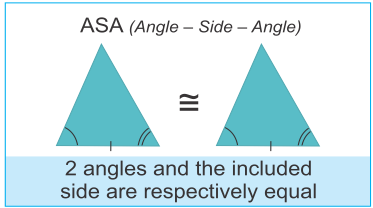
\(\angle A=\angle X\)
\(\angle B=\angle Y\)
\(AB=XY\)
\(\therefore \triangle ABC\cong\triangle XYZ\quad\{AAcorS\}\)
⭐ RHS — Right Angle, Hypotenuse, Side
For two right-angled triangles, if their hypotenuses and one corresponding pair of sides are equal, the triangles are congruent.
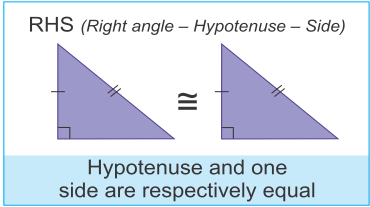
Remember that the hypotenuse is the longest side of a right-angled triangle and is opposite the right angle.
Congruence Tests at a Glance
| Test | Required Information | Conclusion |
|---|---|---|
| SSS | Three corresponding sides equal | Triangles are congruent |
| SAS | Two sides and included angle equal | Triangles are congruent |
| AAcorS | Two corresponding angles and a corresponding side equal | Triangles are congruent |
| RHS | Right angle, hypotenuse and one corresponding side equal | Triangles are congruent |
⚠️ Information That Does NOT Always Prove Congruence
Two sides and a non-included angle are not sufficient. There may be two different triangles that satisfy the same information.
Also, knowing all three angles does not prove congruence, because the triangles may have different sizes.
These limitations are explicitly identified in the source investigation.
Example 2:
Two triangles have two equal sides and the angle between those sides is equal. Which congruence test should be used?
▶️ Answer/Explanation
We know two sides and the included angle.
Therefore, the correct test is:
Hence the triangles are congruent by SAS.
Writing Congruent Triangles Correctly
When writing a congruence statement, the vertices must be written in corresponding order.
For example, if:
\(B\leftrightarrow Y\)
\(C\leftrightarrow Z\)
then the correct statement is:
The order tells us which vertices, angles and sides correspond to one another. The source specifically emphasizes that corresponding vertices must be labelled in the same order.
What Can We Deduce from Congruence?
Once two triangles have been proven congruent, all corresponding sides and angles are equal.
Congruence gives us information about parts of the triangles that were not originally given.
\(\triangle ABC\cong\triangle XYZ\)
\(AB=XY\)
\(BC=YZ\)
\(AC=XZ\)
\(\angle A=\angle X\)
\(\angle B=\angle Y\)
\(\angle C=\angle Z\)
Proof Using Congruence
Congruence is not only used to identify triangles. It can also be used to prove geometric properties.
A typical proof follows this structure:
- Identify the two triangles.
- Show which sides or angles are equal.
- Choose an appropriate congruence test.
- State that the triangles are congruent.
- Use corresponding parts of congruent triangles to establish the required result.
For example, the source uses SSS congruence to prove a property of an isosceles triangle: if \(M\) is the midpoint of the base \(BC\), then triangles \(ABM\) and \(ACM\) are congruent.
Example 3:
\(ABC\) is an isosceles triangle with \(AB=AC\). \(M\) is the midpoint of \(BC\). Show that \(AM\) bisects \(\angle A\).
▶️ Answer/Explanation
Consider triangles \(ABM\) and \(ACM\).
\(BM=CM\)
\(AM=AM\)
Therefore:
Corresponding angles are equal, so:
Therefore, \(AM\) bisects \(\angle A\).
This follows the proof structure demonstrated in the source.
Enlargements and Reductions
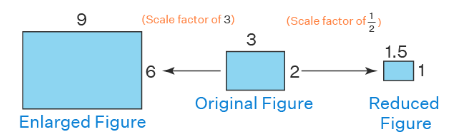
An enlargement makes every length larger by the same scale factor. A reduction makes every length smaller by the same scale factor.
Scale Factor
If an object is enlarged or reduced, every corresponding length is multiplied by the same scale factor.
| Scale Factor | Transformation |
|---|---|
| \(k>1\) | Enlargement |
| \(0<k<1\) | Reduction |
| \(k=1\) | Same size |
For example, a scale factor of \(3\) triples every length, while a scale factor of \(\frac12\) halves every length.
Example 4:
A line has length \(8\) cm. It is enlarged with scale factor \(2.5\). Find its new length.
▶️ Answer/Explanation
\(=20\text{ cm}\)
Therefore, the new length is \(20\) cm.
Similar Figures
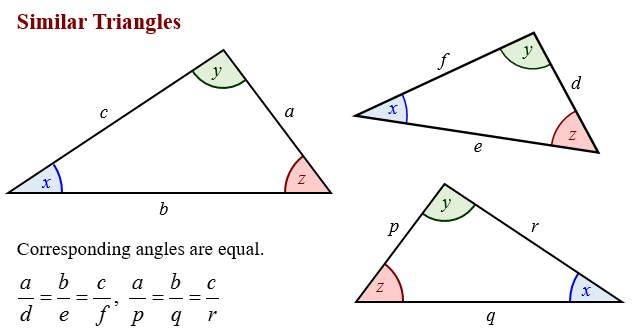
Two figures are similar if they have the same shape but not necessarily the same size.
Definition of Similarity
Two figures are similar if one can be placed exactly on top of the other using a combination of translation, rotation, reflection and an enlargement or reduction.
Similar figures have:
- the same corresponding angle sizes, and
- corresponding side lengths in the same ratio.
The figures are therefore equiangular, while their corresponding sides are proportional.
⭐ Corresponding Side Ratio
If two figures are similar, the ratio of corresponding side lengths is constant.
Similar Triangles
Triangles are a particularly useful case of similarity.
⭐ Tests for Triangle Similarity
Two triangles are similar if either:
- they are equiangular, or
- their corresponding side lengths are in the same ratio.
These are the two similarity tests given in the source.
Since the angles in every triangle add to \(180^\circ\), if two angles in one triangle equal two corresponding angles in another triangle, the third angles must also be equal.
\(\angle A=\angle X\)
\(\angle B=\angle Y\)
\(\therefore \angle C=\angle Z\)
\(\therefore \triangle ABC\sim\triangle XYZ\)
| Property | Congruent Triangles | Similar Triangles |
|---|---|---|
| Shape | Same | Same |
| Size | Same | May be different |
| Corresponding angles | Equal | Equal |
| Corresponding sides | Equal | In the same ratio |
| Symbol | \(\cong\) | \(\sim\) |
Example 5:
Two triangles have two pairs of equal corresponding angles. Explain why the triangles are similar.
▶️ Answer/Explanation
Suppose:
\(\angle B=\angle Y\)
Since the angles in a triangle sum to \(180^\circ\), the third angles must also be equal:
Therefore, the triangles are equiangular and hence:
Finding Unknown Lengths in Similar Triangles
Once two triangles have been shown to be similar, their corresponding side lengths are in the same ratio. This allows us to calculate unknown lengths.
Basic Method
- Identify corresponding angles.
- Match corresponding sides.
- Write a ratio using corresponding sides.
- Solve for the unknown length.
For example, if:
then:
Example 6:
Two similar triangles have corresponding sides of lengths \(4\) cm and \(6\) cm. Another corresponding pair has lengths \(5\) cm and \(x\) cm. Find \(x\).
▶️ Answer/Explanation
Since the triangles are similar, corresponding sides are in the same ratio.
Solve:
\(x=7.5\)
Therefore, \(x=7.5\) cm.
The Similar-Triangle Table Method
For more complicated problems, a table can help prevent corresponding sides from being matched incorrectly.
🎯 Five-Step Method
- Label the equal corresponding angles.
- Show that the triangles are similar.
- Match corresponding sides using the equal angles.
- Write a ratio of corresponding sides.
- Solve the resulting equation.
This five-step approach follows the method presented in the source for solving similar-triangle problems.
Similar Triangles in Practical Problems
Similar triangles are useful when a length or distance is difficult to measure directly. If two triangles have the same angle relationships, their corresponding sides can be compared using ratios.
Common applications include:
- finding the height of a tree or building,
- finding distances that cannot be measured directly,
- scale drawings and maps,
- photographs and enlargements, and
- models and plans.
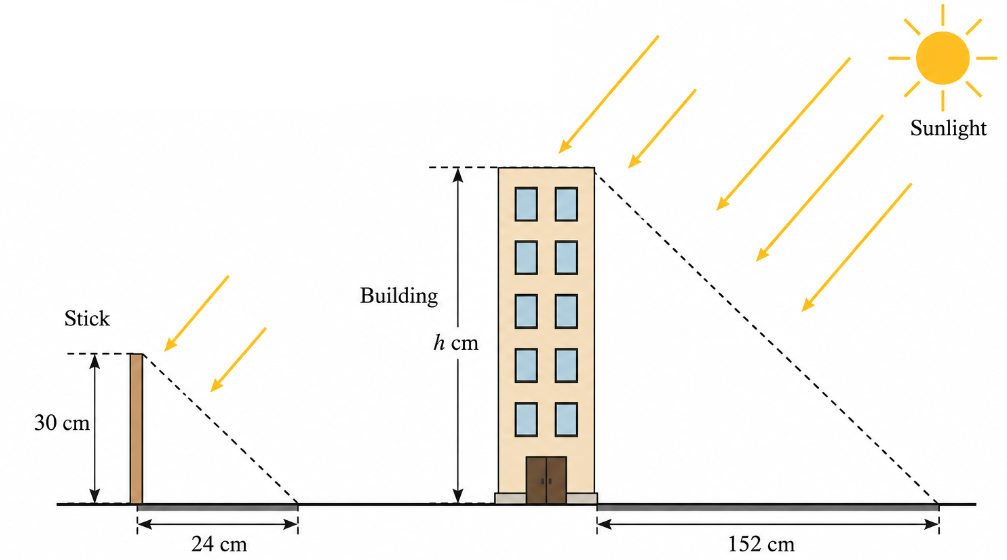
The source illustrates this with a stick and a man casting shadows at the same time. The resulting triangles are equiangular and therefore similar.
Example 7:
A \(30\) cm stick casts a \(24\) cm shadow. At the same time, a building casts a \(152\) cm shadow. Assuming the sunlight creates the same angle, find the height of the building.
▶️ Answer/Explanation
The stick and building form similar right-angled triangles because the sunlight creates the same angle.
Let the building height be \(h\).
Therefore:
\(h=190\)
Therefore, the building is \(190\) cm tall.
This numerical example follows the source’s shadow method.
Problem-Solving Strategy
Similar-triangle problems often require several steps. The most important part is identifying the two triangles and matching their corresponding parts correctly.
🧠 MYP Problem-Solving Method
- Read the problem carefully.
- Draw or interpret the diagram and include all given information.
- Introduce a variable for the unknown quantity.
- Identify the two triangles that can be compared.
- Show that the triangles are similar.
- Match corresponding sides.
- Write a proportion.
- Solve the equation.
- State the answer clearly with the appropriate unit.
This sequence follows the problem-solving steps given in the source.
⚠️ Common Errors to Avoid
- Do not confuse congruent with similar.
- Do not use SAS unless the angle is the included angle.
- Do not assume that three equal angles prove congruence.
- Do not use two sides and a non-included angle as a congruence test.
- Always identify which sides are corresponding before writing a ratio.
- When writing \(\triangle ABC\sim\triangle XYZ\), keep corresponding vertices in the same order.
- Do not compare non-corresponding sides.
Example 8:
Two triangles \(ABC\) and \(DEF\) are similar. The corresponding sides \(AB\) and \(DE\) have lengths \(6\) cm and \(10\) cm respectively. If \(BC=7\) cm, find \(EF\).
▶️ Answer/Explanation
Since the triangles are similar, corresponding sides are in the same ratio.
Match the corresponding sides:
\(BC\leftrightarrow EF\)
Therefore:
\(\frac{7}{EF}=\frac{6}{10}\)
Cross-multiply:
\(EF=\frac{70}{6}\)
\(EF\approx11.67\text{ cm}\)
Therefore, \(EF\approx11.67\) cm.