
6.4 – Pythagoras’ Theorem and Applications
Pythagoras’ theorem is one of the most important results for working with right-angled triangles. It allows us to calculate an unknown side length when two other side lengths are known.
The theorem also has many practical applications, including finding diagonal lengths, distances, heights, lengths of braces and cables, and checking whether an angle is a right angle.
Right-Angled Triangles
A right-angled triangle is a triangle that has one angle equal to \(90^\circ\).
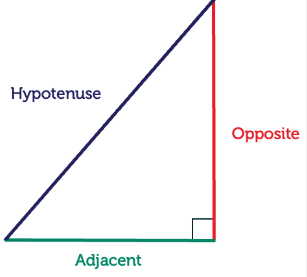
The side opposite the \(90^\circ\) angle is called the hypotenuse.
📌 Important Property
The hypotenuse is always the longest side of a right-angled triangle.
Therefore, before using Pythagoras’ theorem, always identify the \(90^\circ\) angle and then identify the side opposite it.
Identifying the Hypotenuse
The easiest way to identify the hypotenuse is:
- Find the right angle.
- Look directly opposite the right angle.
- That side is the hypotenuse.
⚠️ Common Mistake
Do not automatically choose the longest-looking side from a diagram. Identify the side opposite the right angle.
Diagrams are not always drawn to scale.
Pythagoras’ Theorem
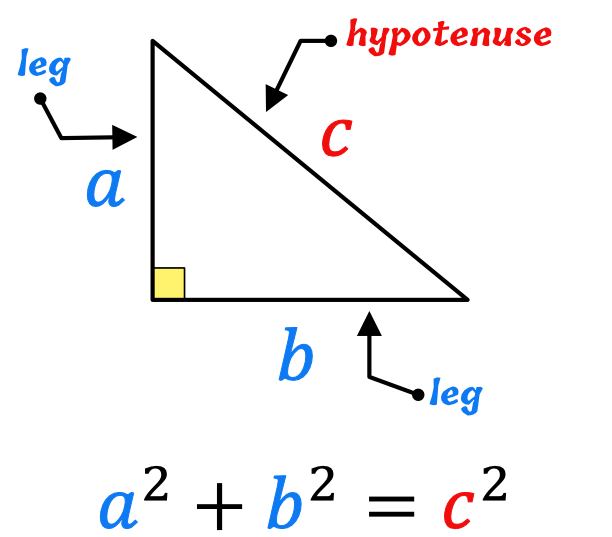
Consider a right-angled triangle with shorter sides of lengths \(a\) and \(b\), and hypotenuse of length \(c\).
Pythagoras’ Theorem
In any right-angled triangle:
where \(c\) is the hypotenuse, and \(a\) and \(b\) are the other two sides.
Geometrically, the theorem states that the area of the square constructed on the hypotenuse is equal to the sum of the areas of the squares constructed on the other two sides.
Formula Symbols
| Symbol | Meaning |
|---|---|
| \(a\) | One shorter side |
| \(b\) | The other shorter side |
| \(c\) | The hypotenuse |
Finding the Hypotenuse
When the two shorter sides are known, use:
Then take the positive square root because a length cannot be negative:
📝 Method
- Identify the hypotenuse.
- Write Pythagoras’ theorem.
- Substitute the known lengths.
- Calculate the square of the unknown.
- Take the positive square root.
- Round if required.
- Include the correct unit.
Example 1:
A right-angled triangle has shorter sides of \(3\) cm and \(7\) cm. Find the length of the hypotenuse, giving your answer to 2 decimal places.
▶️ Answer/Explanation
Let the hypotenuse be \(x\) cm.
\(x^2=9+49\)
\(x^2=58\)
\(x=\sqrt{58}\)
\(x\approx7.62\)
Therefore, the hypotenuse is approximately \(7.62\) cm.
Finding a Missing Shorter Side
Pythagoras’ theorem can also be rearranged when the hypotenuse and one shorter side are known.
Starting with:
If \(a\) is unknown:
\(a=\sqrt{c^2-b^2}\)
Similarly:
Example 2:
A right-angled triangle has a hypotenuse of \(10\) cm and one shorter side of \(4\) cm. Find the length of the remaining side.
▶️ Answer/Explanation
Let the unknown side be \(x\) cm.
\(x^2+16=100\)
\(x^2=84\)
\(x=\sqrt{84}\)
\(x\approx9.17\)
Therefore, the missing side is approximately \(9.17\) cm.
This follows the worked example in Chapter 20, where the third side is calculated from a \(10\) cm hypotenuse and \(4\) cm side.
Three Useful Forms
| Unknown | Formula |
|---|---|
| Hypotenuse \(c\) | \(c=\sqrt{a^2+b^2}\) |
| Side \(a\) | \(a=\sqrt{c^2-b^2}\) |
| Side \(b\) | \(b=\sqrt{c^2-a^2}\) |
Solving Pythagoras’ Equations
Pythagoras’ theorem often produces a power equation. Since lengths must be positive, the negative square-root solution is rejected.
⚠️ Remember
If:
mathematically \(x=\pm7\), but a length cannot be negative, so:
Applications of Pythagoras’ Theorem
Right-angled triangles occur naturally in many real-world situations. Examples include gates, support brackets, vertical and horizontal distances, braces, cables, diagonals and building structures.
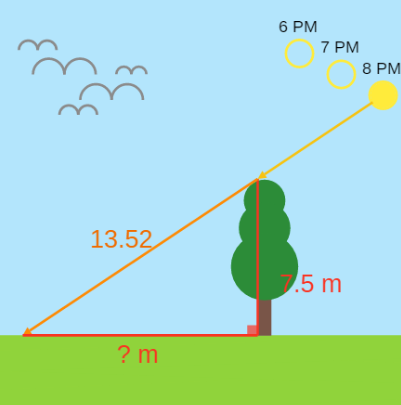
The key is to recognize when the information forms a right-angled triangle.
🛠️ Six-Step Problem-Solving Method
- Draw a neat, clear diagram of the situation.
- Mark the known lengths and right angles.
- Use a variable such as \(x\) for the unknown length.
- Write Pythagoras’ theorem using the given information.
- Solve the equation.
- Write the final answer in a sentence when appropriate.
These are the six problem-solving steps given in the source.
Application A: Diagonal of a Rectangle
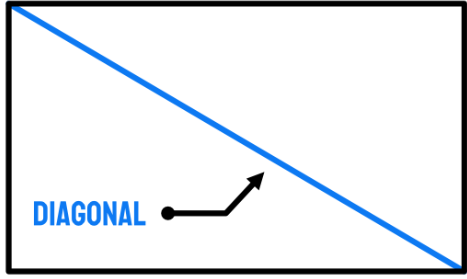
The diagonal of a rectangle creates a right-angled triangle. Therefore, Pythagoras’ theorem can be used to find the diagonal.
Example 3:
A rectangular gate is \(3\) m wide and \(1\) m high. Find the length of its diagonal.
▶️ Answer/Explanation
Let the diagonal be \(x\) m.
\(x^2=9+1\)
\(x^2=10\)
\(x=\sqrt{10}\)
\(x\approx3.16\)
Therefore, the diagonal is approximately \(3.16\) m.
Application B: Distance Between Two Points
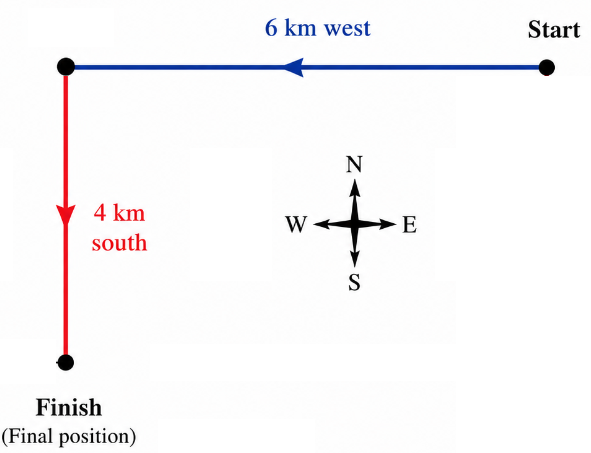
If a person travels a horizontal distance and then a perpendicular vertical distance, the direct distance between the starting and finishing points is the hypotenuse of a right-angled triangle.
Example 4:
Joe runs \(6\) km west and then \(4\) km south. How far is he from his starting point?
▶️ Answer/Explanation
Let the direct distance from the starting point be \(x\) km.
\(x^2=36+16\)
\(x^2=52\)
\(x=\sqrt{52}\)
\(x\approx7.21\)
Therefore, Joe is approximately \(7.21\) km from his starting point.
This is based on the worked application in the source, where Joe runs \(6\) km west and \(4\) km south.
Application C: Height of an Object
Pythagoras’ theorem can be used to find heights when a diagonal distance and horizontal distance are known.
Example 5:
One end of a \(38\) m zip-line is attached to a tree. The other end is fixed to the ground \(32\) m from the base of the tree.
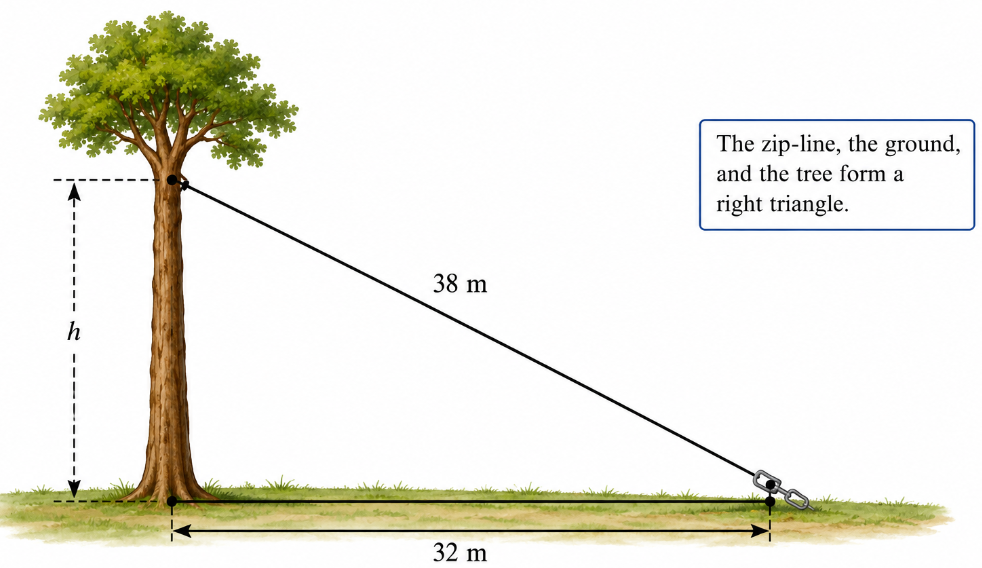
Find the height at which the zip-line is attached.
▶️ Answer/Explanation
The zip-line is the hypotenuse. Let the height be \(h\) m.
\(h^2+1024=1444\)
\(h^2=420\)
\(h=\sqrt{420}\)
\(h\approx20.49\)
Therefore, the zip-line is attached approximately \(20.5\) m above the ground.
The source includes this zip-line application with a \(38\) m line and a \(32\) m horizontal distance.
Application D: Diagonals in 3D Objects
Pythagoras’ theorem can be applied more than once to find a diagonal through a three-dimensional object.
For example, first find the diagonal across the rectangular base, then use that diagonal together with the height to find the space diagonal.
📌 Two-Stage Pythagoras
For a rectangular box with dimensions \(l\), \(w\), and \(h\):
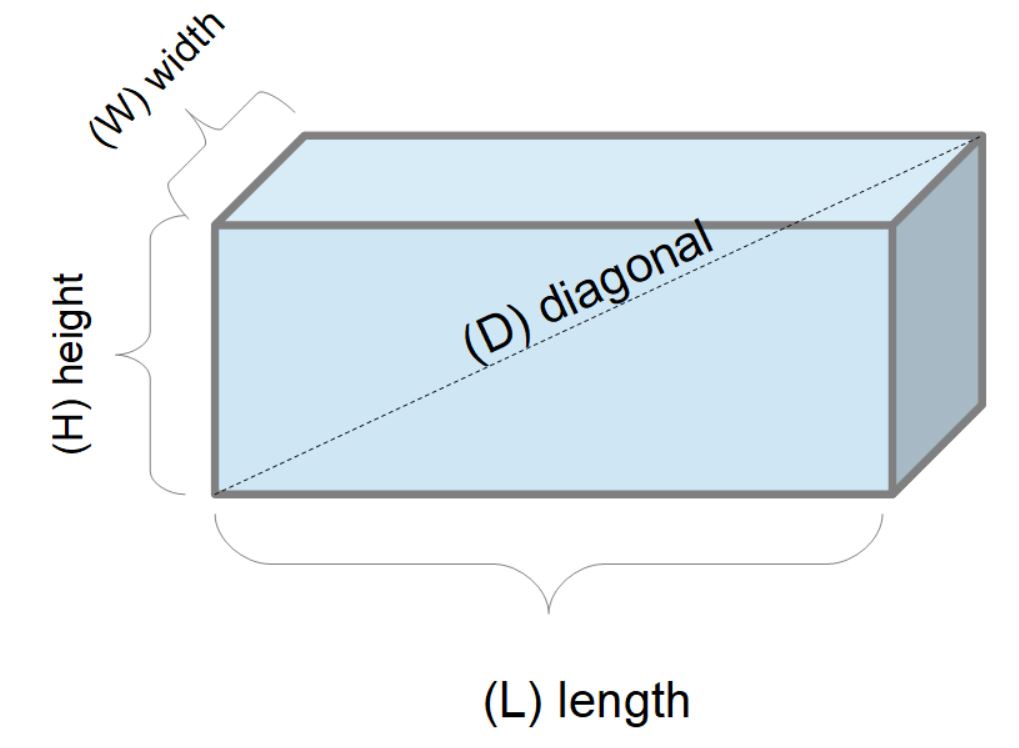
Step 1: Find the base diagonal.
Step 2: Use the base diagonal and height to find the space diagonal.
Example 6:
An aquarium has dimensions \(120\) cm by \(30\) cm by \(40\) cm. Find the length of its space diagonal.
▶️ Answer/Explanation
First find the diagonal of the rectangular base:
\(d^2=14400+900\)
\(d^2=15300\)
Now use \(d\) and the height \(40\) cm:
\(D^2=15300+1600\)
\(D^2=16900\)
\(D=130\)
Therefore, the space diagonal is \(130\) cm.
The source includes an aquarium diagonal problem with dimensions \(120\) cm, \(30\) cm and \(40\) cm.
Special Right-Angled Triangles
Some right-angled triangles have useful relationships between their side lengths.
45°-45°-90° Triangle
A right-angled isosceles triangle has two equal shorter sides. If each shorter side has length \(x\), then:
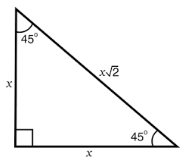
\(c^2=2x^2\)
\(c=x\sqrt{2}\)
⭐ Key Result
In a right-angled isosceles triangle:
where \(x\) is the length of either equal shorter side.
The Converse of Pythagoras’ Theorem
Pythagoras’ theorem normally starts with a right-angled triangle and tells us something about its side lengths.
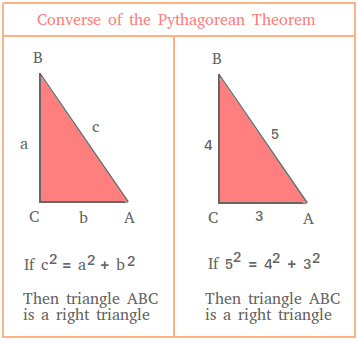
The converse works in the opposite direction. If we know the lengths of all three sides, we can determine whether the triangle is right angled.
⭐ Converse of Pythagoras’ Theorem
If a triangle has side lengths \(a\), \(b\), and \(c\), where \(c\) is the longest side, and:
then the triangle is right angled.
The source states that the converse provides a simple test for deciding whether a triangle is right angled when all three side lengths are known.
📝 How to Test for a Right Angle
- Identify the longest side.
- Call it \(c\).
- Call the other two sides \(a\) and \(b\).
- Calculate \(a^2+b^2\).
- Calculate \(c^2\).
- Compare the results.
If:
the triangle is right angled.
If they are not equal, the triangle is not right angled.
Example 7:
A triangle has side lengths \(9\) cm, \(12\) cm and \(15\) cm. Determine whether the triangle is right angled.
▶️ Answer/Explanation
The longest side is \(15\) cm, so let:
Test Pythagoras’ relationship:
\(9^2+12^2=81+144\)
\(=225\)
\(15^2=225\)
Therefore:
Therefore, the triangle is right angled.
This is the same numerical example used in the source for demonstrating the converse of Pythagoras’ theorem.
The 3 : 4 : 5 Right Triangle
The side lengths \(3\), \(4\), and \(5\) form a right-angled triangle because:
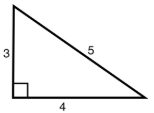
\(9+16=25\)
More generally, any triangle whose side lengths are in the ratio \(3:4:5\) is right angled.
This relationship was historically useful for constructing accurate right angles. The source notes that ancient Egyptians used a rope with equally spaced knots to create \(3:4:5\) right-angled triangles.
Multi-Step Pythagoras Problems
Some problems require Pythagoras’ theorem more than once. This happens when the diagram contains several right-angled triangles.
🎯 Strategy for Multi-Step Problems
- Identify every right angle.
- Find the simplest right-angled triangle first.
- Calculate its missing length.
- Use that newly calculated length in the next right-angled triangle.
- Continue until the required quantity is found.
Perimeter and Area Applications
Pythagoras’ theorem can also be combined with other formulas.
For example, if a right-angled triangle has two known sides, first use Pythagoras to find the third side and then calculate the perimeter:
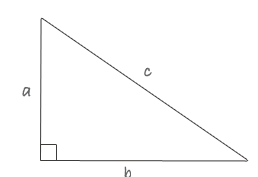
The area of a right-angled triangle can be found from its two perpendicular sides:
Therefore, Pythagoras’ theorem may be one step in a larger geometry problem. The source includes exercises requiring Pythagoras to find missing sides followed by perimeter or area calculations.
Example 8:
A right-angled triangle has perpendicular sides of \(4\) cm and \(7\) cm. Find its perimeter, giving your answer to 2 decimal places.
▶️ Answer/Explanation
First find the hypotenuse:
\(c^2=16+49\)
\(c=\sqrt{65}\)
\(c\approx8.06\)
Now find the perimeter:
\(P=19.06\text{ cm}\)
Therefore, the perimeter is approximately \(19.06\) cm.
Choosing the Correct Method
| What is Given? | What to Do |
|---|---|
| Right angle + two shorter sides | Find the hypotenuse using \(c=\sqrt{a^2+b^2}\) |
| Right angle + hypotenuse + one side | Find the missing side using subtraction |
| Three side lengths, no right angle given | Use the converse to test whether the triangle is right angled |
| Real-world horizontal and vertical distances | Draw a right-angled triangle and apply Pythagoras |
⚠️ Common Errors to Avoid
- Using Pythagoras on a triangle that is not right angled.
- Choosing the wrong side as the hypotenuse.
- Forgetting that the hypotenuse is opposite the \(90^\circ\) angle.
- Using \(c^2=a^2-b^2\) when the unknown is actually the hypotenuse.
- Forgetting to take the square root at the end.
- Keeping a negative square-root solution for a length.
- Rounding too early in a multi-step calculation.
- Forgetting units in the final answer.
- Using the converse without first identifying the longest side as \(c\).
Rounding and Accuracy
Pythagoras’ theorem often produces an irrational answer involving a square root. For example:
This can be written as:
Keep the exact value in your calculator as long as possible and round only at the end of the calculation.
📌 Exam Tip
If a question says “round to 2 decimal places”, give exactly 2 digits after the decimal point.
If it says “3 significant figures”, count significant digits rather than decimal places.
Example 9:
Two roads intersect at right angles. Point \(X\) is \(5\) km from the intersection along one road, and point \(Y\) is \(3\) km from the intersection along the other road.
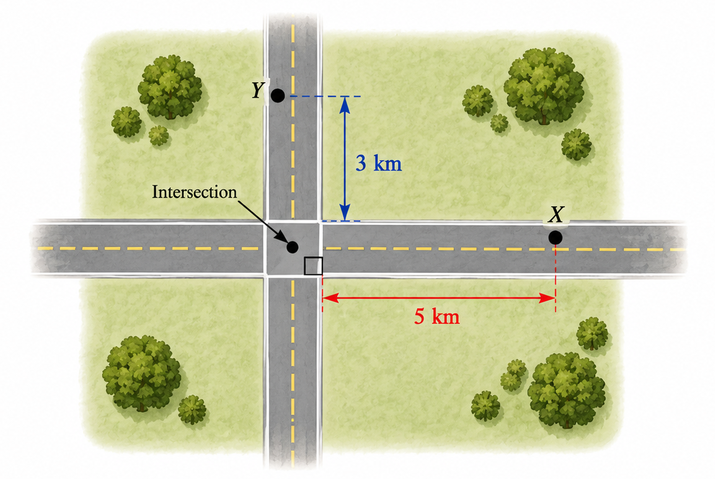
Find the distance saved by travelling directly from \(X\) to \(Y\) instead of travelling along the two roads.
▶️ Answer/Explanation
The direct route \(XY\) is the hypotenuse of a right-angled triangle.
Let \(XY=x\) km.
\(x^2=25+9\)
\(x^2=34\)
\(x=\sqrt{34}\)
\(x\approx5.83 \)
The distance along the roads is:
Therefore, the distance saved is:
Therefore, approximately \(2.17\) km is saved by travelling directly.
This type of application appears in the source review set, involving two roads meeting at right angles with distances of \(5\) km and \(3\) km.