
7.1 – Units, Perimeter and Area
Measurement is used to describe the size and dimensions of objects and spaces. In this topic, we work with length, perimeter, and area, and learn how to choose appropriate units and convert between them.
Accurate measurement is important in everyday situations such as calculating the amount of fencing needed around a garden, the amount of flooring required for a room, or the amount of material needed to cover a surface.
Length and Measurement Units
Length measures the distance between two points. The main metric unit of length is the metre (m).
| Unit | Symbol | Relationship | Typical Use |
|---|---|---|---|
| Kilometre | km | \(1\text{ km}=1000\text{ m}\) | Distances between places |
| Metre | m | \(1\text{ m}=100\text{ cm}\) | Room dimensions, height |
| Centimetre | cm | \(1\text{ cm}=10\text{ mm}\) | Small objects |
| Millimetre | mm | \(10\text{ mm}=1\text{ cm}\) | Thickness and very small lengths |
Metric conversion chain:
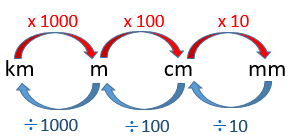
Moving from a larger unit to a smaller unit means multiplying. Moving from a smaller unit to a larger unit means dividing.
\(1\text{ km}=1000\text{ m}\)
\(1\text{ m}=100\text{ cm}\)
\(1\text{ cm}=10\text{ mm}\)
Converting Lengths
When converting measurements, first identify the direction of the conversion. Then multiply or divide by the appropriate conversion factor.
\(4.5\text{ km}=4.5\times1000\text{ m}=4500\text{ m}\)
\(720\text{ cm}=720\div100\text{ m}=7.2\text{ m}\)
Important: Always convert measurements into the same unit before adding, subtracting, comparing, or using them in a calculation.
Perimeter
The perimeter of a closed shape is the total distance around its boundary. For a polygon, the perimeter is found by adding the lengths of all its sides.
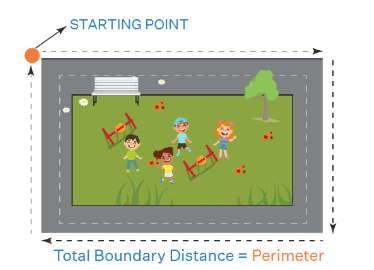
📌 Perimeter Rule
\(\text{Perimeter}=\text{sum of all outside side lengths}\)
For a rectangle with length \(l\) and width \(w\):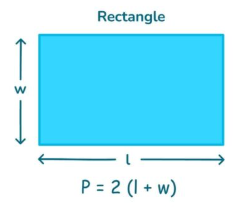
\(P=2l+2w\)
This can also be written as:
\(P=2(l+w)\)
For a square with side length \(s\):
\(P=4s\)
Example: A rectangle has length \(12\text{ cm}\) and width \(7\text{ cm}\).
\(P=2(12+7)\)
\(P=2(19)\)
\(P=38\text{ cm}\)
Therefore, the perimeter is \(38\text{ cm}\).
Perimeter of Composite Boundaries
Some shapes are made from several straight sides. To find their perimeter, carefully trace the outside boundary and add every external side.
Do not include internal lines when calculating perimeter unless they form part of the outside boundary.
Area
Area measures the amount of surface covered by a two-dimensional shape. Area is measured in square units.
| Unit | Meaning |
|---|---|
| \(\text{mm}^2\) | Square millimetres |
| \(\text{cm}^2\) | Square centimetres |
| \(\text{m}^2\) | Square metres |
| \(\text{km}^2\) | Square kilometres |
Important Area Conversions
Area conversions are different from length conversions because the units are squared.
\(1\text{ m}=100\text{ cm}\)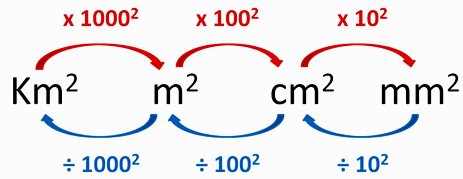
\(1\text{ m}^2=100\times100\text{ cm}^2\)
\(1\text{ m}^2=10\,000\text{ cm}^2\)
Similarly:
\(1\text{ cm}^2=100\text{ mm}^2\)
\(1\text{ ha}=10\,000\text{ m}^2\)
\(1\text{ km}^2=1\,000\,000\text{ m}^2\)
💡 Key Idea:
When converting between square units, square the length conversion factor.
Since \(1\text{ m}=100\text{ cm}\), it follows that \(1\text{ m}^2=10\,000\text{ cm}^2\).
Area Formulae
| Shape | Formula | Symbols |
|---|---|---|
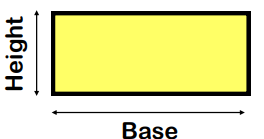
Rectangle | \(A=lw\) | \(l=\) length, \(w=\) width |
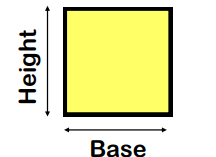
Square | \(A=s^2\) | \(s=\) side length |
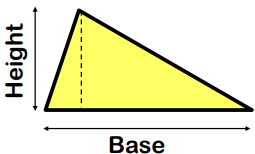
Triangle | \(A=\frac{1}{2}bh\) | \(b=\) base, \(h=\) perpendicular height |
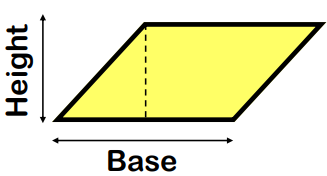
Parallelogram | \(A=bh\) | \(b=\) base, \(h=\) perpendicular height |
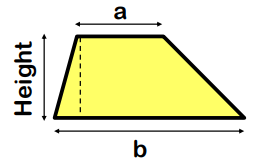
Trapezium | \(A=\frac{1}{2}(a+b)h\) | \(a,b=\) parallel sides, \(h=\) perpendicular height |
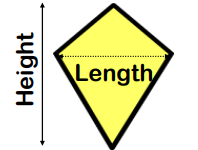
Kite | \(A=\frac{1}{2}d_1d_2\) | \(d_1,d_2=\) diagonals |
Perimeter vs Area
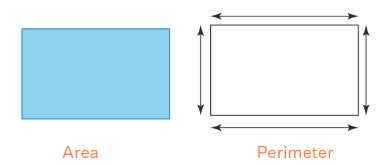
| Perimeter | Area |
|---|---|
| Distance around a shape | Surface covered by a shape |
| Measured in units such as cm, m, km | Measured in square units such as \(\text{cm}^2,\text{m}^2\) |
| Uses lengths of boundaries | Uses area formulae |
Problem-Solving Strategy
- Read the problem carefully.
- Identify whether you need length, perimeter, or area.
- Check that all measurements use the same unit.
- Choose the correct formula or rule.
- Substitute the values carefully.
- Calculate and simplify.
- Give the answer with the correct unit.
- Check whether your answer is reasonable.
Example 1:
A rectangular school garden is \(12\text{ m}\) long and \(8\text{ m}\) wide. A path is going to be built around the outside of the garden.
a) Find the perimeter of the garden.
b) Find the area of the garden.
c) The garden is extended so that its length becomes \(15\text{ m}\), while the width remains \(8\text{ m}\). Find the new area.
d) How much greater is the new area than the original area?
▶️ Answer/Explanation
a) Perimeter
\(P=2(l+w)\)
\(P=2(12+8)\)
\(P=40\text{ m}\)
Answer: \(40\text{ m}\)
b) Original area
\(A=lw\)
\(A=12\times8\)
\(A=96\text{ m}^2\)
Answer: \(96\text{ m}^2\)
c) New area
\(A=15\times8\)
\(A=120\text{ m}^2\)
Answer: \(120\text{ m}^2\)
d) Increase in area
\(120-96=24\text{ m}^2\)
Answer: The area increases by \(24\text{ m}^2\).
Example 2:
A park has a composite shape made from a rectangle and a triangle. The rectangular part is \(10\text{ m}\) long and \(6\text{ m}\) wide. A triangular section has a base of \(10\text{ m}\) and a perpendicular height of \(4\text{ m}\).
a) Find the area of the rectangular section.
b) Find the area of the triangular section.
c) Find the total area of the park.
d) The park is covered with grass at a rate of \(3\) kg per \(10\text{ m}^2\). How many kilograms of grass seed are required?
▶️ Answer/Explanation
a) Rectangle
\(A=lw\)
\(A=10\times6=60\text{ m}^2\)
Answer: \(60\text{ m}^2\)
b) Triangle
\(A=\frac{1}{2}bh\)
\(A=\frac{1}{2}\times10\times4\)
\(A=20\text{ m}^2\)
Answer: \(20\text{ m}^2\)
c) Total area
\(\text{Total area}=60+20\)
\(\text{Total area}=80\text{ m}^2\)
Answer: \(80\text{ m}^2\)
d) Grass seed
Every \(10\text{ m}^2\) requires \(3\) kg.
\(80\div10=8\)
\(8\times3=24\text{ kg}\)
Answer: \(24\text{ kg}\) of grass seed is required.